Public hearing: officials present FONSI for Gardner Park siphon upgrade, outline contamination and mitigation plans
February 03, 2026 | Newport City, Orleans County, Vermont
This article was created by AI summarizing key points discussed. AI makes mistakes, so for full details and context, please refer to the video of the full meeting. Please report any errors so we can fix them. Report an error »
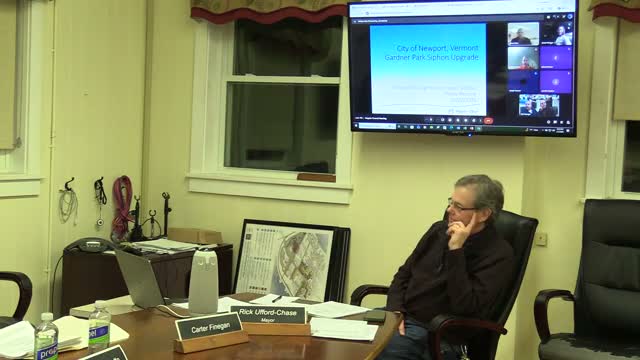
Engineers and state environmental staff presented a Finding of No Significant Impact (FONSI) and answered public questions during a Feb. 2 public hearing on the Gardner Park siphon upgrade.
Nate Pion, a senior engineer with Aldrich & Elliott, described project scope and environmental mitigations: install a second siphon under the Clyde River using horizontal directional drilling, line the gravity sewer with cured-in-place pipe, and replace or supplement the system so one siphon can be taken offline for maintenance. "This project's being funded through CSO ARPA funds, via grant from the state," Pion said, adding that an environmental review and NEPA consultation were required because of federal funding.
Pion outlined two principal environmental concerns raised in state review: air emissions from styrene released during conventional curing of cured-in-place liners, and disturbance of known contaminated soils at the Gardner Park old-fill site. To reduce styrene exposure, the project will use UV curing and require contractor ventilation; for excavation the project team described a soil management plan to test and haul contaminated soils to a certified landfill. When asked, Pion said the contractor would likely use Casella’s Coventry facility for contaminated soil disposal, but that final disposal sites would be confirmed by the contractor and regulated facilities.
On groundwater concerns, the team said groundwater encountered during dewatering would be placed in containment (frac tanks) and treated — typically with granular activated carbon — before discharge to the sewer collection system and subsequent treatment at the wastewater plant. The presenter said monitoring locations around the excavation are currently below state PFAS regulatory thresholds (20 parts per trillion) but that the team will seek state guidance on treatment and discharge protocols.
Council and staff outlined schedule and funding: the work is part of a CSO/ARPA grant that must be spent by Sept. 30; consultants estimated bid opening in May and construction beginning in June or July with a 60–75 day construction window. Council took no formal action other than opening and closing the public hearing and recording comments; the hearing record and minutes will be forwarded to state reviewers as part of the FONSI process.
Key public questions focused on disposal locations, treatment definitions and long-term site contamination; consultants said testing, landfill disposal of excavated soils, and granular activated-carbon treatment of dewatering effluent are the likely mitigation chain subject to regulatory approval.
Nate Pion, a senior engineer with Aldrich & Elliott, described project scope and environmental mitigations: install a second siphon under the Clyde River using horizontal directional drilling, line the gravity sewer with cured-in-place pipe, and replace or supplement the system so one siphon can be taken offline for maintenance. "This project's being funded through CSO ARPA funds, via grant from the state," Pion said, adding that an environmental review and NEPA consultation were required because of federal funding.
Pion outlined two principal environmental concerns raised in state review: air emissions from styrene released during conventional curing of cured-in-place liners, and disturbance of known contaminated soils at the Gardner Park old-fill site. To reduce styrene exposure, the project will use UV curing and require contractor ventilation; for excavation the project team described a soil management plan to test and haul contaminated soils to a certified landfill. When asked, Pion said the contractor would likely use Casella’s Coventry facility for contaminated soil disposal, but that final disposal sites would be confirmed by the contractor and regulated facilities.
On groundwater concerns, the team said groundwater encountered during dewatering would be placed in containment (frac tanks) and treated — typically with granular activated carbon — before discharge to the sewer collection system and subsequent treatment at the wastewater plant. The presenter said monitoring locations around the excavation are currently below state PFAS regulatory thresholds (20 parts per trillion) but that the team will seek state guidance on treatment and discharge protocols.
Council and staff outlined schedule and funding: the work is part of a CSO/ARPA grant that must be spent by Sept. 30; consultants estimated bid opening in May and construction beginning in June or July with a 60–75 day construction window. Council took no formal action other than opening and closing the public hearing and recording comments; the hearing record and minutes will be forwarded to state reviewers as part of the FONSI process.
Key public questions focused on disposal locations, treatment definitions and long-term site contamination; consultants said testing, landfill disposal of excavated soils, and granular activated-carbon treatment of dewatering effluent are the likely mitigation chain subject to regulatory approval.
View the Full Meeting & All Its Details
This article offers just a summary. Unlock complete video, transcripts, and insights as a Founder Member.
✓
Watch full, unedited meeting videos
✓
Search every word spoken in unlimited transcripts
✓
AI summaries & real-time alerts (all government levels)
✓
Permanent access to expanding government content
30-day money-back guarantee
