Destin council backs 'Million Oyster Project' to restore harbor habitat
February 03, 2026 | City of Destin, Okaloosa County, Florida
This article was created by AI summarizing key points discussed. AI makes mistakes, so for full details and context, please refer to the video of the full meeting. Please report any errors so we can fix them. Report an error »
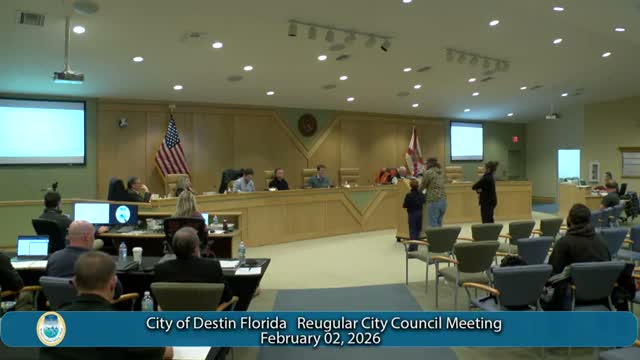
The City of Destin on Feb. 2 voted to support a community‑led oyster restoration project aimed at restoring one million oysters in the Destin Harbor over the next decade.
John Stevens, vice chair of the Harbor & Waterways Board, and Allison McDowell of the Choctawhatchee Basin Alliance described the initiative as modeled on New York City’s Billion Oyster Project. The plan combines vertical oyster gardens (VOGs) deployed at docks, oyster shell recycling with local restaurants, and the eventual placement of bottom oyster gardens in scientifically selected locations.
McDowell said oysters are being deployed for ecological function rather than harvest: "These oysters are not meant for eating. They function solely as natural water filters and habitat builders." Staff and presenters noted that the Florida Fish and Wildlife Conservation Commission designates harvesting waters; Destin Harbor is not designated for harvesting, which affects how oysters will be used and managed.
Presenters said an adult oyster can filter up to about 50 gallons of water per day in ideal conditions and described a habitat suitability model developed with Torrey State University to select bottom garden sites. The initial deployment of VOGs places minimal cost burden on the city; costs and permitting associated with bottom gardens (materials, design, permitting) would come later and require funding and DEP approval.
Council members asked how the project intersects with the harbor’s management and funding sources. Staff and presenters said the project team will pursue permits and funding—explicitly noting that Triumph funding is unlikely given the non‑commercial nature of the project—and recommended formal direction for staff to collaborate with the harbor board and CBA.
Council moved to authorize city staff to work with John Stevens, the CBA and the harbor board on the Million Oyster Project; the motion passed on a unanimous voice vote (5–0). Staff will return with permitting and budget implications for any bottom garden phases.
John Stevens, vice chair of the Harbor & Waterways Board, and Allison McDowell of the Choctawhatchee Basin Alliance described the initiative as modeled on New York City’s Billion Oyster Project. The plan combines vertical oyster gardens (VOGs) deployed at docks, oyster shell recycling with local restaurants, and the eventual placement of bottom oyster gardens in scientifically selected locations.
McDowell said oysters are being deployed for ecological function rather than harvest: "These oysters are not meant for eating. They function solely as natural water filters and habitat builders." Staff and presenters noted that the Florida Fish and Wildlife Conservation Commission designates harvesting waters; Destin Harbor is not designated for harvesting, which affects how oysters will be used and managed.
Presenters said an adult oyster can filter up to about 50 gallons of water per day in ideal conditions and described a habitat suitability model developed with Torrey State University to select bottom garden sites. The initial deployment of VOGs places minimal cost burden on the city; costs and permitting associated with bottom gardens (materials, design, permitting) would come later and require funding and DEP approval.
Council members asked how the project intersects with the harbor’s management and funding sources. Staff and presenters said the project team will pursue permits and funding—explicitly noting that Triumph funding is unlikely given the non‑commercial nature of the project—and recommended formal direction for staff to collaborate with the harbor board and CBA.
Council moved to authorize city staff to work with John Stevens, the CBA and the harbor board on the Million Oyster Project; the motion passed on a unanimous voice vote (5–0). Staff will return with permitting and budget implications for any bottom garden phases.
Don't Miss a Word: See the Full Meeting!
Go beyond summaries. Unlock every video, transcript, and key insight with a Founder Membership.
✓
Get instant access to full meeting videos
✓
Search and clip any phrase from complete transcripts
✓
Receive AI-powered summaries & custom alerts
✓
Enjoy lifetime, unrestricted access to government data
30-day money-back guarantee
