City manager warns of federal funding reductions and rising costs; council requests detailed federal funding and reserve breakdown
February 03, 2026 | East Point, Fulton County, Georgia
This article was created by AI summarizing key points discussed. AI makes mistakes, so for full details and context, please refer to the video of the full meeting. Please report any errors so we can fix them. Report an error »
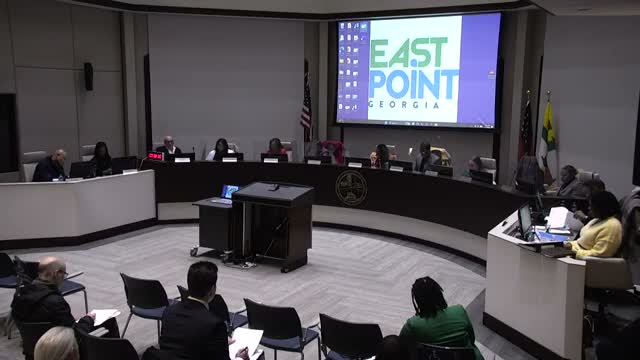
City Manager Jones presented the first part of a two‑part fiscal outlook to help frame the FY‑2027 budget cycle. He outlined macro headwinds — waning federal pandemic-era funds (including ARPA), increased matching requirements for some federal grants, elevated construction and materials costs, supply‑chain delays, and workforce pressures requiring potentially higher compensation to attract qualified staff. Jones said that closing out federal programs requires attention to compliance and reporting and could divert staff time.
Council members pressed for more granular numbers. Councilwoman Martin Rogers requested historical federal funding totals (how much the city received and where those dollars were spent), a reserve balance breakout between restricted and unrestricted funds, and clear documentation of which ARPA‑funded programs would need local funding to continue. Councilmember Hemming asked for concrete amendment strategies and interim actions to manage current year deficits; Jones described typical in‑year management options (pausing hires, slowing nonessential spending, and account structuring) and said staff would present revenue‑generation options in the next presentation.
The city attorney clarified that executive session minutes remain sealed and that the public record should include motions taken in open session after executive session, but not the confidential executive minutes themselves.
Council also directed the clerk to include resolutions referenced by Councilwoman Martin Rogers (resolution numbers cited in the meeting) in the next work session packet for review and possible discussion of a communication protocol item.
Council and staff agreed to continue the budget conversation in the next (micro) budget presentation, where staff said they would provide comparative data, reserve specifics and revenue options (impact fees, utility rate reviews, potential new fees) for the council’s consideration.
Council members pressed for more granular numbers. Councilwoman Martin Rogers requested historical federal funding totals (how much the city received and where those dollars were spent), a reserve balance breakout between restricted and unrestricted funds, and clear documentation of which ARPA‑funded programs would need local funding to continue. Councilmember Hemming asked for concrete amendment strategies and interim actions to manage current year deficits; Jones described typical in‑year management options (pausing hires, slowing nonessential spending, and account structuring) and said staff would present revenue‑generation options in the next presentation.
The city attorney clarified that executive session minutes remain sealed and that the public record should include motions taken in open session after executive session, but not the confidential executive minutes themselves.
Council also directed the clerk to include resolutions referenced by Councilwoman Martin Rogers (resolution numbers cited in the meeting) in the next work session packet for review and possible discussion of a communication protocol item.
Council and staff agreed to continue the budget conversation in the next (micro) budget presentation, where staff said they would provide comparative data, reserve specifics and revenue options (impact fees, utility rate reviews, potential new fees) for the council’s consideration.
Don't Miss a Word: See the Full Meeting!
Go beyond summaries. Unlock every video, transcript, and key insight with a Founder Membership.
✓
Get instant access to full meeting videos
✓
Search and clip any phrase from complete transcripts
✓
Receive AI-powered summaries & custom alerts
✓
Enjoy lifetime, unrestricted access to government data
30-day money-back guarantee
