Baltimore outlines enforcement push for entertainment districts, open containers, dirt bikes and illegal vendors
February 03, 2026 | Baltimore City, Baltimore County, Maryland
This article was created by AI summarizing key points discussed. AI makes mistakes, so for full details and context, please refer to the video of the full meeting. Please report any errors so we can fix them. Report an error »
Baltimore police and city staff described a suite of quality-of-life enforcement actions focused on entertainment districts, open-container complaints, dirt-bike rallies and illegal street vending.
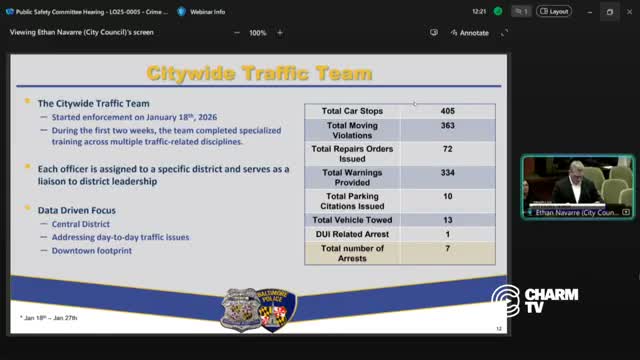
Commissioner Worley said the Entertainment District unit and a recently formed citywide traffic team (two sergeants and 10 officers) are focusing on downtown corridors such as Pratt and Lombard streets and other hot spots. "Most of the time the officer gives a warning or tells the individual to dump it out, that's abated the problem," Worley said, describing how officers handle open-container incidents before escalating to citations or arrests.
Council members said some community leaders believe enforcement changed during COVID; Worley said that perception reflected earlier prosecutorial discretion rather than departmental unwillingness: "During COVID, we couldn't enforce it because we had a state's attorney who wasn't prosecuting it...Now we will address it." He urged residents to call 911 and provide detailed descriptions to help officers identify suspects.
On dirt bikes, Worley said the department is using traffic and entertainment units, plus intelligence from special operations, to target riders and to identify where bikes are stored. He said a captain was sent to Philadelphia to study tactics, and the department plans to prioritize seizures and storage or forfeiture where legally appropriate.
The committee also discussed illegal street vendors and the role of code enforcement, the health department and DHCD in verifying licenses and safety requirements; police said patrol officers and neighborhood coordinating officers should flag suspected illicit businesses for interagency follow-up. Staff emphasized the community's role in reporting problematic vendors or dirt-bike storage locations via 311 or anonymous tips.
A council member also asked about an updated CAD system; staff agreed to follow up on any BCIT-led RFP progress offline and provide details to the council.
Commissioner Worley said the Entertainment District unit and a recently formed citywide traffic team (two sergeants and 10 officers) are focusing on downtown corridors such as Pratt and Lombard streets and other hot spots. "Most of the time the officer gives a warning or tells the individual to dump it out, that's abated the problem," Worley said, describing how officers handle open-container incidents before escalating to citations or arrests.
Council members said some community leaders believe enforcement changed during COVID; Worley said that perception reflected earlier prosecutorial discretion rather than departmental unwillingness: "During COVID, we couldn't enforce it because we had a state's attorney who wasn't prosecuting it...Now we will address it." He urged residents to call 911 and provide detailed descriptions to help officers identify suspects.
On dirt bikes, Worley said the department is using traffic and entertainment units, plus intelligence from special operations, to target riders and to identify where bikes are stored. He said a captain was sent to Philadelphia to study tactics, and the department plans to prioritize seizures and storage or forfeiture where legally appropriate.
The committee also discussed illegal street vendors and the role of code enforcement, the health department and DHCD in verifying licenses and safety requirements; police said patrol officers and neighborhood coordinating officers should flag suspected illicit businesses for interagency follow-up. Staff emphasized the community's role in reporting problematic vendors or dirt-bike storage locations via 311 or anonymous tips.
A council member also asked about an updated CAD system; staff agreed to follow up on any BCIT-led RFP progress offline and provide details to the council.
View the Full Meeting & All Its Details
This article offers just a summary. Unlock complete video, transcripts, and insights as a Founder Member.
✓
Watch full, unedited meeting videos
✓
Search every word spoken in unlimited transcripts
✓
AI summaries & real-time alerts (all government levels)
✓
Permanent access to expanding government content
30-day money-back guarantee
