Education commissioner warns sweeping donor trust, certification fees would harm specialized services and teachers
February 03, 2026 | 2026 Legislature NE, Nebraska
This article was created by AI summarizing key points discussed. AI makes mistakes, so for full details and context, please refer to the video of the full meeting. Please report any errors so we can fix them. Report an error »
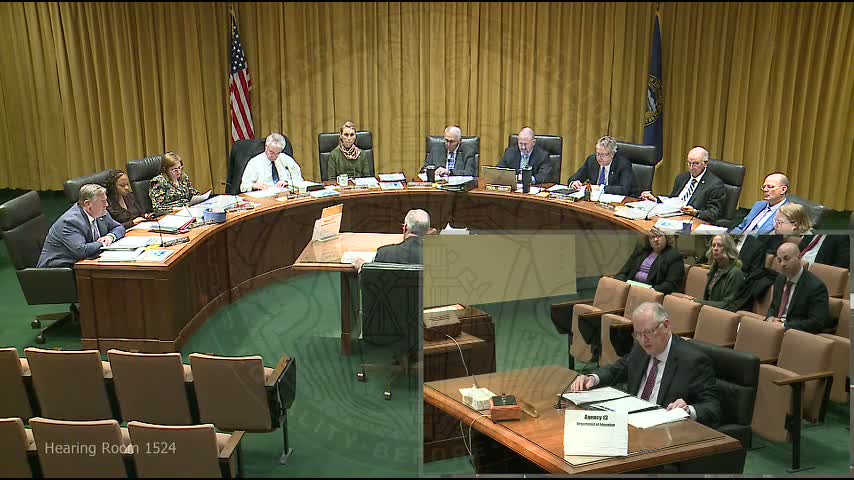
Commissioner Brian Maher told the Legislature’s Appropriations Committee that several mid‑biennium budget actions under consideration would create harms for students and educators.
Maher described the Williams Trust — established by F.D. Williams to benefit blind and visually impaired students served by the Nebraska Center for the Education of Children who are Blind or Visually Impaired (NCECBVI) — as restricted to student supports and not available for salaries or ongoing operations. "The Williams Trust is not a discretionary fund and is not used for ongoing operational costs," he said, adding the trust pays for assistive technology, braille materials and orientation and mobility equipment used statewide.
Tanya Armstrong, administrator of NCECBVI, told the committee that the center serves students with multiple and increasingly complex disabilities, and that losing trust funds "would inevitably result in fewer tools, fewer opportunities, and fewer individualized supports for students across Nebraska who are blind or visually impaired." She warned that repurposing the trust would shift costs to families and local districts and undermine the donor’s intent.
On the teacher certification cash fund, Maher said repeated sweeps risk leaving certification processing unfunded and "we'll need to raise the cost for those certificates," shifting the burden "on the backs of teachers, administrators and others who need a certificate to work in Nebraska." The fund, established by statute, covers processing staff and the certification system; Maher said fee reductions earlier this biennium were the result of efficiency efforts and that the fund supports necessary operations.
Separately, the department asked for $2 million in additional spending authority from the Early Childhood Education Endowment cash fund so trustees’ recent awards (about $13.06 million) can be paid. Eric Buchanan, chair of the Sixpence board of trustees, said the board decided to use additional one‑time cash grants to meet unmet local needs and asked the committee to provide the legislative authority so the amounts already awarded can be disbursed. Buchanan said the endowment combines private endowment, a public endowment and matching general‑fund grants, and that this request has no net general‑fund impact.
Maher and finance staff answered questions from senators about TEOSA modeling, youth rehabilitation school rule changes and staffing: the department said it will release updated TEOSA models soon, that most NDE staff are federally funded and that state‑funded positions are especially exposed to proposed cuts.
The committee heard related testimony from school advocates including Tim Royers of the Nebraska State Education Association, who urged lawmakers not to approve what he characterized as deep cuts to special education: "If you move forward with this proposed reduction, there are two likely outcomes. First, property taxes will rise," Royers said, warning the proposed reductions would increase local levies or reduce services.
Next steps: the Appropriations Committee will consider the department’s requests and the potential legal and programmatic consequences of proposed fund sweeps as budget deliberations continue.
Maher described the Williams Trust — established by F.D. Williams to benefit blind and visually impaired students served by the Nebraska Center for the Education of Children who are Blind or Visually Impaired (NCECBVI) — as restricted to student supports and not available for salaries or ongoing operations. "The Williams Trust is not a discretionary fund and is not used for ongoing operational costs," he said, adding the trust pays for assistive technology, braille materials and orientation and mobility equipment used statewide.
Tanya Armstrong, administrator of NCECBVI, told the committee that the center serves students with multiple and increasingly complex disabilities, and that losing trust funds "would inevitably result in fewer tools, fewer opportunities, and fewer individualized supports for students across Nebraska who are blind or visually impaired." She warned that repurposing the trust would shift costs to families and local districts and undermine the donor’s intent.
On the teacher certification cash fund, Maher said repeated sweeps risk leaving certification processing unfunded and "we'll need to raise the cost for those certificates," shifting the burden "on the backs of teachers, administrators and others who need a certificate to work in Nebraska." The fund, established by statute, covers processing staff and the certification system; Maher said fee reductions earlier this biennium were the result of efficiency efforts and that the fund supports necessary operations.
Separately, the department asked for $2 million in additional spending authority from the Early Childhood Education Endowment cash fund so trustees’ recent awards (about $13.06 million) can be paid. Eric Buchanan, chair of the Sixpence board of trustees, said the board decided to use additional one‑time cash grants to meet unmet local needs and asked the committee to provide the legislative authority so the amounts already awarded can be disbursed. Buchanan said the endowment combines private endowment, a public endowment and matching general‑fund grants, and that this request has no net general‑fund impact.
Maher and finance staff answered questions from senators about TEOSA modeling, youth rehabilitation school rule changes and staffing: the department said it will release updated TEOSA models soon, that most NDE staff are federally funded and that state‑funded positions are especially exposed to proposed cuts.
The committee heard related testimony from school advocates including Tim Royers of the Nebraska State Education Association, who urged lawmakers not to approve what he characterized as deep cuts to special education: "If you move forward with this proposed reduction, there are two likely outcomes. First, property taxes will rise," Royers said, warning the proposed reductions would increase local levies or reduce services.
Next steps: the Appropriations Committee will consider the department’s requests and the potential legal and programmatic consequences of proposed fund sweeps as budget deliberations continue.
Don't Miss a Word: See the Full Meeting!
Go beyond summaries. Unlock every video, transcript, and key insight with a Founder Membership.
✓
Get instant access to full meeting videos
✓
Search and clip any phrase from complete transcripts
✓
Receive AI-powered summaries & custom alerts
✓
Enjoy lifetime, unrestricted access to government data
30-day money-back guarantee
