Santa Barbara council weighs charter change to remove 50-year lease cap and debates handbook reforms
February 02, 2026 | Santa Barbara City, Santa Barbara County, California
This article was created by AI summarizing key points discussed. AI makes mistakes, so for full details and context, please refer to the video of the full meeting. Please report any errors so we can fix them. Report an error »
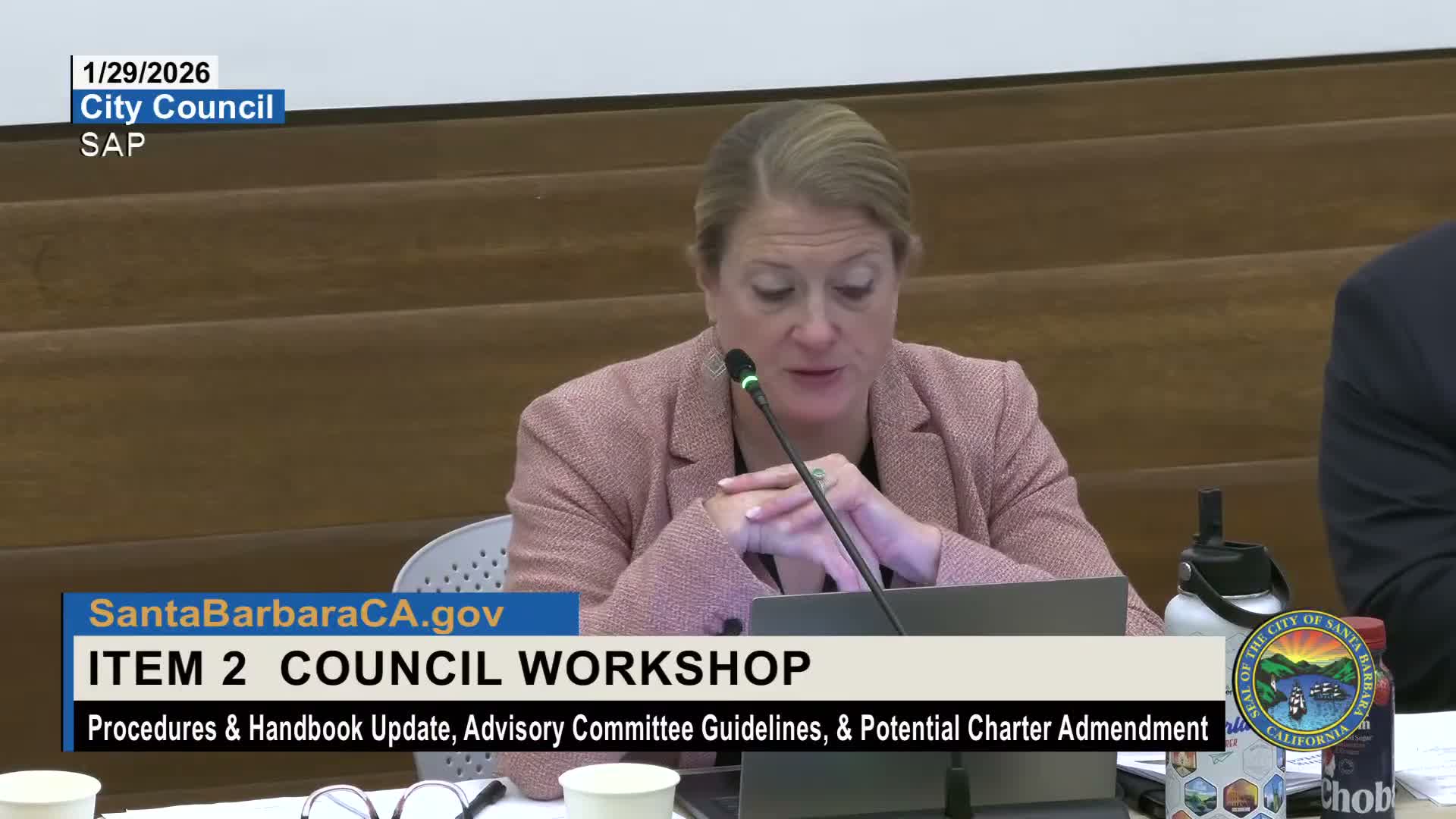
Santa Barbara — During a special meeting on Jan. 29, City staff presented proposed changes to City Charter section 5.21 that would remove an explicit 50-year maximum on city leases and allow the City Council to set lease terms by ordinance or resolution. Council members and staff debated the legal wording, ballot timing and the broader handbook updates needed to implement related redevelopment goals.
Kelly (staff) presented the draft charter language, saying the principal change is to allow contracts for the sale, lease or use of city property "to be a municipal affair subject only to the limitations as may be provided in this charter and in the constitution of the state of California" and to permit the council to "lease property owned, held, or controlled by it for terms established by the city council." The stated purpose is to give the city flexibility to negotiate longer ground leases for projects — including housing — that require multi-decade financing horizons.
Council and staff discussed procedural trade-offs. The city attorney said allowing approval by resolution (instead of only by ordinance) can reduce delay by removing the second-reading/30-day-waiting period, letting a lessee start operations sooner if the council so chooses. The attorney also said this change is not intended to supplant federal or other legally required limitations (for example, FAA rules on airport property or waterfront trust restrictions).
Council members raised questions about the precise text. One concern was whether removing explicit ‘‘extension’’ language could create legal ambiguities; the city attorney said the redrafting is intended to clarify rather than to limit council authority and that certain statutory limits would still bind particular properties.
Staff outlined practical next steps and costs: to meet county deadlines for a June special election the council would need to adopt a resolution at its next meeting; staff estimated that holding the referendum in June would increase election costs by roughly $140,000 compared with placing the measure on the November general election ballot. Council asked staff to return with cost comparisons for both June and November. Several council members signaled interest in returning the charter item for formal consideration at the next meeting so the council could decide whether to place the amendment on the June ballot.
The meeting then moved into a substantive, hour-long workshop on updates to the council procedures handbook. Topics included streamlining the two-person memo process for adding items to the council agenda (several members sought a single-meeting approach or mayoral routing as an alternative), establishing clearer council budget guidelines (allowable uses such as interns and travel), event sponsorship and cost-recovery policies, standards for proclamations and recognitions, teleconference meeting updates to comply with recent state law, and the possibility of study sessions as a regular meeting type.
Staff and council also discussed advisory committee issues including whether to permit limited remote participation with guardrails (majority in-person requirement, accessibility exceptions), whether to impose term recommendations or limits, and whether to consolidate or re-scope some boards and commissions. Council created an ad hoc committee (members volunteered in the meeting) to work with staff on handbook language and to report back with recommended final changes.
Next steps: staff will prepare language and cost estimates for ballot timing options on the charter amendment, revise handbook draft language based on council feedback, and the ad hoc committee will convene to refine final recommended updates for future council action.
Kelly (staff) presented the draft charter language, saying the principal change is to allow contracts for the sale, lease or use of city property "to be a municipal affair subject only to the limitations as may be provided in this charter and in the constitution of the state of California" and to permit the council to "lease property owned, held, or controlled by it for terms established by the city council." The stated purpose is to give the city flexibility to negotiate longer ground leases for projects — including housing — that require multi-decade financing horizons.
Council and staff discussed procedural trade-offs. The city attorney said allowing approval by resolution (instead of only by ordinance) can reduce delay by removing the second-reading/30-day-waiting period, letting a lessee start operations sooner if the council so chooses. The attorney also said this change is not intended to supplant federal or other legally required limitations (for example, FAA rules on airport property or waterfront trust restrictions).
Council members raised questions about the precise text. One concern was whether removing explicit ‘‘extension’’ language could create legal ambiguities; the city attorney said the redrafting is intended to clarify rather than to limit council authority and that certain statutory limits would still bind particular properties.
Staff outlined practical next steps and costs: to meet county deadlines for a June special election the council would need to adopt a resolution at its next meeting; staff estimated that holding the referendum in June would increase election costs by roughly $140,000 compared with placing the measure on the November general election ballot. Council asked staff to return with cost comparisons for both June and November. Several council members signaled interest in returning the charter item for formal consideration at the next meeting so the council could decide whether to place the amendment on the June ballot.
The meeting then moved into a substantive, hour-long workshop on updates to the council procedures handbook. Topics included streamlining the two-person memo process for adding items to the council agenda (several members sought a single-meeting approach or mayoral routing as an alternative), establishing clearer council budget guidelines (allowable uses such as interns and travel), event sponsorship and cost-recovery policies, standards for proclamations and recognitions, teleconference meeting updates to comply with recent state law, and the possibility of study sessions as a regular meeting type.
Staff and council also discussed advisory committee issues including whether to permit limited remote participation with guardrails (majority in-person requirement, accessibility exceptions), whether to impose term recommendations or limits, and whether to consolidate or re-scope some boards and commissions. Council created an ad hoc committee (members volunteered in the meeting) to work with staff on handbook language and to report back with recommended final changes.
Next steps: staff will prepare language and cost estimates for ballot timing options on the charter amendment, revise handbook draft language based on council feedback, and the ad hoc committee will convene to refine final recommended updates for future council action.
View the Full Meeting & All Its Details
This article offers just a summary. Unlock complete video, transcripts, and insights as a Founder Member.
✓
Watch full, unedited meeting videos
✓
Search every word spoken in unlimited transcripts
✓
AI summaries & real-time alerts (all government levels)
✓
Permanent access to expanding government content
30-day money-back guarantee
