Committee hears NDOT bill to create infrastructure bank, tighten delivery tools and set new ‘superload’ fees
February 03, 2026 | 2026 Legislature NE, Nebraska
This article was created by AI summarizing key points discussed. AI makes mistakes, so for full details and context, please refer to the video of the full meeting. Please report any errors so we can fix them. Report an error »
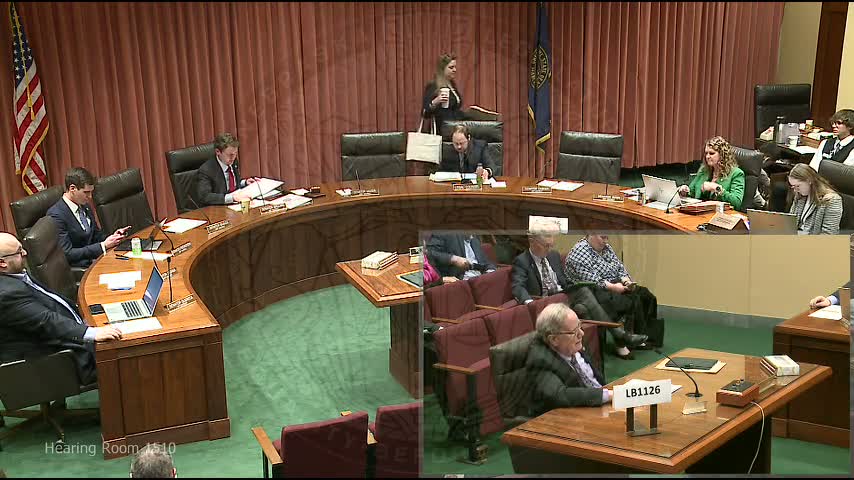
Sen. Mike Moser, chairman of the Transportation and Telecommunications Committee, introduced LB1126, saying it “represents several initiatives to modernize the way we build transportation projects” and would establish an Infrastructure Development Investment Program — a revolving loan program often called a state infrastructure bank — to help cities and counties finance transportation projects that local revenues cannot immediately support.
Vikki Kramer, director of the Nebraska Department of Transportation, told the committee the program “will establish a statutory framework for a revolving loan program” similar to existing state revolving funds for water and wastewater. Kramer said the bill itself does not provide initial capitalization but would allow NDOT to seek federal financing tools such as a Transportation Infrastructure Finance and Innovation Act (TIFIA) loan from the U.S. Department of Transportation to capitalize the program and then make loans to political subdivisions.
Beyond the lending framework, the bill would revise NDOT procurement and operations: it would clarify rules for public–private partnerships and progressive design–build contracting, remove a prequalification requirement for certain low-complexity contracts (for example mowing and guardrail maintenance) to broaden competition for smaller firms, and raise the monetary threshold that triggers crash reporting from $1,500 to $2,000. Kramer told the committee NDOT estimates the change to crash-report redaction rules could save about $30,000 by avoiding an unnecessary new contract database.
LB1126 would also create a new permit class for extremely heavy vehicles described in testimony as “superloads” and raise the present $25 cap on such permit fees. Kramer and the fiscal note referenced projected permit revenue in the neighborhood of $4,000,000, which the department said could be used to offset pavement damage and permitting costs. Committee members and witnesses discussed how fees and permitting would operate and whether fees would match actual pavement damage in specific cases; Kramer said how fees are set is meant to align Nebraska with neighboring states.
Beth Bazyn Ferrell of the Nebraska Association of County Officials said her group is conditionally opposed to a portion of the bill related to superloads. She asked for a narrow amendment to ensure that superload permits are not valid on roads under county jurisdiction unless the county has explicitly issued a permit, so counties would be informed and could protect local roads. “So that the county would know, if the superload was gonna be on the road,” Bazyn Ferrell said.
Supporters including the Greater Omaha Chamber, ACC Nebraska and the Metropolitan Area Planning Agency urged the committee to approve the statutory framework so local governments could bundle smaller projects, access favorable federal financing, and accelerate project delivery. Matt Bridal of the Greater Omaha Chamber said the model has helped other states finance projects sooner and at lower cost.
The committee closed the LB1126 hearing without taking a vote. The hearing record included proponents, conditional opposition from county officials on the superload language, and offers from NDOT and industry witnesses to work with counties on implementation details. The bill’s text in statute will determine the exact fee schedules and the weight threshold that defines a superload; testimony contained differing spoken references to weight thresholds, so the committee and stakeholders noted the need to confirm the bill text before final action.
Vikki Kramer, director of the Nebraska Department of Transportation, told the committee the program “will establish a statutory framework for a revolving loan program” similar to existing state revolving funds for water and wastewater. Kramer said the bill itself does not provide initial capitalization but would allow NDOT to seek federal financing tools such as a Transportation Infrastructure Finance and Innovation Act (TIFIA) loan from the U.S. Department of Transportation to capitalize the program and then make loans to political subdivisions.
Beyond the lending framework, the bill would revise NDOT procurement and operations: it would clarify rules for public–private partnerships and progressive design–build contracting, remove a prequalification requirement for certain low-complexity contracts (for example mowing and guardrail maintenance) to broaden competition for smaller firms, and raise the monetary threshold that triggers crash reporting from $1,500 to $2,000. Kramer told the committee NDOT estimates the change to crash-report redaction rules could save about $30,000 by avoiding an unnecessary new contract database.
LB1126 would also create a new permit class for extremely heavy vehicles described in testimony as “superloads” and raise the present $25 cap on such permit fees. Kramer and the fiscal note referenced projected permit revenue in the neighborhood of $4,000,000, which the department said could be used to offset pavement damage and permitting costs. Committee members and witnesses discussed how fees and permitting would operate and whether fees would match actual pavement damage in specific cases; Kramer said how fees are set is meant to align Nebraska with neighboring states.
Beth Bazyn Ferrell of the Nebraska Association of County Officials said her group is conditionally opposed to a portion of the bill related to superloads. She asked for a narrow amendment to ensure that superload permits are not valid on roads under county jurisdiction unless the county has explicitly issued a permit, so counties would be informed and could protect local roads. “So that the county would know, if the superload was gonna be on the road,” Bazyn Ferrell said.
Supporters including the Greater Omaha Chamber, ACC Nebraska and the Metropolitan Area Planning Agency urged the committee to approve the statutory framework so local governments could bundle smaller projects, access favorable federal financing, and accelerate project delivery. Matt Bridal of the Greater Omaha Chamber said the model has helped other states finance projects sooner and at lower cost.
The committee closed the LB1126 hearing without taking a vote. The hearing record included proponents, conditional opposition from county officials on the superload language, and offers from NDOT and industry witnesses to work with counties on implementation details. The bill’s text in statute will determine the exact fee schedules and the weight threshold that defines a superload; testimony contained differing spoken references to weight thresholds, so the committee and stakeholders noted the need to confirm the bill text before final action.
View the Full Meeting & All Its Details
This article offers just a summary. Unlock complete video, transcripts, and insights as a Founder Member.
✓
Watch full, unedited meeting videos
✓
Search every word spoken in unlimited transcripts
✓
AI summaries & real-time alerts (all government levels)
✓
Permanent access to expanding government content
30-day money-back guarantee
