Senate committee advances bill creating 'veterinary professional associate' role after hours of testimony
February 04, 2026 | 2026 Legislature FL, Florida
This article was created by AI summarizing key points discussed. AI makes mistakes, so for full details and context, please refer to the video of the full meeting. Please report any errors so we can fix them. Report an error »
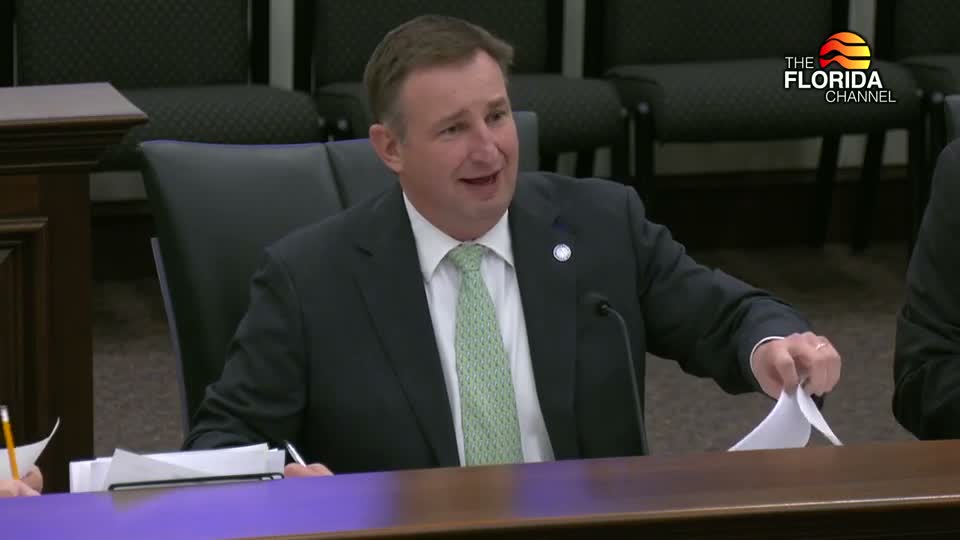
The Florida Senate Appropriations Committee on Agriculture, Environment, and General Government on Feb. 5 reported CS for Senate Bill 796 favorably, a measure that would create a licensed midlevel role called a veterinary professional associate (VPA) to perform delegated clinical tasks under a licensed Florida veterinarian.
Sponsor Senator Bridal told the committee the measure mirrors the physician‑assistant model in human medicine and would broaden access, lower costs, and create career pathways. The bill requires completion of an approved master’s program and a national competency exam, limits VPAs to practice only as delegated by a supervising veterinarian, and bars VPAs from prescribing certain controlled substances and performing most surgeries. It also extends permitted veterinary telehealth prescription windows for flea and tick medications from one to six months and for other medications from 14 to 30 days.
The committee heard more than an hour of public testimony, much of it from veterinary students and early‑career veterinarians expressing strong opposition. Fourth‑year student Ashley Fratto said she left clinical rotations to speak against the bill and warned new associates could be compelled by corporate employers to work under VPAs, saying, “I personally will not take a job that has a VPA in that practice.” Fratto added that newly graduated veterinarians may lack the experience to supervise other practitioners and raised concern about liability if an inadequately trained VPA harms a patient.
Several practicing veterinarians also expressed concerns about oversight, training and federal law. A practicing small‑animal veterinarian (identified in testimony as Julie Mudajon) said the Board of Veterinary Medicine currently lacks licensing or oversight mechanisms for the proposed role and warned that some permissive provisions could conflict with federal controls on controlled substances. In response, veterinarian Dr. April Steele — who testified in favor of the bill — said VPAs would complete six years of higher education, have clinical experience prerequisites, and that the role is permissive (only vets who choose to hire VPAs would do so). Steele said VPAs would work under “responsible supervision” and predicted greater supply would help reduce costs in underserved settings.
Supporters including veterinarian Bob Murtaugh argued the role could extend care in counties lacking services and provide a career track for veterinary technicians.
Senators asked sponsors and witnesses about curriculum, supervision, the potential for corporate practices to use VPAs to reduce payroll costs, and whether the measure would meaningfully address shortages in large‑animal and rural practice areas. Senator Masullo noted the bill establishes the framework and that educational programs would follow. Senator Bridal told the committee the statute allows the Board of Veterinary Medicine to adopt rules establishing reasonable supervision and other guardrails, and the sponsor said he welcomed stakeholder feedback.
After debate, the committee recorded a favorable report on CS for SB 796. The roll call in committee recorded 11 votes in the affirmative and no recorded negative votes.
Sponsor Senator Bridal told the committee the measure mirrors the physician‑assistant model in human medicine and would broaden access, lower costs, and create career pathways. The bill requires completion of an approved master’s program and a national competency exam, limits VPAs to practice only as delegated by a supervising veterinarian, and bars VPAs from prescribing certain controlled substances and performing most surgeries. It also extends permitted veterinary telehealth prescription windows for flea and tick medications from one to six months and for other medications from 14 to 30 days.
The committee heard more than an hour of public testimony, much of it from veterinary students and early‑career veterinarians expressing strong opposition. Fourth‑year student Ashley Fratto said she left clinical rotations to speak against the bill and warned new associates could be compelled by corporate employers to work under VPAs, saying, “I personally will not take a job that has a VPA in that practice.” Fratto added that newly graduated veterinarians may lack the experience to supervise other practitioners and raised concern about liability if an inadequately trained VPA harms a patient.
Several practicing veterinarians also expressed concerns about oversight, training and federal law. A practicing small‑animal veterinarian (identified in testimony as Julie Mudajon) said the Board of Veterinary Medicine currently lacks licensing or oversight mechanisms for the proposed role and warned that some permissive provisions could conflict with federal controls on controlled substances. In response, veterinarian Dr. April Steele — who testified in favor of the bill — said VPAs would complete six years of higher education, have clinical experience prerequisites, and that the role is permissive (only vets who choose to hire VPAs would do so). Steele said VPAs would work under “responsible supervision” and predicted greater supply would help reduce costs in underserved settings.
Supporters including veterinarian Bob Murtaugh argued the role could extend care in counties lacking services and provide a career track for veterinary technicians.
Senators asked sponsors and witnesses about curriculum, supervision, the potential for corporate practices to use VPAs to reduce payroll costs, and whether the measure would meaningfully address shortages in large‑animal and rural practice areas. Senator Masullo noted the bill establishes the framework and that educational programs would follow. Senator Bridal told the committee the statute allows the Board of Veterinary Medicine to adopt rules establishing reasonable supervision and other guardrails, and the sponsor said he welcomed stakeholder feedback.
After debate, the committee recorded a favorable report on CS for SB 796. The roll call in committee recorded 11 votes in the affirmative and no recorded negative votes.
View the Full Meeting & All Its Details
This article offers just a summary. Unlock complete video, transcripts, and insights as a Founder Member.
✓
Watch full, unedited meeting videos
✓
Search every word spoken in unlimited transcripts
✓
AI summaries & real-time alerts (all government levels)
✓
Permanent access to expanding government content
30-day money-back guarantee
