Senate committee backs plan to restore Ocklawaha River after extensive, divided public testimony
February 04, 2026 | 2026 Legislature FL, Florida
This article was created by AI summarizing key points discussed. AI makes mistakes, so for full details and context, please refer to the video of the full meeting. Please report any errors so we can fix them. Report an error »
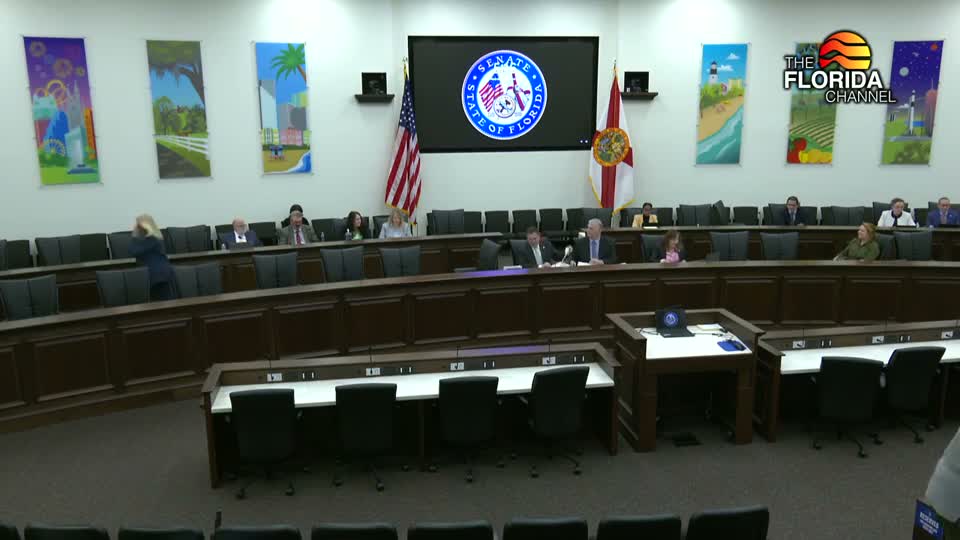
The Appropriations Committee on Agriculture, Environment, and General Government reported CS for CS Senate Bill 1066 favorably after a lengthy hearing that drew supporters and opponents who characterized the bill as either a long‑overdue ecological restoration of a fragmented river system or an unfunded state intrusion that threatens local wells and economies.
Senator Broder framed the bill as a five‑year, gradual restoration plan to return the Ocklawaha River system to more natural flows while enrolling local stakeholders and providing planning grants and oversight for implementation. He explained an amendment allowing updated scientific data and analyses to be incorporated into the restoration framework had been accepted.
Supporters included scientists, filmmakers and conservation groups who described severe ecological declines since construction of the Rodman Reservoir and the Cross‑Florida Barge Canal works. Dr. Quentin Witt, a lead author of the Ocklawaha River restoration science and economic report, urged the committee to complete the “last major piece” of St. Johns River restoration and cited projected restoration costs in the tens of millions with favorable cost‑benefit ratios for ecological and recreational gains. Mark Emery (a National Geographic filmmaker and fishing guide) and others described how fish diversity and visitation declined after the dam was built.
Opponents — including Putnam County officials, local commissioners and some residents — pressed home‑rule, water‑supply and economic concerns. Putnam County Commissioner Larry Harvey warned that wells in West Putnam were drying up, described current drought and fire impacts, and said residents fear the state would allow development of former canal lands if ownership issues revert to previous owners. Local speakers emphasized potential increases in nutrient loads to the St. Johns River and the cost and uncertainty of mitigation, asking for more study and local protections.
Several witnesses proposed compromises, including staged drawdowns to test ecological responses, or additional mitigation work in downstream systems before large‑scale restoration. Senator Broder stressed the bill’s local enrollment approach (a multi‑stakeholder committee) and emphasized phased planning and funding to reduce abrupt impacts.
The committee recorded a favorable report on CS for CS SB 1066; the roll call included a single recorded 'No' and multiple 'Yes' votes. The bill will move forward for further consideration with a large record of technical testimony and community concerns to be addressed.
Senator Broder framed the bill as a five‑year, gradual restoration plan to return the Ocklawaha River system to more natural flows while enrolling local stakeholders and providing planning grants and oversight for implementation. He explained an amendment allowing updated scientific data and analyses to be incorporated into the restoration framework had been accepted.
Supporters included scientists, filmmakers and conservation groups who described severe ecological declines since construction of the Rodman Reservoir and the Cross‑Florida Barge Canal works. Dr. Quentin Witt, a lead author of the Ocklawaha River restoration science and economic report, urged the committee to complete the “last major piece” of St. Johns River restoration and cited projected restoration costs in the tens of millions with favorable cost‑benefit ratios for ecological and recreational gains. Mark Emery (a National Geographic filmmaker and fishing guide) and others described how fish diversity and visitation declined after the dam was built.
Opponents — including Putnam County officials, local commissioners and some residents — pressed home‑rule, water‑supply and economic concerns. Putnam County Commissioner Larry Harvey warned that wells in West Putnam were drying up, described current drought and fire impacts, and said residents fear the state would allow development of former canal lands if ownership issues revert to previous owners. Local speakers emphasized potential increases in nutrient loads to the St. Johns River and the cost and uncertainty of mitigation, asking for more study and local protections.
Several witnesses proposed compromises, including staged drawdowns to test ecological responses, or additional mitigation work in downstream systems before large‑scale restoration. Senator Broder stressed the bill’s local enrollment approach (a multi‑stakeholder committee) and emphasized phased planning and funding to reduce abrupt impacts.
The committee recorded a favorable report on CS for CS SB 1066; the roll call included a single recorded 'No' and multiple 'Yes' votes. The bill will move forward for further consideration with a large record of technical testimony and community concerns to be addressed.
View the Full Meeting & All Its Details
This article offers just a summary. Unlock complete video, transcripts, and insights as a Founder Member.
✓
Watch full, unedited meeting videos
✓
Search every word spoken in unlimited transcripts
✓
AI summaries & real-time alerts (all government levels)
✓
Permanent access to expanding government content
30-day money-back guarantee
