Florida House updates criteria for gang‑membership enhancements amid First‑Amendment and equity concerns
February 04, 2026 | 2026 Legislature FL, Florida
This article was created by AI summarizing key points discussed. AI makes mistakes, so for full details and context, please refer to the video of the full meeting. Please report any errors so we can fix them. Report an error »
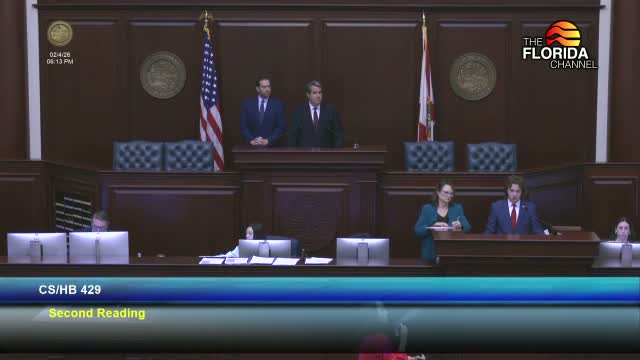
The Florida House on Feb. 4 passed CS for HB 429 to modernize the evidentiary criteria for determining criminal gang membership used for penalty enhancements.
Sponsor Representative Baker said the bill updates a statute that once relied largely on tattoos, hand signs and street‑level association to reflect modern recruitment and coordination on social media. Under the change, admissions and gang‑related language posted online can be considered as part of the criteria to establish membership for enhancement purposes, but a criminal act that furthers a gang’s interests must still be proved.
Floor debate focused on constitutional and evidentiary safeguards. Representative Raynor and Representative Rainer (also transcribed as Rainer/Raynor in different turns) expressed concern the bill could pierce spousal privilege, expand prosecutions or sweep in individuals tangentially associated with gang members. Representative Nixon asked whether people arrested for civil disobedience or protests could face enhanced penalties if social‑media language were used as evidence; sponsors replied that a crime must be proved and the enhancement requires meeting the statutory criteria beyond a reasonable doubt.
Critics, including Representative Eskamani and others, warned of disproportionate impact on Black and brown communities and of over‑reliance on social media signals. Sponsors and some law‑enforcement proponents said the bill merely adds usable evidence so courts and juries can consider contemporary behavior when a crime in furtherance of gang activity has occurred.
After debate the House moved to final passage; the clerk announced a vote of 100 yays and 7 nays and the bill passed.
Sponsor Representative Baker said the bill updates a statute that once relied largely on tattoos, hand signs and street‑level association to reflect modern recruitment and coordination on social media. Under the change, admissions and gang‑related language posted online can be considered as part of the criteria to establish membership for enhancement purposes, but a criminal act that furthers a gang’s interests must still be proved.
Floor debate focused on constitutional and evidentiary safeguards. Representative Raynor and Representative Rainer (also transcribed as Rainer/Raynor in different turns) expressed concern the bill could pierce spousal privilege, expand prosecutions or sweep in individuals tangentially associated with gang members. Representative Nixon asked whether people arrested for civil disobedience or protests could face enhanced penalties if social‑media language were used as evidence; sponsors replied that a crime must be proved and the enhancement requires meeting the statutory criteria beyond a reasonable doubt.
Critics, including Representative Eskamani and others, warned of disproportionate impact on Black and brown communities and of over‑reliance on social media signals. Sponsors and some law‑enforcement proponents said the bill merely adds usable evidence so courts and juries can consider contemporary behavior when a crime in furtherance of gang activity has occurred.
After debate the House moved to final passage; the clerk announced a vote of 100 yays and 7 nays and the bill passed.
Don't Miss a Word: See the Full Meeting!
Go beyond summaries. Unlock every video, transcript, and key insight with a Founder Membership.
✓
Get instant access to full meeting videos
✓
Search and clip any phrase from complete transcripts
✓
Receive AI-powered summaries & custom alerts
✓
Enjoy lifetime, unrestricted access to government data
30-day money-back guarantee
