Nebraska senators debate LB 669’s trafficking screening in abortion care; recommit and reconsider motions fail
February 03, 2026 | 2026 Legislature NE, Nebraska
This article was created by AI summarizing key points discussed. AI makes mistakes, so for full details and context, please refer to the video of the full meeting. Please report any errors so we can fix them. Report an error »
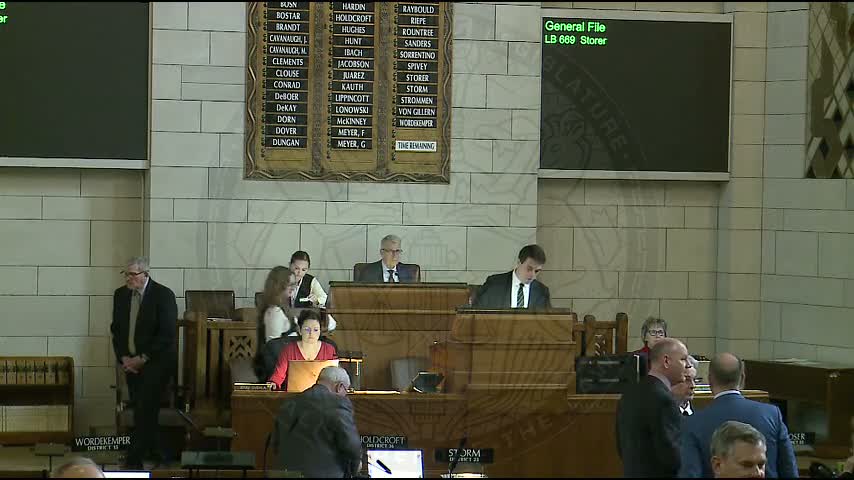
Lincoln — Nebraska senators spent a large portion of the Feb. 3 floor session debating LB 669, a bill introduced by Senator Storer that would require screening for domestic violence and human trafficking in the context of abortion care and add related informed-consent steps to the abortion statute.
Senator Storer, the bill’s introducer, told colleagues the measure is intended to identify and help victims when they seek abortion services, saying the bill “does nothing to impact or change how women access that service” and would provide a private place and access to national hotlines when a patient answers yes to screening questions.
Opponents said the bill is not ready for the floor. Senator Spivey, who led an effort to reconsider a prior indefinite-postponement motion, said colleagues were still negotiating amendments and that the bill’s language is too narrow to address reproductive coercion in its full definition. “I’m asking you to reconsider your vote on the motion to indefinitely postpone on LB 669,” Spivey said, arguing more dialogue and stakeholder input are needed.
Several senators, including Senator Hunt and Senator Duncan, said clinicians and medical associations had not been adequately consulted. Senator Hunt said she had received an email from the Nebraska chapter of the American College of Obstetricians and Gynecologists and from the Nebraska Medical Association raising concerns that the bill would insert new statutory duties into the abortion statute — 28-3-25 — and could impose compliance burdens on clinicians who do not provide abortion care.
Senator Mikaela Kavanaugh, sharing a personal account, said the proposal risked retraumatizing patients who have miscarried or needed medical follow-up, and argued that training and professional credentialing pathways were better channels for addressing trafficking and coercion than a statutory checkbox. “We should have significant and robust training on human trafficking,” she said. “Placating making every medical professional ask every pregnant woman … is not something I agree with.”
Senator Juarez urged a broader, systemwide approach to maternal care and survivor supports, saying the legislature should focus on research-backed measures that improve pre- and postpartum services rather than narrowly mandating a screening step tied to abortion care.
Floor tactics became central to the session. Senators repeatedly called the question to end debate and put votes on procedural motions. The clerk recorded multiple roll-call tallies during the session; for example, one clerk announcement reported that debate was ceased by a vote the clerk read as 29 ayes to 12 nays. The body rejected a motion to reconsider earlier action (announced by the clerk as 13 ayes, 32 nays), and it rejected Senator Hunt’s motion to recommit the bill to the Judiciary Committee (reported as 11 ayes, 30 nays).
Senator Juarez later moved to reconsider the vote on recommit, but the clerk announced that motion was not adopted (reported as 13 ayes, 29 nays). Near the close of debate Senator Hunt proposed to bracket the bill until April 17, 2026 and asked for additional work to clarify whether an alleged abuser could be present during a screening and how the bill defined the “first pregnancy appointment.” The transcript does not record a completed vote on the bracket motion before the body moved on to other business and adjourned.
Senators on both sides said their aims include protecting victims of coercion and trafficking, but they disagreed sharply on how to accomplish that in statute without producing unintended harms or regulatory burdens. Proponents argued LB 669 would create an additional entry point to help people in danger; opponents and clinical groups said it was poorly drafted, risked producing misleading or harmful requirements for clinicians, and might deter disclosure if patients were required to certify that they had been asked certain questions.
What’s next: The session concluded without passage of LB 669. Because motions to recommit and to reconsider were defeated on the floor, the bill remained on general file; its sponsor and opponents indicated options including bringing a new committee amendment or returning the measure to committee for further stakeholder work.
Senator Storer, the bill’s introducer, told colleagues the measure is intended to identify and help victims when they seek abortion services, saying the bill “does nothing to impact or change how women access that service” and would provide a private place and access to national hotlines when a patient answers yes to screening questions.
Opponents said the bill is not ready for the floor. Senator Spivey, who led an effort to reconsider a prior indefinite-postponement motion, said colleagues were still negotiating amendments and that the bill’s language is too narrow to address reproductive coercion in its full definition. “I’m asking you to reconsider your vote on the motion to indefinitely postpone on LB 669,” Spivey said, arguing more dialogue and stakeholder input are needed.
Several senators, including Senator Hunt and Senator Duncan, said clinicians and medical associations had not been adequately consulted. Senator Hunt said she had received an email from the Nebraska chapter of the American College of Obstetricians and Gynecologists and from the Nebraska Medical Association raising concerns that the bill would insert new statutory duties into the abortion statute — 28-3-25 — and could impose compliance burdens on clinicians who do not provide abortion care.
Senator Mikaela Kavanaugh, sharing a personal account, said the proposal risked retraumatizing patients who have miscarried or needed medical follow-up, and argued that training and professional credentialing pathways were better channels for addressing trafficking and coercion than a statutory checkbox. “We should have significant and robust training on human trafficking,” she said. “Placating making every medical professional ask every pregnant woman … is not something I agree with.”
Senator Juarez urged a broader, systemwide approach to maternal care and survivor supports, saying the legislature should focus on research-backed measures that improve pre- and postpartum services rather than narrowly mandating a screening step tied to abortion care.
Floor tactics became central to the session. Senators repeatedly called the question to end debate and put votes on procedural motions. The clerk recorded multiple roll-call tallies during the session; for example, one clerk announcement reported that debate was ceased by a vote the clerk read as 29 ayes to 12 nays. The body rejected a motion to reconsider earlier action (announced by the clerk as 13 ayes, 32 nays), and it rejected Senator Hunt’s motion to recommit the bill to the Judiciary Committee (reported as 11 ayes, 30 nays).
Senator Juarez later moved to reconsider the vote on recommit, but the clerk announced that motion was not adopted (reported as 13 ayes, 29 nays). Near the close of debate Senator Hunt proposed to bracket the bill until April 17, 2026 and asked for additional work to clarify whether an alleged abuser could be present during a screening and how the bill defined the “first pregnancy appointment.” The transcript does not record a completed vote on the bracket motion before the body moved on to other business and adjourned.
Senators on both sides said their aims include protecting victims of coercion and trafficking, but they disagreed sharply on how to accomplish that in statute without producing unintended harms or regulatory burdens. Proponents argued LB 669 would create an additional entry point to help people in danger; opponents and clinical groups said it was poorly drafted, risked producing misleading or harmful requirements for clinicians, and might deter disclosure if patients were required to certify that they had been asked certain questions.
What’s next: The session concluded without passage of LB 669. Because motions to recommit and to reconsider were defeated on the floor, the bill remained on general file; its sponsor and opponents indicated options including bringing a new committee amendment or returning the measure to committee for further stakeholder work.
View the Full Meeting & All Its Details
This article offers just a summary. Unlock complete video, transcripts, and insights as a Founder Member.
✓
Watch full, unedited meeting videos
✓
Search every word spoken in unlimited transcripts
✓
AI summaries & real-time alerts (all government levels)
✓
Permanent access to expanding government content
30-day money-back guarantee
