Committee advances bill to broaden interpreter licensure pathways and add emergency exemption
February 04, 2026 | 2026 Legislature ME, Maine
This article was created by AI summarizing key points discussed. AI makes mistakes, so for full details and context, please refer to the video of the full meeting. Please report any errors so we can fix them. Report an error »
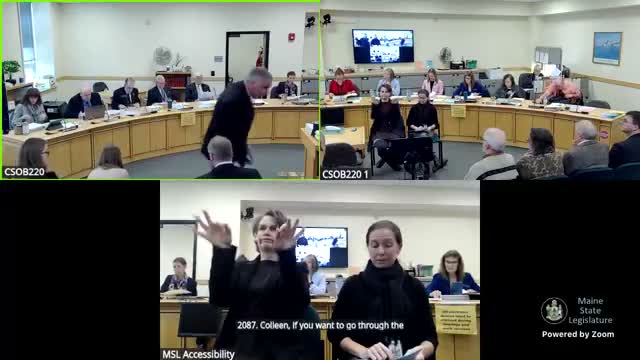
The Health Coverage, Insurance and Financial Services Committee on Thursday advanced LD 20 87, a department bill from the Office of Professional and Occupational Regulation (OPOR) that changes licensing pathways for interpreters and clarifies emergency exemptions.
Colleen, the committee analyst, told members the bill would extend the maximum duration of a conditional interpreter license from four years to five years and allow a sixth year at the director’s discretion in cases of extreme hardship. The proposal would also broaden the educational pathway so ‘‘an associate degree or higher in any field’’ or completion of 60 credits toward a bachelor’s degree could meet degree requirements, while preserving the current exam requirement.
The bill includes a provision clarifying that interpreter licensure requirements do not apply to a person providing communication assistance during an emergency response ‘‘as determined by the OPOR director after consultation with the commissioner.’’ That language prompted questions about timing and process from members concerned the exemption could be delayed if it required two officials to agree during an urgent event.
Penny Ballencourt, identified in testimony as an OPOR director and stakeholder participant, said the intent is ‘‘to avoid creating a licensing barrier during an emergency’’ and that the office would convene stakeholders to refine alternative pathways. ‘‘We are all committed to doing this work together,’’ she told the committee.
Members debated whether the statute should expressly permit a director to make an after‑the‑fact determination that an unlicensed individual who provided communication assistance during an emergency will not be disciplined. The committee adopted amended emergency language clarifying the exemption and agreed to send a letter or include unallocated language asking OPOR to report back on stakeholder work and any additional amendments.
Representative Foley moved the amended motion and the committee voted 13–0 to pass LD 2087 as amended.
The committee also asked staff to preserve and circulate the Maine Association for the Deaf’s proposed language for future consideration and to monitor the department’s follow‑up work on apprenticeship and educational partnerships.
Colleen, the committee analyst, told members the bill would extend the maximum duration of a conditional interpreter license from four years to five years and allow a sixth year at the director’s discretion in cases of extreme hardship. The proposal would also broaden the educational pathway so ‘‘an associate degree or higher in any field’’ or completion of 60 credits toward a bachelor’s degree could meet degree requirements, while preserving the current exam requirement.
The bill includes a provision clarifying that interpreter licensure requirements do not apply to a person providing communication assistance during an emergency response ‘‘as determined by the OPOR director after consultation with the commissioner.’’ That language prompted questions about timing and process from members concerned the exemption could be delayed if it required two officials to agree during an urgent event.
Penny Ballencourt, identified in testimony as an OPOR director and stakeholder participant, said the intent is ‘‘to avoid creating a licensing barrier during an emergency’’ and that the office would convene stakeholders to refine alternative pathways. ‘‘We are all committed to doing this work together,’’ she told the committee.
Members debated whether the statute should expressly permit a director to make an after‑the‑fact determination that an unlicensed individual who provided communication assistance during an emergency will not be disciplined. The committee adopted amended emergency language clarifying the exemption and agreed to send a letter or include unallocated language asking OPOR to report back on stakeholder work and any additional amendments.
Representative Foley moved the amended motion and the committee voted 13–0 to pass LD 2087 as amended.
The committee also asked staff to preserve and circulate the Maine Association for the Deaf’s proposed language for future consideration and to monitor the department’s follow‑up work on apprenticeship and educational partnerships.
Don't Miss a Word: See the Full Meeting!
Go beyond summaries. Unlock every video, transcript, and key insight with a Founder Membership.
✓
Get instant access to full meeting videos
✓
Search and clip any phrase from complete transcripts
✓
Receive AI-powered summaries & custom alerts
✓
Enjoy lifetime, unrestricted access to government data
30-day money-back guarantee
