UVM president says $16M estate gift will fund nursing scholarships amid clinical-placement bottleneck
February 05, 2026 | Appropriations, HOUSE OF REPRESENTATIVES, Committees, Legislative , Vermont
This article was created by AI summarizing key points discussed. AI makes mistakes, so for full details and context, please refer to the video of the full meeting. Please report any errors so we can fix them. Report an error »
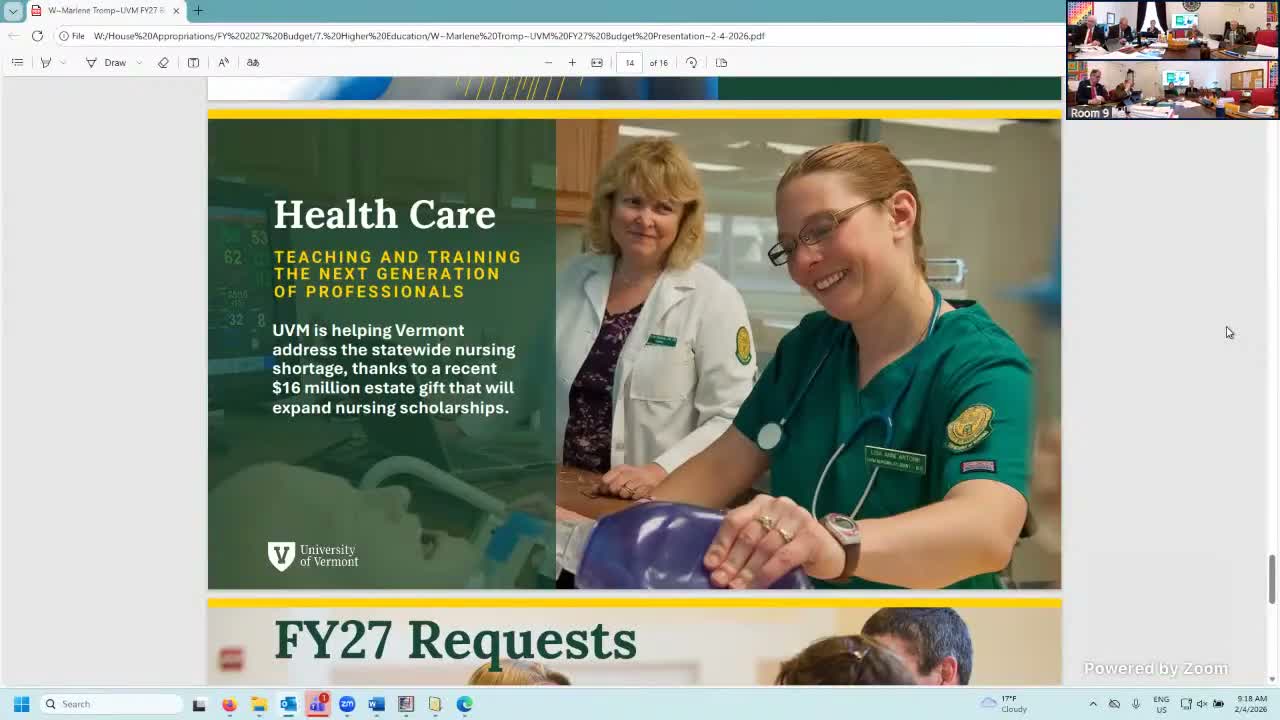
University of Vermont President Marlene Trump told the House of Communications Committee that a recent $16,000,000 estate gift will be used to reduce costs for nursing students and expand scholarships, but she warned the committee that clinical-placement capacity and supervisor-to-student accreditation limits create a bottleneck to quickly expanding enrollment.
Trump said, "we just got a $16,000,000 estate gift that will reduce the costs for students who wanna study nursing at UVM so that we can scholarship those students." Committee members welcomed the donation but pressed on the limits that constrain growth: accreditation requires clinical rotations supervised by practicing nurses and imposes maximum student-to-supervisor ratios, and many clinical sites lack staff to provide both care and student supervision.
Why it matters: Vermont and UVM have cited workforce shortages in health care; scholarship funds help financial access, but training capacity and clinical placements determine how many new nurses can be produced and deployed into the state health system.
Details and context: Committee discussion covered the interplay of private aid and federal support. One member raised concerns about federal changes to loan and grant programs and said those changes have reduced student resources; Trump said federal negotiations are ongoing and that private philanthropy can help offset federal funding reductions. Trump also noted UVM’s rural health focus and said that every nurse retained in Vermont increases capacity to train more nurses.
Claims and follow-up: A committee member (Steven) criticized federal policy changes in testimony, stating that those changes have harmed nursing professionals. Trump said she expects some federal programs may be restored and reiterated UVM’s intent to use private gifts to help students while addressing clinical-placement bottlenecks.
Next steps: The committee requested additional financial details and follow-up information on clinical-placement strategies and potential coordination with state health agencies.
Trump said, "we just got a $16,000,000 estate gift that will reduce the costs for students who wanna study nursing at UVM so that we can scholarship those students." Committee members welcomed the donation but pressed on the limits that constrain growth: accreditation requires clinical rotations supervised by practicing nurses and imposes maximum student-to-supervisor ratios, and many clinical sites lack staff to provide both care and student supervision.
Why it matters: Vermont and UVM have cited workforce shortages in health care; scholarship funds help financial access, but training capacity and clinical placements determine how many new nurses can be produced and deployed into the state health system.
Details and context: Committee discussion covered the interplay of private aid and federal support. One member raised concerns about federal changes to loan and grant programs and said those changes have reduced student resources; Trump said federal negotiations are ongoing and that private philanthropy can help offset federal funding reductions. Trump also noted UVM’s rural health focus and said that every nurse retained in Vermont increases capacity to train more nurses.
Claims and follow-up: A committee member (Steven) criticized federal policy changes in testimony, stating that those changes have harmed nursing professionals. Trump said she expects some federal programs may be restored and reiterated UVM’s intent to use private gifts to help students while addressing clinical-placement bottlenecks.
Next steps: The committee requested additional financial details and follow-up information on clinical-placement strategies and potential coordination with state health agencies.
View the Full Meeting & All Its Details
This article offers just a summary. Unlock complete video, transcripts, and insights as a Founder Member.
✓
Watch full, unedited meeting videos
✓
Search every word spoken in unlimited transcripts
✓
AI summaries & real-time alerts (all government levels)
✓
Permanent access to expanding government content
30-day money-back guarantee
