Sheriff pay demands and shortages strain courthouse security, judiciary tells appropriators
February 04, 2026 | Appropriations, HOUSE OF REPRESENTATIVES, Committees, Legislative , Vermont
This article was created by AI summarizing key points discussed. AI makes mistakes, so for full details and context, please refer to the video of the full meeting. Please report any errors so we can fix them. Report an error »
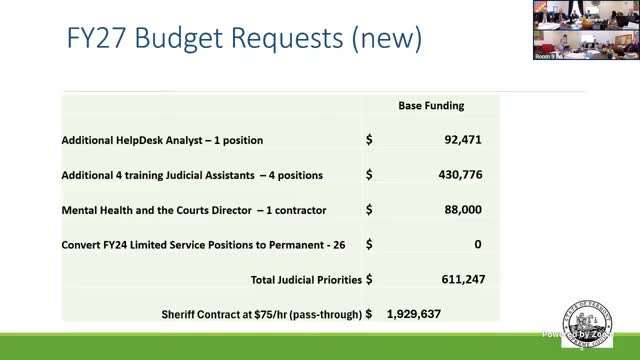
State court financial staff told the House Appropriations Committee on Feb. 3 that court-security costs and staffing have risen sharply, producing operational gaps in some courthouses and creating a budget pressure the governor did not include in the recommended appropriation.
Greg Mosley said sheriff-provided court security rates had risen over recent years: "when I first started pre COVID, we were paying an average of about $30 an hour ... it jumped to 45 ... it's currently at 57" and that the sheriff's associations "came in and are requesting $75 an hour, which is a 31% increase." Mosley said the $75/hour request "probably" explains why that amount did not appear as a 'current service' increase in the governor's recommendation.
Impact on operations: Mosley reported the judiciary started the year with about 40 deputy FTEs assigned to courthouse security and is now down to about 35, with multiple counties having difficulty replacing deputies. He said one courthouse "remains closed, on most days because we don't have the security to screen at the front door," requiring coverage with unarmed court-security staff or private armed guards in some locations.
Mosley emphasized the operational difference between unarmed court-security officers — trained in de-escalation and courtroom procedures — and armed deputies with arrest authority, noting the judiciary seeks at least one law-enforcement 'rover' in buildings where arrests or weapon response may be required. He also described a mixed model used in various counties, including private guards, sheriff rovers, and court staff, and said converting previously limited-term security positions to permanent status is part of the judiciary's personnel request.
The committee did not take a vote on security funding at the hearing. Members asked about whether incidents have worsened when security staff were unarmed; Mosley said he was not aware of worsening outcomes and emphasized staff training and nonlethal equipment for some positions.
Greg Mosley said sheriff-provided court security rates had risen over recent years: "when I first started pre COVID, we were paying an average of about $30 an hour ... it jumped to 45 ... it's currently at 57" and that the sheriff's associations "came in and are requesting $75 an hour, which is a 31% increase." Mosley said the $75/hour request "probably" explains why that amount did not appear as a 'current service' increase in the governor's recommendation.
Impact on operations: Mosley reported the judiciary started the year with about 40 deputy FTEs assigned to courthouse security and is now down to about 35, with multiple counties having difficulty replacing deputies. He said one courthouse "remains closed, on most days because we don't have the security to screen at the front door," requiring coverage with unarmed court-security staff or private armed guards in some locations.
Mosley emphasized the operational difference between unarmed court-security officers — trained in de-escalation and courtroom procedures — and armed deputies with arrest authority, noting the judiciary seeks at least one law-enforcement 'rover' in buildings where arrests or weapon response may be required. He also described a mixed model used in various counties, including private guards, sheriff rovers, and court staff, and said converting previously limited-term security positions to permanent status is part of the judiciary's personnel request.
The committee did not take a vote on security funding at the hearing. Members asked about whether incidents have worsened when security staff were unarmed; Mosley said he was not aware of worsening outcomes and emphasized staff training and nonlethal equipment for some positions.
View the Full Meeting & All Its Details
This article offers just a summary. Unlock complete video, transcripts, and insights as a Founder Member.
✓
Watch full, unedited meeting videos
✓
Search every word spoken in unlimited transcripts
✓
AI summaries & real-time alerts (all government levels)
✓
Permanent access to expanding government content
30-day money-back guarantee
