House subcommittee backs substitute to limit juror exposure to prior convictions
February 04, 2026 | 2026 Legislature VA, Virginia
This article was created by AI summarizing key points discussed. AI makes mistakes, so for full details and context, please refer to the video of the full meeting. Please report any errors so we can fix them. Report an error »
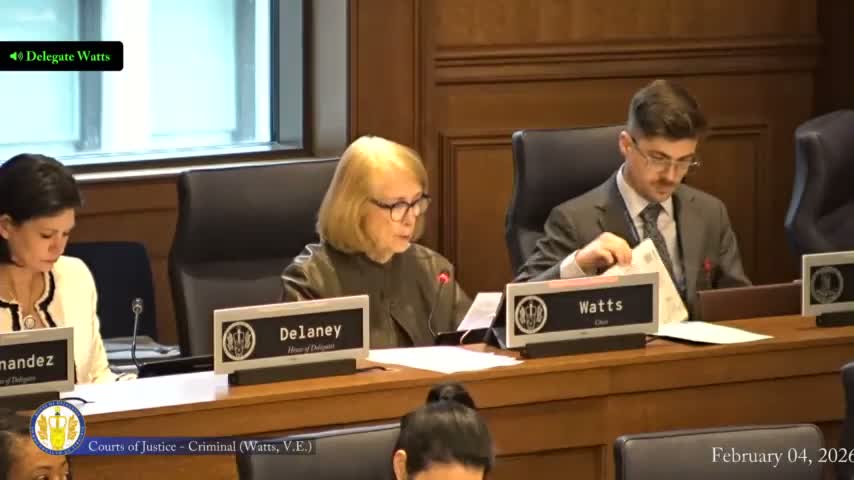
The House Courts Committee’s criminal law subcommittee on Thursday reported a substitute to HB1070 that would change how certified prior convictions are presented at trial, with the committee approving the measure by a 7-3 roll call.
Delegate Rasul, the bill’s patron, told the panel the substitute creates a process where, in many cases, a judge would first determine whether a defendant has the certified priors that enhance an offense and note that finding for the record so the jury would not hear those priors. "This simply says that when we're presenting the information ... if the defendant chooses to, they can forego and waive the portion of their trial that has their prior conviction going to the jury," Rasul said.
Supporters argued the change would reduce juror bias. Brad Haywood of Justice Forward testified online that jurors are more likely to convict when told of prior convictions: "You are most likely to convict. You're more likely to convict if you learn the defendant committed a similar crime in the past," Haywood said, urging support for the substitute.
Opponents, including Bethany Harrison, attorney for the city of Lynchburg speaking for the Virginia Association of Commonwealth's Attorneys (VACA), warned of constitutional and practical problems. Harrison told the subcommittee the Virginia Constitution favors trial by jury and said subsection (a) of the substitute could be vulnerable under Article I, Section 8. She raised concerns that changing indictment language and the process for sealed or sensitive affidavits could cause confusion in practice and lead to suppression or mistrials in some circuits.
Counsel and the patron said the substitute preserves jury roles for guilt-phase elements while assigning to judges the limited task of resolving whether certified priors exist in certain enhancement contexts. Counsel described the change as procedural and noted the substitute leaves sentencing outcomes untouched. On status offenses such as possession by a felon or registry requirements, the substitute relies on stipulations that would be presented to juries under subsection (b).
The subcommittee debate included arguments from a criminal defense perspective and from members concerned about jurors lacking relevant context. After discussion, the subcommittee voted to report the substitute (7 yes, 3 no). The bill will proceed with the substitute language to the next committee stage.
Delegate Rasul, the bill’s patron, told the panel the substitute creates a process where, in many cases, a judge would first determine whether a defendant has the certified priors that enhance an offense and note that finding for the record so the jury would not hear those priors. "This simply says that when we're presenting the information ... if the defendant chooses to, they can forego and waive the portion of their trial that has their prior conviction going to the jury," Rasul said.
Supporters argued the change would reduce juror bias. Brad Haywood of Justice Forward testified online that jurors are more likely to convict when told of prior convictions: "You are most likely to convict. You're more likely to convict if you learn the defendant committed a similar crime in the past," Haywood said, urging support for the substitute.
Opponents, including Bethany Harrison, attorney for the city of Lynchburg speaking for the Virginia Association of Commonwealth's Attorneys (VACA), warned of constitutional and practical problems. Harrison told the subcommittee the Virginia Constitution favors trial by jury and said subsection (a) of the substitute could be vulnerable under Article I, Section 8. She raised concerns that changing indictment language and the process for sealed or sensitive affidavits could cause confusion in practice and lead to suppression or mistrials in some circuits.
Counsel and the patron said the substitute preserves jury roles for guilt-phase elements while assigning to judges the limited task of resolving whether certified priors exist in certain enhancement contexts. Counsel described the change as procedural and noted the substitute leaves sentencing outcomes untouched. On status offenses such as possession by a felon or registry requirements, the substitute relies on stipulations that would be presented to juries under subsection (b).
The subcommittee debate included arguments from a criminal defense perspective and from members concerned about jurors lacking relevant context. After discussion, the subcommittee voted to report the substitute (7 yes, 3 no). The bill will proceed with the substitute language to the next committee stage.
View the Full Meeting & All Its Details
This article offers just a summary. Unlock complete video, transcripts, and insights as a Founder Member.
✓
Watch full, unedited meeting videos
✓
Search every word spoken in unlimited transcripts
✓
AI summaries & real-time alerts (all government levels)
✓
Permanent access to expanding government content
30-day money-back guarantee
