Subcommittee advances bill to align sealed-affidavit rules for residential search warrants
February 04, 2026 | 2026 Legislature VA, Virginia
This article was created by AI summarizing key points discussed. AI makes mistakes, so for full details and context, please refer to the video of the full meeting. Please report any errors so we can fix them. Report an error »
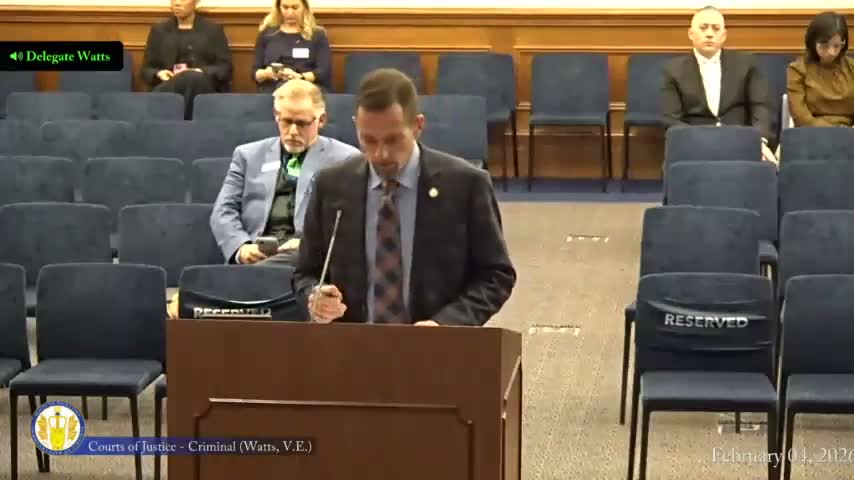
The House criminal law subcommittee moved HB690 with a substitute after testimony that the bill resolves a technical inconsistency in the code on sealed affidavits for residential search warrants.
Sponsor testimony explained the statute requires officers to leave the search warrant and supporting affidavit with the occupant or owner when a warrant is executed. "This legislation would remedy that issue by specifically granting that when an affidavit has been sealed, the affidavit is not required to be provided to the resident of the place to be searched," the patron said, arguing it protects ongoing investigations while preserving the defendant’s right to view the affidavit once the seal is lifted.
Bethany Harrison, Commonwealth’s Attorney for the city of Lynchburg, said her circuit has seen evidence suppressed because judges interpreted subsection B (residential warrants) as lacking an explicit exemption when affidavits are sealed. "Our only remedy here is to ask for an amendment to this code section to make it clear that if we are in the exceptional circumstance of having to apply for a separate order to seal the warrant affidavit that it could be treated the same as subsection a," Harrison said.
Committee discussion focused on the practical circumstances where warrants and sealed affidavits coexist, including ongoing investigations and co-defendant or continuing enterprise cases. After questions and a brief debate, the subcommittee moved and reported the substitute; members were invited to sign on as co-patrons.
The substitute was reported and will move forward for additional committee consideration.
Sponsor testimony explained the statute requires officers to leave the search warrant and supporting affidavit with the occupant or owner when a warrant is executed. "This legislation would remedy that issue by specifically granting that when an affidavit has been sealed, the affidavit is not required to be provided to the resident of the place to be searched," the patron said, arguing it protects ongoing investigations while preserving the defendant’s right to view the affidavit once the seal is lifted.
Bethany Harrison, Commonwealth’s Attorney for the city of Lynchburg, said her circuit has seen evidence suppressed because judges interpreted subsection B (residential warrants) as lacking an explicit exemption when affidavits are sealed. "Our only remedy here is to ask for an amendment to this code section to make it clear that if we are in the exceptional circumstance of having to apply for a separate order to seal the warrant affidavit that it could be treated the same as subsection a," Harrison said.
Committee discussion focused on the practical circumstances where warrants and sealed affidavits coexist, including ongoing investigations and co-defendant or continuing enterprise cases. After questions and a brief debate, the subcommittee moved and reported the substitute; members were invited to sign on as co-patrons.
The substitute was reported and will move forward for additional committee consideration.
Don't Miss a Word: See the Full Meeting!
Go beyond summaries. Unlock every video, transcript, and key insight with a Founder Membership.
✓
Get instant access to full meeting videos
✓
Search and clip any phrase from complete transcripts
✓
Receive AI-powered summaries & custom alerts
✓
Enjoy lifetime, unrestricted access to government data
30-day money-back guarantee
