Virginia subcommittee carries bill on companion chatbots and minors after emotional testimony
February 04, 2026 | 2026 Legislature VA, Virginia
This article was created by AI summarizing key points discussed. AI makes mistakes, so for full details and context, please refer to the video of the full meeting. Please report any errors so we can fix them. Report an error »
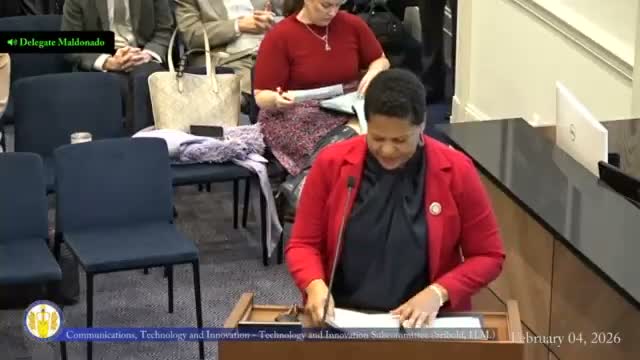
The subcommittee carried HB 635, a bill intended to restrict emotionally immersive AI “companion” chatbots when used by minors, after hours of testimony and policy questions.
Delegate Delia Maldonado introduced HB 635 by citing recent cases in which families say children developed harmful relationships with chatbots; she said the bill “prohibits operators from offering companion chatbots that are capable of encouraging secrecy, isolation, emotional dependency and self harm when used by minors.” The draft also requires operators to provide interventions such as directing users to 988 and forbids training models on a minor’s inputs without parental consent.
Parents, clinicians and advocacy groups urged quick action. Emily Harrison, representing a parents’ coalition, said the timeline for harm can be short: “From the time he started having conversations with chatbots to when he became a victim of suicide was 6 months.” Steve Wimmer of the Transparency Coalition emphasized perceived risks and cited internal platform data reported in testimony.
Industry groups including the Northern Virginia Technology Council and the Chamber of Progress urged more study. Eric Link, speaking for the technology council, warned the bill’s definitions and the inclusion of a private right of action could create compliance burdens for companies and lead to over‑compliance.
Committee members debated enforcement and age verification. Delegate Maldonado said she had vetted the bills with the Attorney General’s office and that the substitute was crafted to fit carve‑outs in the federal AI executive order, while acknowledging differing views about enforcement mechanisms. Given outstanding concerns, the committee voted to carry HB 635 to 2027 and to send a letter to the Joint Commission on Technology and Science (JCOTS) for additional review.
The patron said she remains open to amendments but defended including a limited private right of action to ensure parents have recourse if the Attorney General declines to sue.
The bill will be revised and returned for additional vetting before any floor consideration.
Delegate Delia Maldonado introduced HB 635 by citing recent cases in which families say children developed harmful relationships with chatbots; she said the bill “prohibits operators from offering companion chatbots that are capable of encouraging secrecy, isolation, emotional dependency and self harm when used by minors.” The draft also requires operators to provide interventions such as directing users to 988 and forbids training models on a minor’s inputs without parental consent.
Parents, clinicians and advocacy groups urged quick action. Emily Harrison, representing a parents’ coalition, said the timeline for harm can be short: “From the time he started having conversations with chatbots to when he became a victim of suicide was 6 months.” Steve Wimmer of the Transparency Coalition emphasized perceived risks and cited internal platform data reported in testimony.
Industry groups including the Northern Virginia Technology Council and the Chamber of Progress urged more study. Eric Link, speaking for the technology council, warned the bill’s definitions and the inclusion of a private right of action could create compliance burdens for companies and lead to over‑compliance.
Committee members debated enforcement and age verification. Delegate Maldonado said she had vetted the bills with the Attorney General’s office and that the substitute was crafted to fit carve‑outs in the federal AI executive order, while acknowledging differing views about enforcement mechanisms. Given outstanding concerns, the committee voted to carry HB 635 to 2027 and to send a letter to the Joint Commission on Technology and Science (JCOTS) for additional review.
The patron said she remains open to amendments but defended including a limited private right of action to ensure parents have recourse if the Attorney General declines to sue.
The bill will be revised and returned for additional vetting before any floor consideration.
Don't Miss a Word: See the Full Meeting!
Go beyond summaries. Unlock every video, transcript, and key insight with a Founder Membership.
✓
Get instant access to full meeting videos
✓
Search and clip any phrase from complete transcripts
✓
Receive AI-powered summaries & custom alerts
✓
Enjoy lifetime, unrestricted access to government data
30-day money-back guarantee
