Urbana police urge narrower surveillance definition, warn of heavy oversight workload
February 02, 2026 | Urbana, Champaign County, Illinois
This article was created by AI summarizing key points discussed. AI makes mistakes, so for full details and context, please refer to the video of the full meeting. Please report any errors so we can fix them. Report an error »
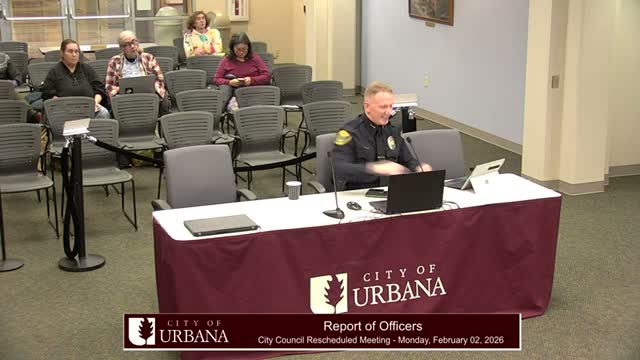
Deputy Chief Mickaloud told the Urbana City Council the city’s draft surveillance ordinance is well intentioned but risks sweeping ordinary police investigative tools into a new oversight regime unless its definitions are tightened. "As written, the current definition of surveillance is functionally limitless," he said, urging the council to focus oversight on technologies that enable automated, persistent or large-scale monitoring rather than routine investigative analysis.
Mickaloud explained an operational distinction that drove his remarks: some systems "observe, record, and generate new data," while others only sort or analyze records the department already holds. He told the council that nationally used law-enforcement databases such as LEADS and NCIC are governed by state and federal law and include training and audit controls; treating those systems as the same kind of "surveillance" the ordinance targets would create redundancy and constitutional concerns. He also said tools used only with judicial authorization should not be regulated the same way as programmatic monitoring.
On exigent circumstances, Mickaloud recommended language that reflects how law enforcement understands urgency — narrowly and time-limited to situations such as a missing person or imminent threat — and argued that authority in those moments typically rests with the chief of police or a designee rather than the mayor. "Adding an executive approval step in a time sensitive situation would slow response and undermine effective incident management," he said.
Mickaloud described the ordinance’s reporting and review obligations as a two-phase workload: a concentrated Phase 1 to inventory and bring existing technologies into compliance and a Phase 2 of ongoing annual reporting and updates. He estimated Phase 1 would require the department’s administrative staff, data analysts and "2 or 3" professional staff to compile inventory and reports, and said the work would not replace existing duties. "It would require at least a full-time position regardless," he said.
Councilmembers pressed for specifics. Grace and Mary Alice said use policies might cover certain investigatory uses (for example borrowing ALPRs or other equipment) while James and others asked whether the ordinance could allow borrowing technology from neighboring agencies for emergencies. Mickaloud said the city’s draft definition was based on several sources, including constitutional law and civil-liberties frameworks, and that the department had drafted proposed definition language intended to move exemptions into upfront criteria.
The presentation underscored points the council will need to decide: where to draw the line between investigative work and programmatic surveillance, who can authorize exigent uses, and how the city will staff and fund ongoing oversight. The council asked the department to share slides, the draft use-policy template and specific technology lists to inform ordinance refinement and future votes. The council did not vote on the ordinance at this meeting; staff and councilmembers agreed to follow up with more specific use policies and draft definition language.
Mickaloud explained an operational distinction that drove his remarks: some systems "observe, record, and generate new data," while others only sort or analyze records the department already holds. He told the council that nationally used law-enforcement databases such as LEADS and NCIC are governed by state and federal law and include training and audit controls; treating those systems as the same kind of "surveillance" the ordinance targets would create redundancy and constitutional concerns. He also said tools used only with judicial authorization should not be regulated the same way as programmatic monitoring.
On exigent circumstances, Mickaloud recommended language that reflects how law enforcement understands urgency — narrowly and time-limited to situations such as a missing person or imminent threat — and argued that authority in those moments typically rests with the chief of police or a designee rather than the mayor. "Adding an executive approval step in a time sensitive situation would slow response and undermine effective incident management," he said.
Mickaloud described the ordinance’s reporting and review obligations as a two-phase workload: a concentrated Phase 1 to inventory and bring existing technologies into compliance and a Phase 2 of ongoing annual reporting and updates. He estimated Phase 1 would require the department’s administrative staff, data analysts and "2 or 3" professional staff to compile inventory and reports, and said the work would not replace existing duties. "It would require at least a full-time position regardless," he said.
Councilmembers pressed for specifics. Grace and Mary Alice said use policies might cover certain investigatory uses (for example borrowing ALPRs or other equipment) while James and others asked whether the ordinance could allow borrowing technology from neighboring agencies for emergencies. Mickaloud said the city’s draft definition was based on several sources, including constitutional law and civil-liberties frameworks, and that the department had drafted proposed definition language intended to move exemptions into upfront criteria.
The presentation underscored points the council will need to decide: where to draw the line between investigative work and programmatic surveillance, who can authorize exigent uses, and how the city will staff and fund ongoing oversight. The council asked the department to share slides, the draft use-policy template and specific technology lists to inform ordinance refinement and future votes. The council did not vote on the ordinance at this meeting; staff and councilmembers agreed to follow up with more specific use policies and draft definition language.
Don't Miss a Word: See the Full Meeting!
Go beyond summaries. Unlock every video, transcript, and key insight with a Founder Membership.
✓
Get instant access to full meeting videos
✓
Search and clip any phrase from complete transcripts
✓
Receive AI-powered summaries & custom alerts
✓
Enjoy lifetime, unrestricted access to government data
30-day money-back guarantee
