State advisory group finalizes methods to flag "inadequate" collection systems based on spills and reporting
February 02, 2026 | State Water Resources Control Board, Agencies under Office of the Governor, Executive, California
This article was created by AI summarizing key points discussed. AI makes mistakes, so for full details and context, please refer to the video of the full meeting. Please report any errors so we can fix them. Report an error »
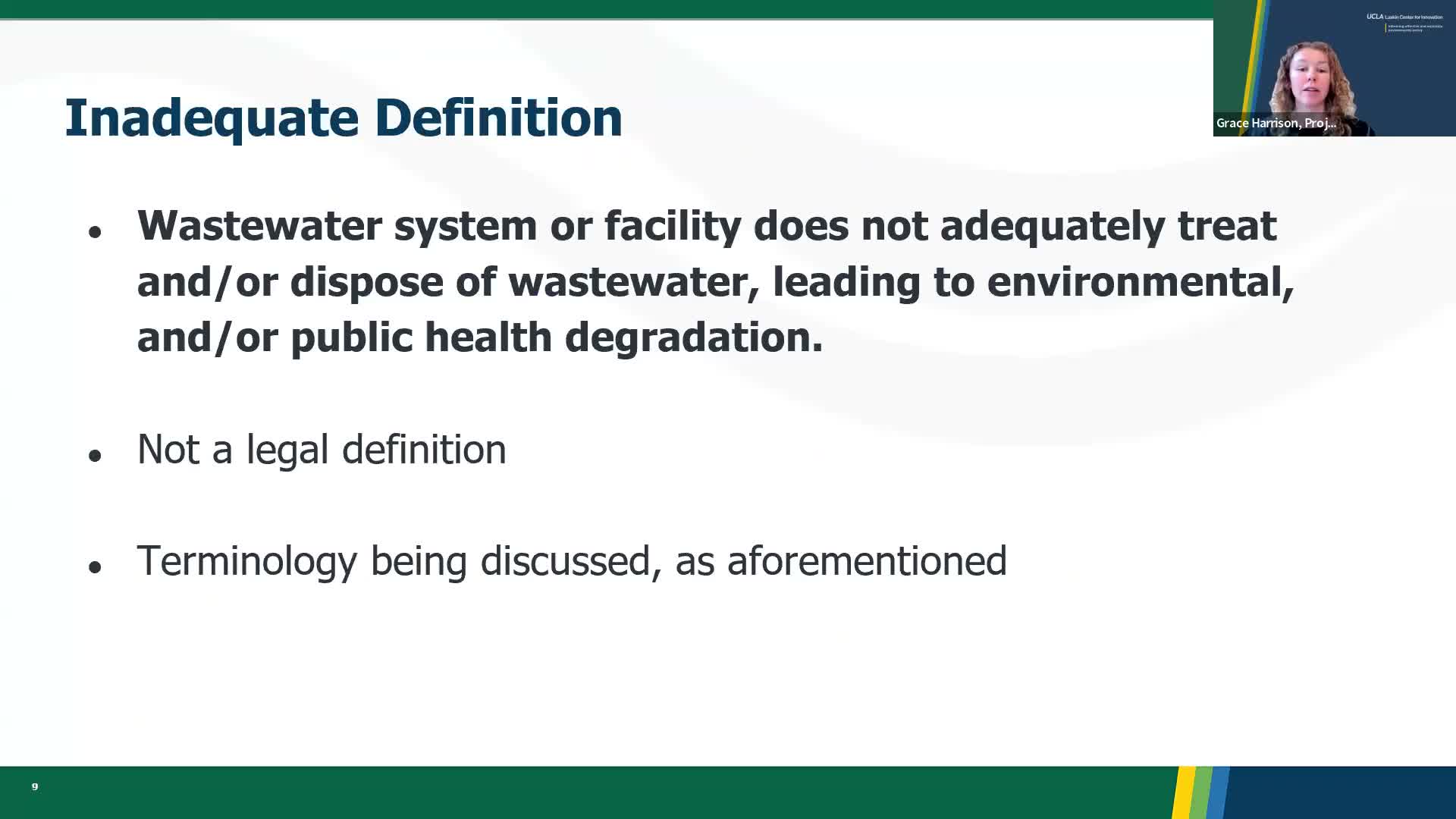
The wastewater needs assessment advisory group heard a detailed explanation of how collection systems will be flagged as "inadequate" for the State Water Resources Control Board's statewide list.
Grace Harrison, a UCLA project manager, said the working definition used in the project is "a wastewater system or facility that does not adequately treat and or dispose of wastewater leading to environmental and or public health degradation," and she emphasized the term is nonlegal and remains under review by the board. "A wastewater system or facility does not adequately treat and or dispose of wastewater leading to environmental and or public health degradation," Harrison said during the meeting.
Why it matters: the inadequate-systems list will be used to prioritize funding, technical assistance and options such as regionalization or infrastructure upgrades; it is not itself a regulatory enforcement action. Harrison said the list and methodology will be shared with regional water boards and with the advisory group prior to potential public release, and that CalEPA review is a required step.
How systems are flagged: the collection-system criteria use two spill-focused metrics and reporting completeness.
- Spill volume per population served: staff calculate five-year and 12-month rolling averages of spill volume per population. Systems that fall in the top 25% on both averages are classified as low performers and thus flagged.
- Spill count per system length: an analogous metric uses spill counts scaled by pipe length (main line only; laterals excluded) with the same five-year and 12-month rolling-average and top-25% rule.
- Reporting gaps: systems that miss required monthly "no-spill" certifications for a full year while also missing annual-report records in the CWICs dataset going back multiple years are flagged, since the combination suggests data or reporting failures that obscure true performance.
Staff emphasized the scaling: "large systems are only being compared to other large systems; small systems are being compared to small systems," Harrison said, to avoid penalizing very small utilities.
Questions and next steps: advisory members asked for worked examples and one-page walkthroughs to illustrate how the two spill metrics identify different system types. Members also raised concerns about whether recent improvements would be captured; staff pointed to the dual rolling averages (12-month and five-year) as a mechanism to balance recent progress against longer-term performance. The project team requested members share facilities of concern so analysts can investigate data anomalies.
The group plans to post working drafts for regional review (two weeks), allow two weeks for project responses, then notify CalEPA before sharing the advisory-group review copies; public release is anticipated midyear, subject to CalEPA timing.
Grace Harrison, a UCLA project manager, said the working definition used in the project is "a wastewater system or facility that does not adequately treat and or dispose of wastewater leading to environmental and or public health degradation," and she emphasized the term is nonlegal and remains under review by the board. "A wastewater system or facility does not adequately treat and or dispose of wastewater leading to environmental and or public health degradation," Harrison said during the meeting.
Why it matters: the inadequate-systems list will be used to prioritize funding, technical assistance and options such as regionalization or infrastructure upgrades; it is not itself a regulatory enforcement action. Harrison said the list and methodology will be shared with regional water boards and with the advisory group prior to potential public release, and that CalEPA review is a required step.
How systems are flagged: the collection-system criteria use two spill-focused metrics and reporting completeness.
- Spill volume per population served: staff calculate five-year and 12-month rolling averages of spill volume per population. Systems that fall in the top 25% on both averages are classified as low performers and thus flagged.
- Spill count per system length: an analogous metric uses spill counts scaled by pipe length (main line only; laterals excluded) with the same five-year and 12-month rolling-average and top-25% rule.
- Reporting gaps: systems that miss required monthly "no-spill" certifications for a full year while also missing annual-report records in the CWICs dataset going back multiple years are flagged, since the combination suggests data or reporting failures that obscure true performance.
Staff emphasized the scaling: "large systems are only being compared to other large systems; small systems are being compared to small systems," Harrison said, to avoid penalizing very small utilities.
Questions and next steps: advisory members asked for worked examples and one-page walkthroughs to illustrate how the two spill metrics identify different system types. Members also raised concerns about whether recent improvements would be captured; staff pointed to the dual rolling averages (12-month and five-year) as a mechanism to balance recent progress against longer-term performance. The project team requested members share facilities of concern so analysts can investigate data anomalies.
The group plans to post working drafts for regional review (two weeks), allow two weeks for project responses, then notify CalEPA before sharing the advisory-group review copies; public release is anticipated midyear, subject to CalEPA timing.
View the Full Meeting & All Its Details
This article offers just a summary. Unlock complete video, transcripts, and insights as a Founder Member.
✓
Watch full, unedited meeting videos
✓
Search every word spoken in unlimited transcripts
✓
AI summaries & real-time alerts (all government levels)
✓
Permanent access to expanding government content
30-day money-back guarantee
