How EPA SNC designations and WDR thresholds feed California's "inadequate" facility list
February 02, 2026 | State Water Resources Control Board, Agencies under Office of the Governor, Executive, California
This article was created by AI summarizing key points discussed. AI makes mistakes, so for full details and context, please refer to the video of the full meeting. Please report any errors so we can fix them. Report an error »
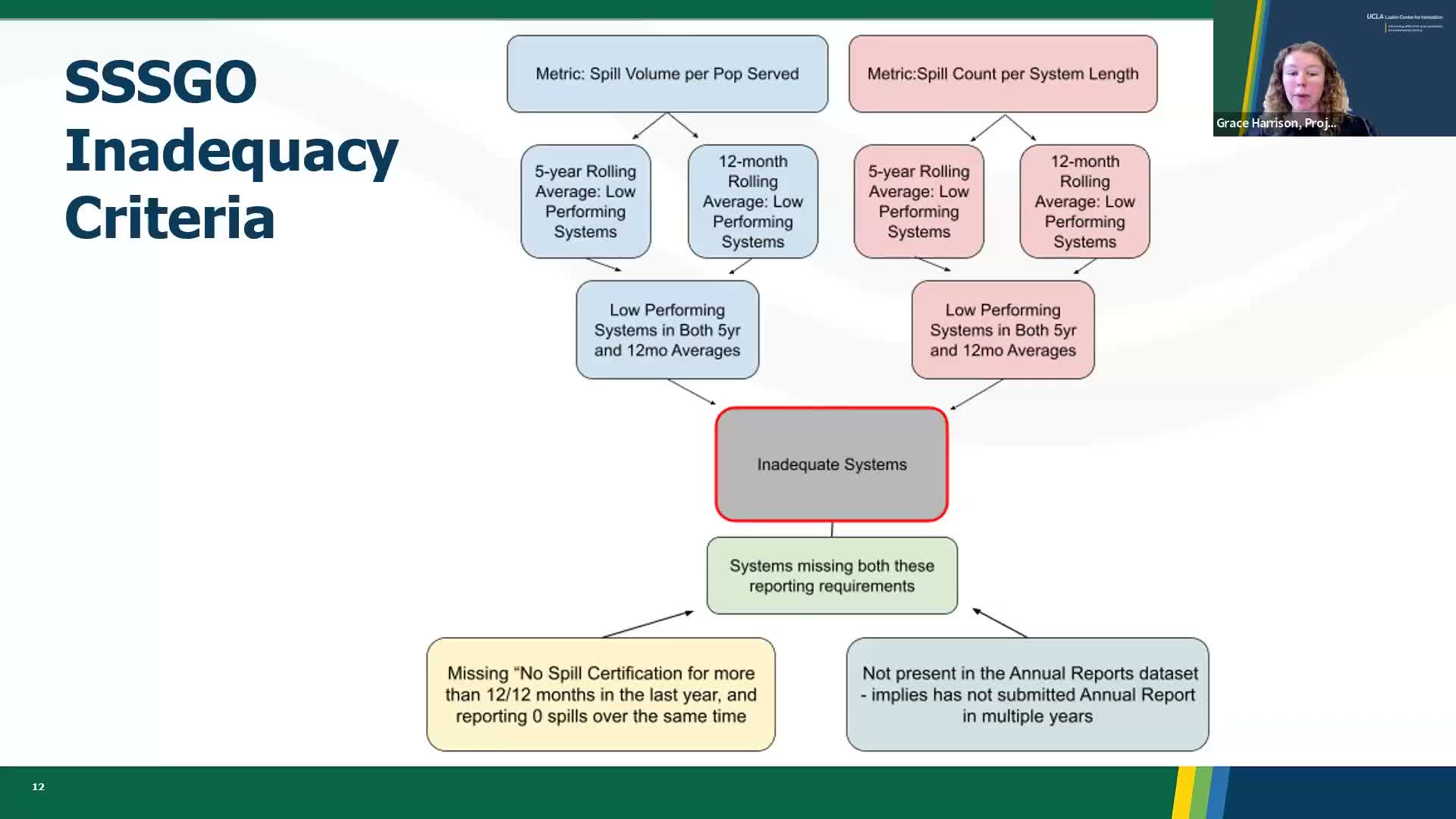
Project analysts told advisory-group members the inadequate-facility methodology builds on existing regulatory designations and staff-recommended thresholds.
Grace Harrison said the NPDS (NPDES) criteria lean on EPA's "significant noncompliance" (SNC) designation: facilities in an active SNC streak (SNC two or more consecutive quarters) are commonly added to the inadequate list, and facilities with a recent SNC plus any prior SNC in the last five years may also be flagged.
For WDR-permitted facilities, Harrison said the inadequacy logic looks at three elements: selected effluent exceedances (percent-of-limit thresholds recommended by water board staff), active enforcement orders (binary presence of an order), and monitoring/reporting (M&R) violations weighted into a score.
Example thresholds and rules explained at the meeting:
- Effluent percent exceedance (example thresholds recommended by staff): nitrogen ' 20% exceedance (two months in a six-month window within the last five years triggers a flag); BOD ' 40% threshold; oil and grease ' 60% threshold. Harrison said staff recommended different thresholds because contaminants vary in significance.
- Enforcement orders: presence of an active enforcement order generally triggers an inadequate flag; for Notices of Violation (NOVs) specific counting rules apply (two or more NOVs in the last five years are used as the threshold).
- Monitoring and reporting: M&R violations are tallied and weighted (weights supplied by staff; e.g., critical=3, medium=2, low=1). Facilities with weighted scores in the top 25% are flagged.
Harrison emphasized that failing one effluent criterion is sufficient to place a facility on the inadequate list and that regional board review will remove facilities where local records indicate problems were remediated or where the inclusion was erroneous.
Members asked technical questions about how repeated violations for the same test are counted and whether missing or deficient reports are distinguished; Harrison and staff said the data do separate late/deficient submissions from fully missing reports and offered to follow up on specific examples.
Grace Harrison said the NPDS (NPDES) criteria lean on EPA's "significant noncompliance" (SNC) designation: facilities in an active SNC streak (SNC two or more consecutive quarters) are commonly added to the inadequate list, and facilities with a recent SNC plus any prior SNC in the last five years may also be flagged.
For WDR-permitted facilities, Harrison said the inadequacy logic looks at three elements: selected effluent exceedances (percent-of-limit thresholds recommended by water board staff), active enforcement orders (binary presence of an order), and monitoring/reporting (M&R) violations weighted into a score.
Example thresholds and rules explained at the meeting:
- Effluent percent exceedance (example thresholds recommended by staff): nitrogen ' 20% exceedance (two months in a six-month window within the last five years triggers a flag); BOD ' 40% threshold; oil and grease ' 60% threshold. Harrison said staff recommended different thresholds because contaminants vary in significance.
- Enforcement orders: presence of an active enforcement order generally triggers an inadequate flag; for Notices of Violation (NOVs) specific counting rules apply (two or more NOVs in the last five years are used as the threshold).
- Monitoring and reporting: M&R violations are tallied and weighted (weights supplied by staff; e.g., critical=3, medium=2, low=1). Facilities with weighted scores in the top 25% are flagged.
Harrison emphasized that failing one effluent criterion is sufficient to place a facility on the inadequate list and that regional board review will remove facilities where local records indicate problems were remediated or where the inclusion was erroneous.
Members asked technical questions about how repeated violations for the same test are counted and whether missing or deficient reports are distinguished; Harrison and staff said the data do separate late/deficient submissions from fully missing reports and offered to follow up on specific examples.
Don't Miss a Word: See the Full Meeting!
Go beyond summaries. Unlock every video, transcript, and key insight with a Founder Membership.
✓
Get instant access to full meeting videos
✓
Search and clip any phrase from complete transcripts
✓
Receive AI-powered summaries & custom alerts
✓
Enjoy lifetime, unrestricted access to government data
30-day money-back guarantee
