Advisory group reviews risk-scoring framework to flag systems that could become inadequate
February 02, 2026 | State Water Resources Control Board, Agencies under Office of the Governor, Executive, California
This article was created by AI summarizing key points discussed. AI makes mistakes, so for full details and context, please refer to the video of the full meeting. Please report any errors so we can fix them. Report an error »
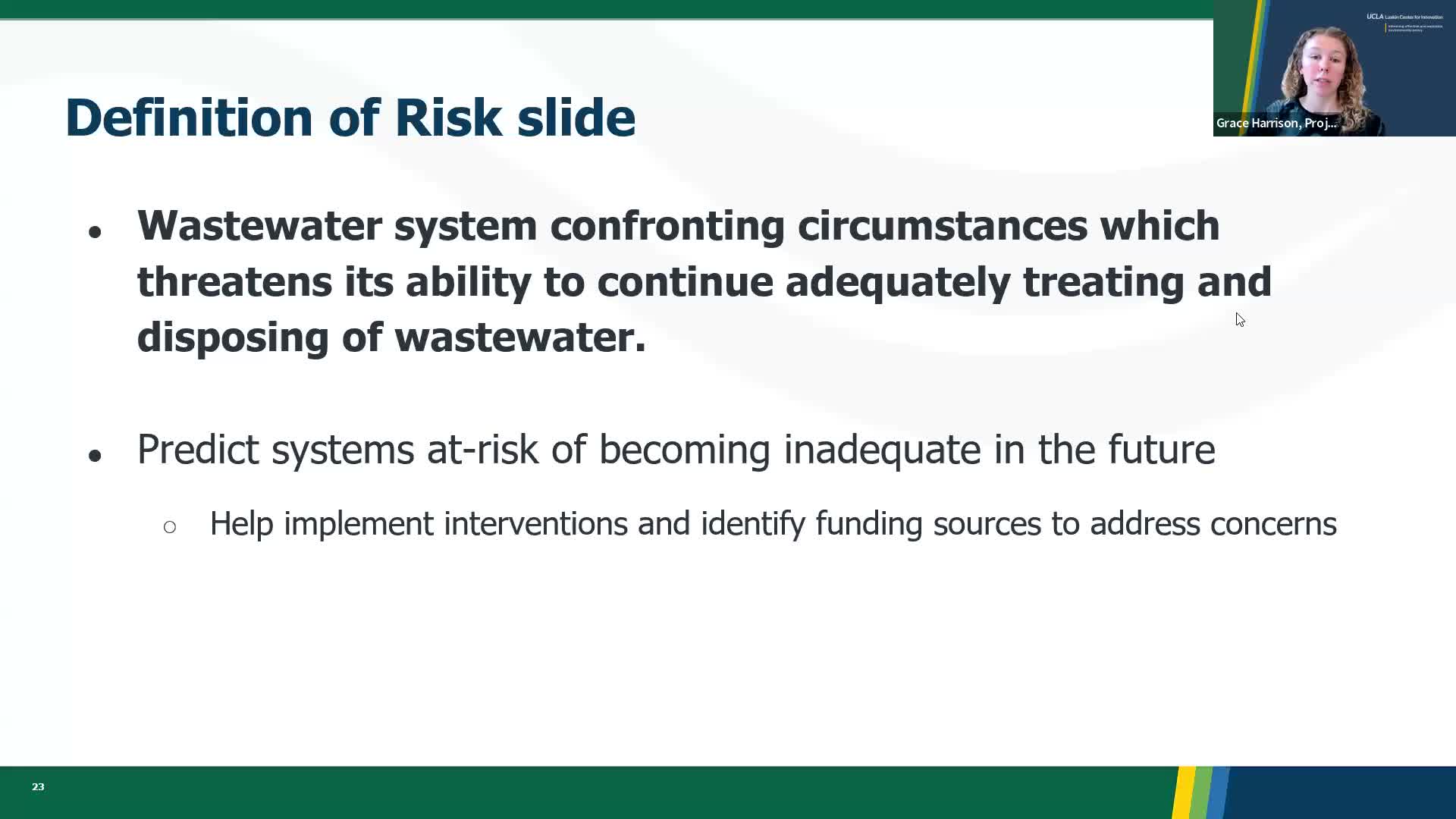
Advisory-group members heard an overview of the project's risk assessment, which is intended to identify wastewater facilities and collection systems at elevated risk of becoming inadequate in the future.
Grace Harrison said the risk assessment compiles many variables, some specific to system types (for example, average flow per capita for collection systems) and some applicable across facility types (e.g., discharge proximity, community socioeconomic attributes). "We're defining risk as the wastewater system or facility confronting circumstances which threatens its ability to continue adequately treating and disposing of wastewater," Harrison said.
Example approach and weights: the framework assigns binary or tiered scores to each variable, multiplies them by staff-recommended weights and sums them into a composite risk score. Harrison presented a flow-based example for collection systems using thresholds (dry-weather average flow per capita such as 120 gallons per capita per day and wet-weather flow such as 275 gpcd) and noted those thresholds were taken from EPA guidance and remain open to technical comment. Other variables include approach-to-discharge-limit (for NPDS facilities), presence of active enforcement orders, discharge to impaired waterbodies, and monitoring/reporting patterns.
Data limitations and process: Harrison and Greg Pierce said many variables have statewide data sources but some variables were intentionally excluded because of poor statewide coverage. The team has identified data sources, is in the process of cleaning and consolidating them, and has not yet run the full analysis; the final cutoff to label a facility "at risk" will be chosen after data distributions are examined.
Member input sought: participants raised issues including how industrial or commercial customers affect per-capita flow metrics, whether peak/peaking factors should be considered, and how to capture pending compliance costs (compliance schedules or new permit limits). Staff said they would accept technical comments and reweight variables if analysis demonstrates issues.
Grace Harrison said the risk assessment compiles many variables, some specific to system types (for example, average flow per capita for collection systems) and some applicable across facility types (e.g., discharge proximity, community socioeconomic attributes). "We're defining risk as the wastewater system or facility confronting circumstances which threatens its ability to continue adequately treating and disposing of wastewater," Harrison said.
Example approach and weights: the framework assigns binary or tiered scores to each variable, multiplies them by staff-recommended weights and sums them into a composite risk score. Harrison presented a flow-based example for collection systems using thresholds (dry-weather average flow per capita such as 120 gallons per capita per day and wet-weather flow such as 275 gpcd) and noted those thresholds were taken from EPA guidance and remain open to technical comment. Other variables include approach-to-discharge-limit (for NPDS facilities), presence of active enforcement orders, discharge to impaired waterbodies, and monitoring/reporting patterns.
Data limitations and process: Harrison and Greg Pierce said many variables have statewide data sources but some variables were intentionally excluded because of poor statewide coverage. The team has identified data sources, is in the process of cleaning and consolidating them, and has not yet run the full analysis; the final cutoff to label a facility "at risk" will be chosen after data distributions are examined.
Member input sought: participants raised issues including how industrial or commercial customers affect per-capita flow metrics, whether peak/peaking factors should be considered, and how to capture pending compliance costs (compliance schedules or new permit limits). Staff said they would accept technical comments and reweight variables if analysis demonstrates issues.
Don't Miss a Word: See the Full Meeting!
Go beyond summaries. Unlock every video, transcript, and key insight with a Founder Membership.
✓
Get instant access to full meeting videos
✓
Search and clip any phrase from complete transcripts
✓
Receive AI-powered summaries & custom alerts
✓
Enjoy lifetime, unrestricted access to government data
30-day money-back guarantee
