West Chester planning commission flags PennDOT-driven street standards, seeks targeted zoning fixes
February 03, 2026 | West Chester, Chester County, Pennsylvania
This article was created by AI summarizing key points discussed. AI makes mistakes, so for full details and context, please refer to the video of the full meeting. Please report any errors so we can fix them. Report an error »
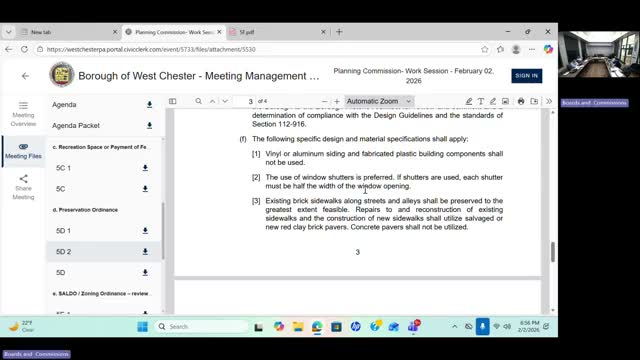
The West Chester Planning Commission on Feb. 2 reviewed a series of proposed zoning and design-code changes and asked staff to prepare a limited, actionable package of amendments that would reconcile the borough's historic street patterns with new unified residential development standards.
Commissioners and staff spent the meeting highlighting technical inconsistencies that could make desirable, walkable projects nonconforming under the proposed language. A central concern was a newly inserted measurement in a draft design standard requiring a minimum distance between exterior walls of buildings — described in the meeting as 15 feet — which several commissioners said should be removed or handled as a discretionary guideline rather than mandatory code.
"I would definitely strongly encourage us to strike that one," a commission member said of the exterior-wall spacing requirement, arguing the dimension read like a construction code and was inappropriate for zoning text. Commissioners also pointed out conflicting alley and right-of-way standards: the design guidelines discuss alleys with cartway widths as small as 12–16 feet for unified developments, while other code sections and referenced diagrams list minimum right-of-way widths as high as 50 feet.
The discussion broadened into street geometry and safety, with commissioners noting that the draft carries a "minimum paving radius of 25 feet at all street intersections," language copied from higher-level engineering guidance that, if enforced literally, would render many historic blocks nonconforming. "This language is copy-pasted from PennDOT/National engineering requirements," one presenter said. "We can be confident pushing back on that so it doesn't make most of our historic streets nonconforming."
Commissioners asked staff and consultants (identified in the meeting as Tom/Thomas and others working on the unified-residential materials) to prepare a short list of changes that could be combined in one amendment package rather than a series of piecemeal edits. The commission agreed to treat version 5d2 of the draft as the working document and to route specific amendment language for legal and consultant review before the next voting session.
The commission also discussed practical design solutions that would preserve walkability while accommodating emergency access and pedestrian safety, such as mountable curbs, cobbled radii and narrower cartways for traditional-neighborhood streets. Several members recommended early coordination with PennDOT for any segment the state controls.
Next steps: staff will consolidate the commission's prioritized list of edits, produce redline language or amendment instructions for consultants, and circulate the 5d2 working draft for review at the next meeting. The commission did not take a formal vote at the Feb. 2 work session.
Commissioners and staff spent the meeting highlighting technical inconsistencies that could make desirable, walkable projects nonconforming under the proposed language. A central concern was a newly inserted measurement in a draft design standard requiring a minimum distance between exterior walls of buildings — described in the meeting as 15 feet — which several commissioners said should be removed or handled as a discretionary guideline rather than mandatory code.
"I would definitely strongly encourage us to strike that one," a commission member said of the exterior-wall spacing requirement, arguing the dimension read like a construction code and was inappropriate for zoning text. Commissioners also pointed out conflicting alley and right-of-way standards: the design guidelines discuss alleys with cartway widths as small as 12–16 feet for unified developments, while other code sections and referenced diagrams list minimum right-of-way widths as high as 50 feet.
The discussion broadened into street geometry and safety, with commissioners noting that the draft carries a "minimum paving radius of 25 feet at all street intersections," language copied from higher-level engineering guidance that, if enforced literally, would render many historic blocks nonconforming. "This language is copy-pasted from PennDOT/National engineering requirements," one presenter said. "We can be confident pushing back on that so it doesn't make most of our historic streets nonconforming."
Commissioners asked staff and consultants (identified in the meeting as Tom/Thomas and others working on the unified-residential materials) to prepare a short list of changes that could be combined in one amendment package rather than a series of piecemeal edits. The commission agreed to treat version 5d2 of the draft as the working document and to route specific amendment language for legal and consultant review before the next voting session.
The commission also discussed practical design solutions that would preserve walkability while accommodating emergency access and pedestrian safety, such as mountable curbs, cobbled radii and narrower cartways for traditional-neighborhood streets. Several members recommended early coordination with PennDOT for any segment the state controls.
Next steps: staff will consolidate the commission's prioritized list of edits, produce redline language or amendment instructions for consultants, and circulate the 5d2 working draft for review at the next meeting. The commission did not take a formal vote at the Feb. 2 work session.
View the Full Meeting & All Its Details
This article offers just a summary. Unlock complete video, transcripts, and insights as a Founder Member.
✓
Watch full, unedited meeting videos
✓
Search every word spoken in unlimited transcripts
✓
AI summaries & real-time alerts (all government levels)
✓
Permanent access to expanding government content
30-day money-back guarantee
