JLBC: HR 1 expands SNAP work rules, shifts admin costs and could expose state to benefit-share liability
February 02, 2026 | 2026 Legislature Arizona, Arizona
This article was created by AI summarizing key points discussed. AI makes mistakes, so for full details and context, please refer to the video of the full meeting. Please report any errors so we can fix them. Report an error »
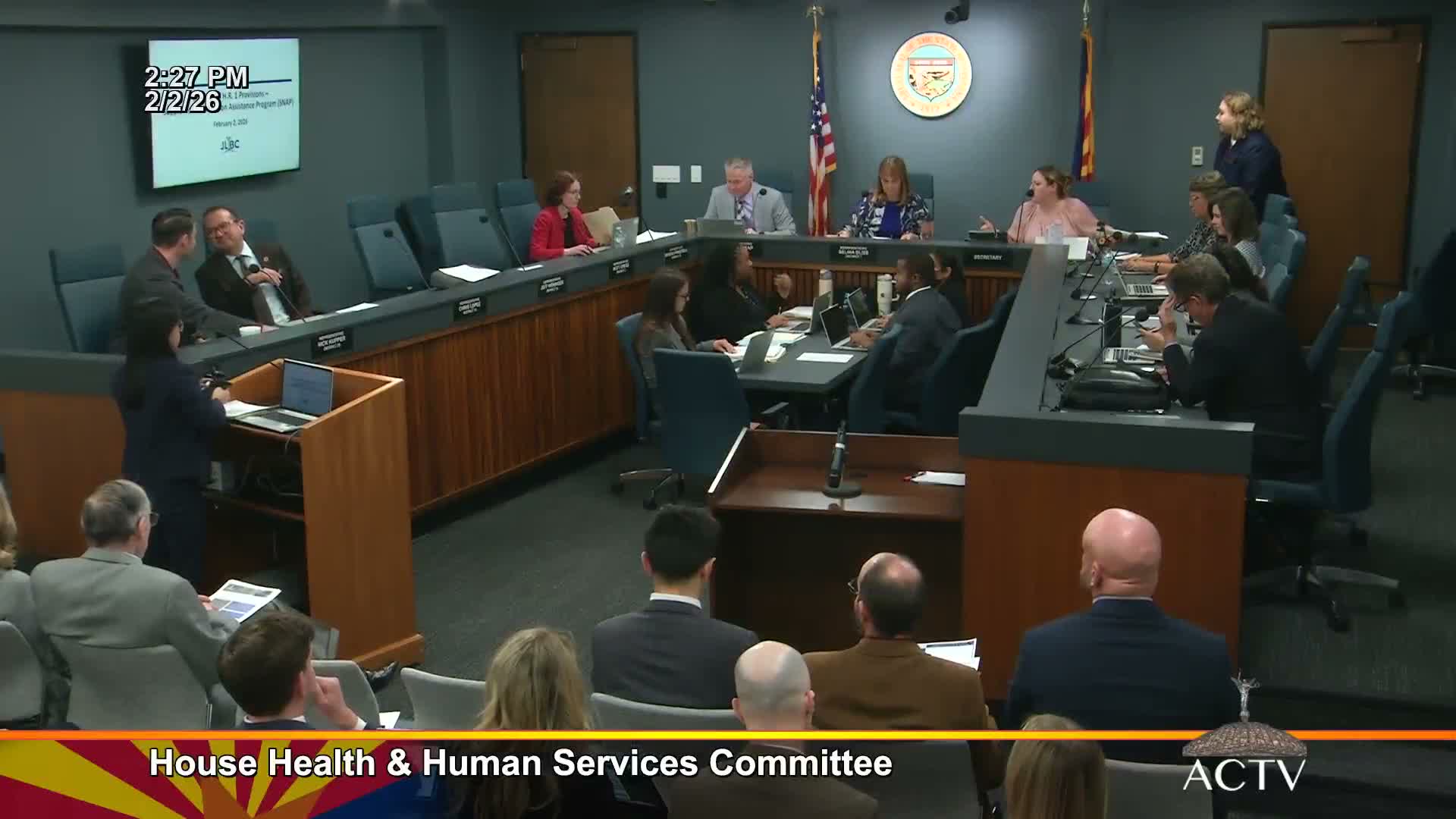
Grace Timpani of the Joint Legislative Budget Committee told the Health and Human Services Committee that HR 1 (the recent federal omnibus of SNAP reforms) would expand who is subject to SNAP work requirements and change several administrative cost formulas, creating potential state fiscal exposure.
Timpani said the bill expands work requirements by increasing the upper age limit of able-bodied adults without dependents from 54 to 64 and by altering how adults with dependents are counted in some instances. She also told the committee that the federal-state split of administrative costs for SNAP would shift under HR 1, raising the state share from 50% to 75% beginning in FY2027; JLBC estimated that change would cost about $32.7 million in FY2027 and roughly $44 million in FY2028.
The JLBC analyst noted a separate HR 1 provision that would require a state to pay a share of actual SNAP benefits when a state's payment error rate exceeds federal thresholds. Using Arizona’s FY2024 Quality Control error rate (8.8%) as a baseline, JLBC estimated the state could face an approximately $139 million payment obligation in FY2028 under HR 1’s formulas, though the final FY2028 obligation depends on the FY2025–26 published error rates.
Timpani also said SNAP caseload in Arizona had declined about 30% since August, and that continuing caseload changes would materially affect benefit costs independent of HR 1. Committee members used the presentation to press on administrative capacity, whether federal grants are available to assist implementation, and the extent to which state staffing or technology investments could reduce the error rate.
What happens next: JLBC’s fiscal points framed a steady line of bills the committee considered that day—several aimed at reducing the error rate, tightening data matching and verification, limiting state waiver authority, and funding administrative work—each of which received sponsor explanations, public testimony, and committee votes.
Timpani said the bill expands work requirements by increasing the upper age limit of able-bodied adults without dependents from 54 to 64 and by altering how adults with dependents are counted in some instances. She also told the committee that the federal-state split of administrative costs for SNAP would shift under HR 1, raising the state share from 50% to 75% beginning in FY2027; JLBC estimated that change would cost about $32.7 million in FY2027 and roughly $44 million in FY2028.
The JLBC analyst noted a separate HR 1 provision that would require a state to pay a share of actual SNAP benefits when a state's payment error rate exceeds federal thresholds. Using Arizona’s FY2024 Quality Control error rate (8.8%) as a baseline, JLBC estimated the state could face an approximately $139 million payment obligation in FY2028 under HR 1’s formulas, though the final FY2028 obligation depends on the FY2025–26 published error rates.
Timpani also said SNAP caseload in Arizona had declined about 30% since August, and that continuing caseload changes would materially affect benefit costs independent of HR 1. Committee members used the presentation to press on administrative capacity, whether federal grants are available to assist implementation, and the extent to which state staffing or technology investments could reduce the error rate.
What happens next: JLBC’s fiscal points framed a steady line of bills the committee considered that day—several aimed at reducing the error rate, tightening data matching and verification, limiting state waiver authority, and funding administrative work—each of which received sponsor explanations, public testimony, and committee votes.
View the Full Meeting & All Its Details
This article offers just a summary. Unlock complete video, transcripts, and insights as a Founder Member.
✓
Watch full, unedited meeting videos
✓
Search every word spoken in unlimited transcripts
✓
AI summaries & real-time alerts (all government levels)
✓
Permanent access to expanding government content
30-day money-back guarantee
