Finance Committee clears multiple tax, pension and technical bills
February 02, 2026 | 2026 Legislature Arizona, Arizona
This article was created by AI summarizing key points discussed. AI makes mistakes, so for full details and context, please refer to the video of the full meeting. Please report any errors so we can fix them. Report an error »
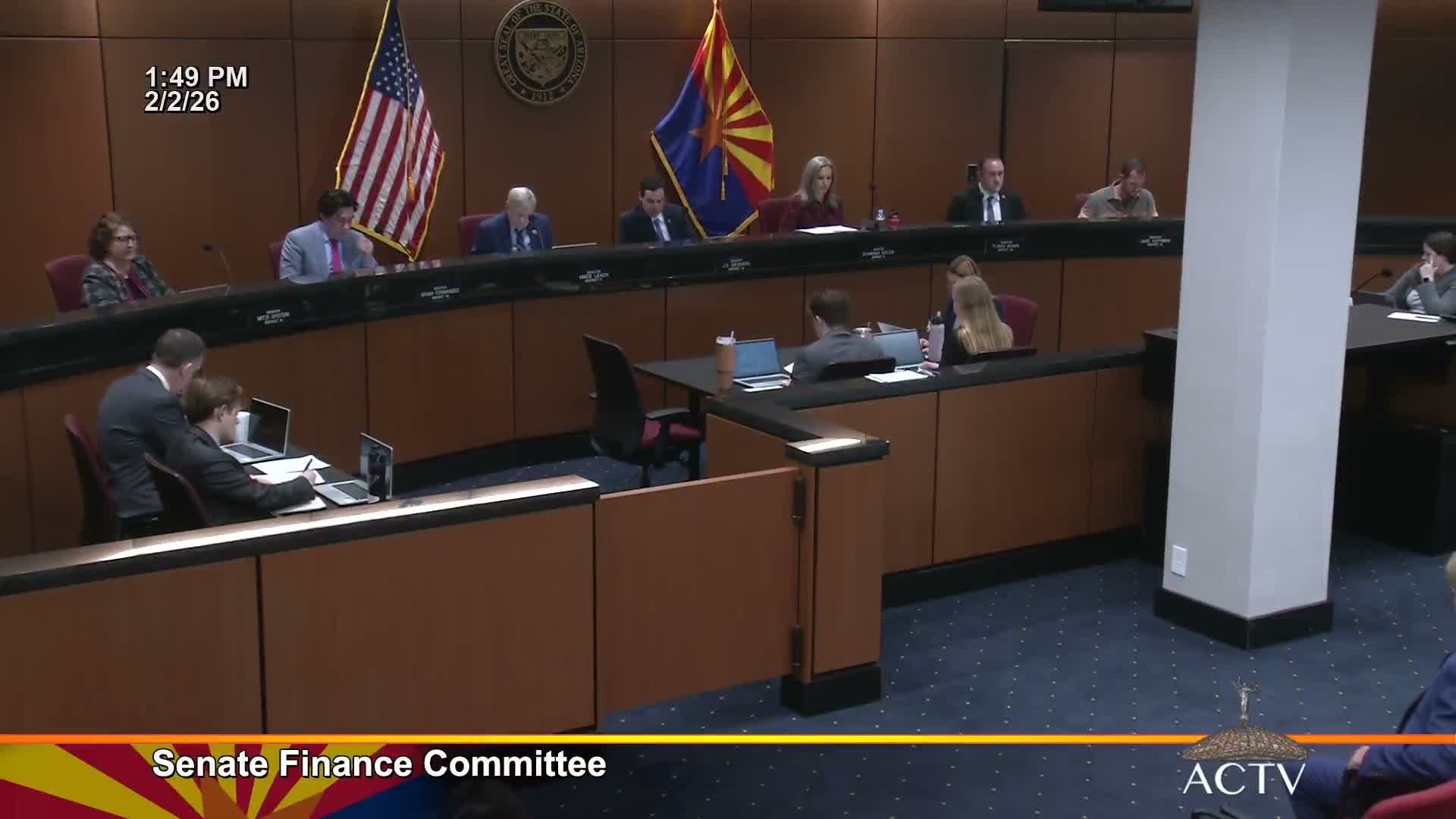
The Senate Finance Committee moved several technical or noncontroversial bills forward in a single hearing session.
SB 11‑80 would codify the Department of Revenue's long‑standing practice of assuming federal 'above‑the‑line' adjustments that affect federal adjusted gross income will be conformed into state forms; Molly Murphy of DOR testified the bill largely codifies practice and would not have prevented recent changes made by executive order. The committee returned SB 11‑80 with a do‑pass recommendation (roll call recorded as unanimous in committee discussion).
SB 12‑92 clarifies that PSPRS' prohibition on owning more than 5% of the voting stock of any one corporation applies only to publicly traded corporations, a change intended to avoid costly forced divestures when investment funds are wound down. Diane McAllister (PSPRS) described examples where shareholders received in‑kind asset distributions that temporarily raised ownership shares absent ill intent; the committee approved the bill unanimously.
SB 12‑94 restores county assessors' authority (retroactive to 09/14/2024) to prorate property value for properties destroyed 'in any manner' and retains prior policy that only properties destroyed by verifiable accident may retain classification for up to five years; Jennifer Stilo of the Arizona Tax Research Association supported the bill as consistent with prior legislative intent.
SB 14‑30, the annual tax corrections act, was presented by DOR staff as containing a small set of technical fixes (redundant language removal, cross‑reference correction, codification of practice) and was approved by the committee.
SB 12‑70 allows employers participating in the Corrections Officer Retirement Plan to make optional supplemental contributions (up to $5,000 per member) for Tier 3 members as a retention incentive. The bill drew more discussion than the other items but passed the committee 6–1; sponsors and FOP representatives framed the change as optional and targeted to recruiting/retention needs.
Each bill passed or received a do‑pass recommendation in committee and will proceed to the Senate calendar per usual legislative procedure.
SB 11‑80 would codify the Department of Revenue's long‑standing practice of assuming federal 'above‑the‑line' adjustments that affect federal adjusted gross income will be conformed into state forms; Molly Murphy of DOR testified the bill largely codifies practice and would not have prevented recent changes made by executive order. The committee returned SB 11‑80 with a do‑pass recommendation (roll call recorded as unanimous in committee discussion).
SB 12‑92 clarifies that PSPRS' prohibition on owning more than 5% of the voting stock of any one corporation applies only to publicly traded corporations, a change intended to avoid costly forced divestures when investment funds are wound down. Diane McAllister (PSPRS) described examples where shareholders received in‑kind asset distributions that temporarily raised ownership shares absent ill intent; the committee approved the bill unanimously.
SB 12‑94 restores county assessors' authority (retroactive to 09/14/2024) to prorate property value for properties destroyed 'in any manner' and retains prior policy that only properties destroyed by verifiable accident may retain classification for up to five years; Jennifer Stilo of the Arizona Tax Research Association supported the bill as consistent with prior legislative intent.
SB 14‑30, the annual tax corrections act, was presented by DOR staff as containing a small set of technical fixes (redundant language removal, cross‑reference correction, codification of practice) and was approved by the committee.
SB 12‑70 allows employers participating in the Corrections Officer Retirement Plan to make optional supplemental contributions (up to $5,000 per member) for Tier 3 members as a retention incentive. The bill drew more discussion than the other items but passed the committee 6–1; sponsors and FOP representatives framed the change as optional and targeted to recruiting/retention needs.
Each bill passed or received a do‑pass recommendation in committee and will proceed to the Senate calendar per usual legislative procedure.
Don't Miss a Word: See the Full Meeting!
Go beyond summaries. Unlock every video, transcript, and key insight with a Founder Membership.
✓
Get instant access to full meeting videos
✓
Search and clip any phrase from complete transcripts
✓
Receive AI-powered summaries & custom alerts
✓
Enjoy lifetime, unrestricted access to government data
30-day money-back guarantee
