Air Quality division reports monitoring and permitting gains, flags ozone challenge linked to summertime heat and transport
February 03, 2026 | 2026 Utah Legislature, Utah Legislature, Utah Legislative Branch, Utah
This article was created by AI summarizing key points discussed. AI makes mistakes, so for full details and context, please refer to the video of the full meeting. Please report any errors so we can fix them. Report an error »
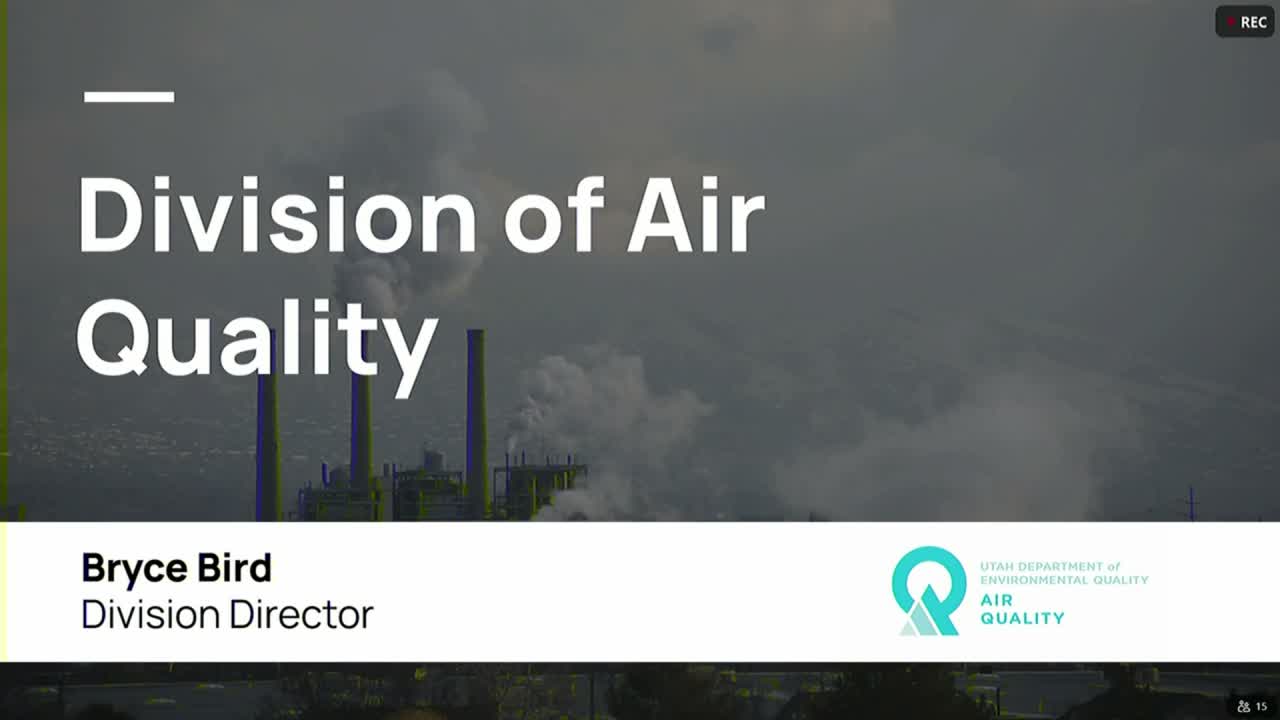
Bryce Bird, director of the Utah Division of Air Quality, briefed legislators on monitoring, permitting and compliance work and outlined next steps to address summertime ozone and dust from the West Desert.
Bird said the division meets key EPA data quality goals — "we have 99% of our air quality data that meets that completeness and quality assurance requirements" — and reported a PM2.5 design value on the Wasatch Front that is roughly half what it was 25 years ago. The division’s permit average is under 131 days and it issues 87% of permits within 180 days. On compliance metrics, Bird reported a 91.5% compliance rate for inspected sources.
Bird told the committee that progress on ozone has flattened in recent years, and hotter drier summers combined with increased transported emissions make local progress harder. He described a 179B demonstration (Clean Air Act provision) used to model how much ozone precursor emissions arrive from outside the region; the demonstration found roughly 10% of summertime ozone‑forming emissions originate from international sources. Bird said EPA was expected to publish approval of that demonstration for public comment imminently.
The division is building a dust‑monitoring network (legislative funds and Great Salt Lake Commission support) to better understand emissions from the Great Salt Lake and West Desert, and Bird said the program has installed six focus monitors so far. Bird also outlined technical controls under consideration to reduce reactive volatile organic compounds — paints, solvents and gasoline emissions — and said the division will pursue regulatory, industry and outreach approaches to meet Clean Air Act obligations.
Bird urged that members consult the division’s annual report and offered staff support for forthcoming bills, including work on ozone state implementation plans and regional haze and sulfur dioxide planning. Committee members asked clarifying questions about statewide versus Salt Lake Valley metrics; Bird said the PM2.5 figures he cited were for the Salt Lake Valley, the state’s worst air‑quality area.
Bird said the division meets key EPA data quality goals — "we have 99% of our air quality data that meets that completeness and quality assurance requirements" — and reported a PM2.5 design value on the Wasatch Front that is roughly half what it was 25 years ago. The division’s permit average is under 131 days and it issues 87% of permits within 180 days. On compliance metrics, Bird reported a 91.5% compliance rate for inspected sources.
Bird told the committee that progress on ozone has flattened in recent years, and hotter drier summers combined with increased transported emissions make local progress harder. He described a 179B demonstration (Clean Air Act provision) used to model how much ozone precursor emissions arrive from outside the region; the demonstration found roughly 10% of summertime ozone‑forming emissions originate from international sources. Bird said EPA was expected to publish approval of that demonstration for public comment imminently.
The division is building a dust‑monitoring network (legislative funds and Great Salt Lake Commission support) to better understand emissions from the Great Salt Lake and West Desert, and Bird said the program has installed six focus monitors so far. Bird also outlined technical controls under consideration to reduce reactive volatile organic compounds — paints, solvents and gasoline emissions — and said the division will pursue regulatory, industry and outreach approaches to meet Clean Air Act obligations.
Bird urged that members consult the division’s annual report and offered staff support for forthcoming bills, including work on ozone state implementation plans and regional haze and sulfur dioxide planning. Committee members asked clarifying questions about statewide versus Salt Lake Valley metrics; Bird said the PM2.5 figures he cited were for the Salt Lake Valley, the state’s worst air‑quality area.
Don't Miss a Word: See the Full Meeting!
Go beyond summaries. Unlock every video, transcript, and key insight with a Founder Membership.
✓
Get instant access to full meeting videos
✓
Search and clip any phrase from complete transcripts
✓
Receive AI-powered summaries & custom alerts
✓
Enjoy lifetime, unrestricted access to government data
30-day money-back guarantee
