WSAC says Washington Completes FAFSA campaign showing early gains; launches toolkit and dashboard
February 02, 2026 | Legislative Sessions, Washington
This article was created by AI summarizing key points discussed. AI makes mistakes, so for full details and context, please refer to the video of the full meeting. Please report any errors so we can fix them. Report an error »
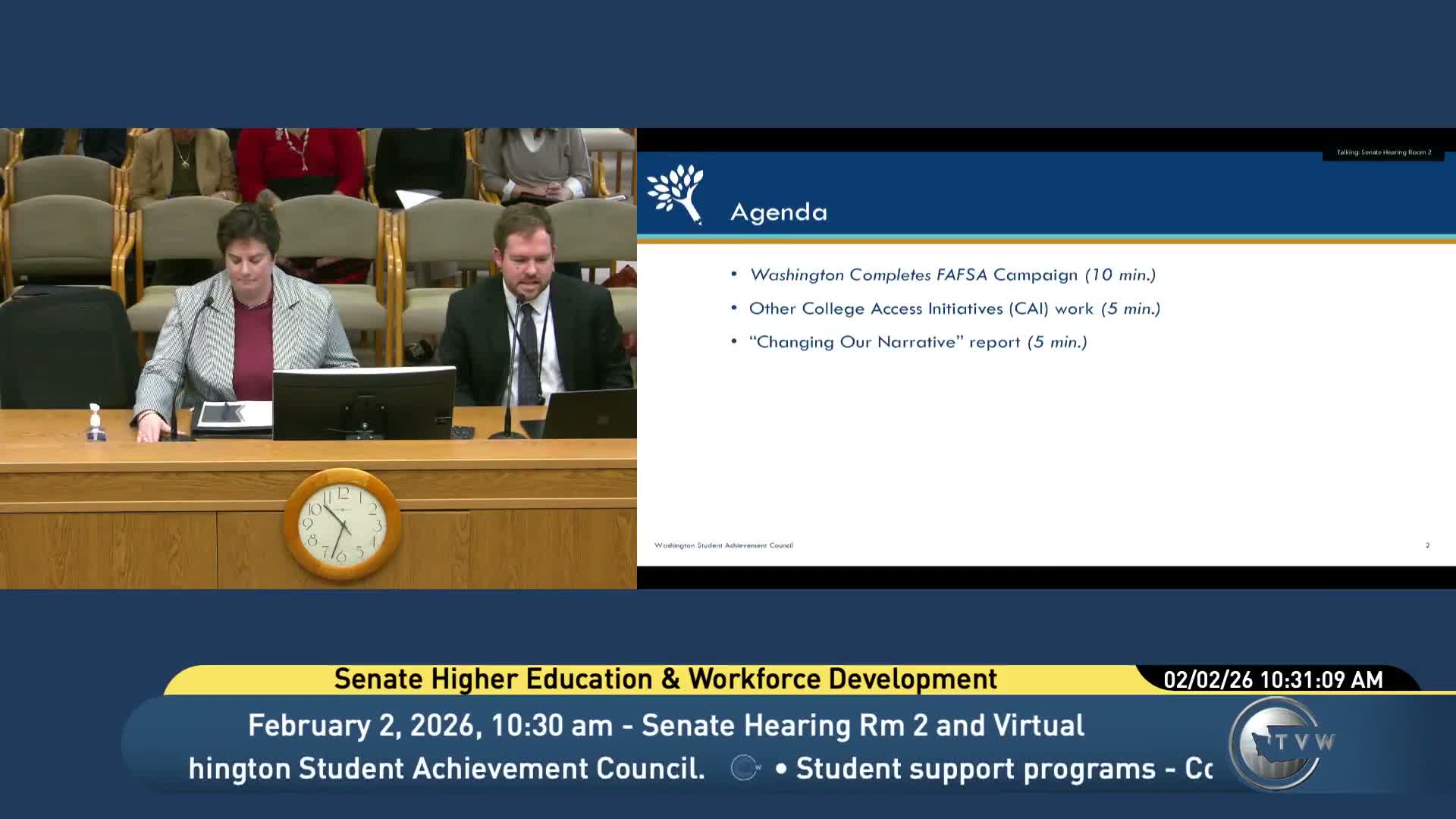
The Washington Student Achievement Council told the Senate Higher Education and Workforce Development Committee that the Washington Completes FAFSA campaign is making early progress toward statewide goals.
Joel Anderson, associate director for legislative and external affairs at the Washington Student Achievement Council, said the campaign was established by Executive Order 2508 on Sept. 19 and that an advisory board of 14 members—students, K–12 counselors, superintendents, state agencies, higher-education and philanthropic representatives—will guide targeted outreach during the academic year. "The board meets every month, every third Tuesday from 2 to 4 p.m.," Anderson said.
Sarah Wise, director of college access initiatives at the council, said WSAC set a goal of 46,000 seniors completing a financial-aid application this year and described a three-part strategy—system alignment, high-impact support to schools, and relying on trusted messengers such as counselors and teachers. "As of January, we are seeing a 35% year-over-year increase," Wise told senators, adding WSAC is “two-thirds of the way” toward its FAFSA/WASFA completion goal so far this year.
Wise said WSAC has rolled out a public dashboard (updated weekly) that shows district- and subgroup-level filing rates, highlights overperforming and underperforming districts, and supports outreach planning. On the equity front, she said the council aims for at least 150 high schools to achieve a 6 percentage-point increase in FAFSA/WASFA completion among students eligible for free or reduced-price lunch.
Committee members asked for absolute student counts underlying the percentages; Wise provided completion rates (roughly 30% for free-and-reduced-price-lunch–eligible students and 37% for others) and said she would follow up with the specific population totals.
Anderson also described the Lumina Foundation–funded "Changing the Narrative" project, led by WSAC with Central Washington University and Sandbox Inc., that produced a College Toolkit website and short-format video content. He said early findings favored messaging that highlights multiple postsecondary pathways and uses relatable, diverse messengers.
The council noted other outreach tools including OtterBot, an AI-enabled texting platform WSAC uses to answer students' questions; WSAC staff said nearly 200,000 students and parents are currently enrolled in that service and the agency is piloting locally branded, school-specific chatbots to test engagement.
The presentation concluded with WSAC offering to provide committee members additional district-level counts and to share links to the dashboard and toolkit.
Joel Anderson, associate director for legislative and external affairs at the Washington Student Achievement Council, said the campaign was established by Executive Order 2508 on Sept. 19 and that an advisory board of 14 members—students, K–12 counselors, superintendents, state agencies, higher-education and philanthropic representatives—will guide targeted outreach during the academic year. "The board meets every month, every third Tuesday from 2 to 4 p.m.," Anderson said.
Sarah Wise, director of college access initiatives at the council, said WSAC set a goal of 46,000 seniors completing a financial-aid application this year and described a three-part strategy—system alignment, high-impact support to schools, and relying on trusted messengers such as counselors and teachers. "As of January, we are seeing a 35% year-over-year increase," Wise told senators, adding WSAC is “two-thirds of the way” toward its FAFSA/WASFA completion goal so far this year.
Wise said WSAC has rolled out a public dashboard (updated weekly) that shows district- and subgroup-level filing rates, highlights overperforming and underperforming districts, and supports outreach planning. On the equity front, she said the council aims for at least 150 high schools to achieve a 6 percentage-point increase in FAFSA/WASFA completion among students eligible for free or reduced-price lunch.
Committee members asked for absolute student counts underlying the percentages; Wise provided completion rates (roughly 30% for free-and-reduced-price-lunch–eligible students and 37% for others) and said she would follow up with the specific population totals.
Anderson also described the Lumina Foundation–funded "Changing the Narrative" project, led by WSAC with Central Washington University and Sandbox Inc., that produced a College Toolkit website and short-format video content. He said early findings favored messaging that highlights multiple postsecondary pathways and uses relatable, diverse messengers.
The council noted other outreach tools including OtterBot, an AI-enabled texting platform WSAC uses to answer students' questions; WSAC staff said nearly 200,000 students and parents are currently enrolled in that service and the agency is piloting locally branded, school-specific chatbots to test engagement.
The presentation concluded with WSAC offering to provide committee members additional district-level counts and to share links to the dashboard and toolkit.
View the Full Meeting & All Its Details
This article offers just a summary. Unlock complete video, transcripts, and insights as a Founder Member.
✓
Watch full, unedited meeting videos
✓
Search every word spoken in unlimited transcripts
✓
AI summaries & real-time alerts (all government levels)
✓
Permanent access to expanding government content
30-day money-back guarantee
