Committee hears bill to remove spring blade knives from 'dangerous weapons' list
February 02, 2026 | Legislative Sessions, Washington
This article was created by AI summarizing key points discussed. AI makes mistakes, so for full details and context, please refer to the video of the full meeting. Please report any errors so we can fix them. Report an error »
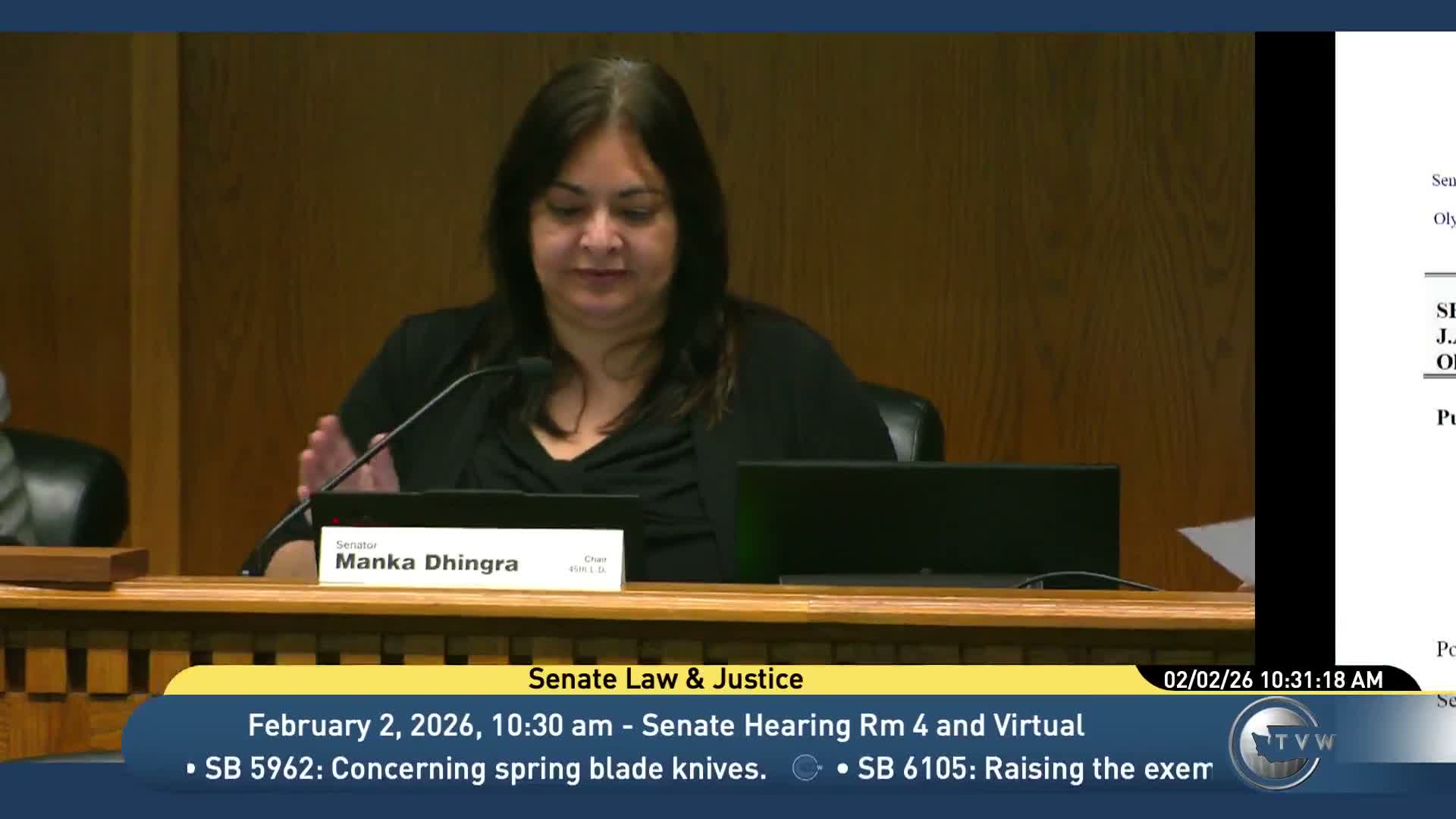
The Senate Law & Justice Committee heard public testimony Feb. 2 on SB 5962, a bill to remove spring blade knives from the statutory list of 'dangerous weapons' and to harmonize several code sections.
Tim Ford, committee staff, told senators that current law treats spring blade knives as dangerous weapons and makes possession a gross misdemeanor, while exemptions exist for law enforcement and certain contract manufacture and sales. The bill would explicitly state that a spring blade knife is not a dangerous weapon but would keep prohibitions on carrying such a knife into schools, mental-health facilities, jails and child-care settings.
Todd Rathner, representing Knife Rights, urged approval and said previous versions of the measure have passed the Senate. He argued the change would update an 'outdated and inconsistent' statutory scheme, help Washington knife makers compete, and reduce what he described as disproportionate enforcement against people of color.
Not all proponent testimony was unqualified. Jeff Pack, who had signed in supporting the bill, said after reviewing the draft he now opposes the version before the committee because it adds carry restrictions keyed to the mechanism of opening a knife. "Adding all these restrictions based solely upon the mechanism of how a knife opens is just — I can't even fathom it," he said, arguing the differences between manual, assisted and spring-opening knives are measured in milliseconds and are effectively indistinguishable in practice.
Senator Tawanna Nobles, the prime sponsor, framed SB 5962 as a modernization and statutory alignment that reduces legal ambiguity while maintaining public-safety guardrails for sensitive locations. Michael McKinley, another proponent, gave brief testimony in favor, saying one-handed knives can be safer in emergencies.
The committee did not vote on the bill during the hearing. Before testimony began, the panel agreed to suspend a five-day notice for SB 5962 so it could be heard that day; the voice motion to suspend carried.
The hearing record shows broad public engagement: the vice chair reported 50 pro and 2 con sign-ins (not all testified). The committee asked no immediate clarifying questions and moved on to other items on the agenda.
What happens next: The bill remains before the committee; sponsors and stakeholders may propose technical amendments before executive action.
Tim Ford, committee staff, told senators that current law treats spring blade knives as dangerous weapons and makes possession a gross misdemeanor, while exemptions exist for law enforcement and certain contract manufacture and sales. The bill would explicitly state that a spring blade knife is not a dangerous weapon but would keep prohibitions on carrying such a knife into schools, mental-health facilities, jails and child-care settings.
Todd Rathner, representing Knife Rights, urged approval and said previous versions of the measure have passed the Senate. He argued the change would update an 'outdated and inconsistent' statutory scheme, help Washington knife makers compete, and reduce what he described as disproportionate enforcement against people of color.
Not all proponent testimony was unqualified. Jeff Pack, who had signed in supporting the bill, said after reviewing the draft he now opposes the version before the committee because it adds carry restrictions keyed to the mechanism of opening a knife. "Adding all these restrictions based solely upon the mechanism of how a knife opens is just — I can't even fathom it," he said, arguing the differences between manual, assisted and spring-opening knives are measured in milliseconds and are effectively indistinguishable in practice.
Senator Tawanna Nobles, the prime sponsor, framed SB 5962 as a modernization and statutory alignment that reduces legal ambiguity while maintaining public-safety guardrails for sensitive locations. Michael McKinley, another proponent, gave brief testimony in favor, saying one-handed knives can be safer in emergencies.
The committee did not vote on the bill during the hearing. Before testimony began, the panel agreed to suspend a five-day notice for SB 5962 so it could be heard that day; the voice motion to suspend carried.
The hearing record shows broad public engagement: the vice chair reported 50 pro and 2 con sign-ins (not all testified). The committee asked no immediate clarifying questions and moved on to other items on the agenda.
What happens next: The bill remains before the committee; sponsors and stakeholders may propose technical amendments before executive action.
Don't Miss a Word: See the Full Meeting!
Go beyond summaries. Unlock every video, transcript, and key insight with a Founder Membership.
✓
Get instant access to full meeting videos
✓
Search and clip any phrase from complete transcripts
✓
Receive AI-powered summaries & custom alerts
✓
Enjoy lifetime, unrestricted access to government data
30-day money-back guarantee
