Advocates press committee to raise wage protections for medical-debt garnishment
February 02, 2026 | Legislative Sessions, Washington
This article was created by AI summarizing key points discussed. AI makes mistakes, so for full details and context, please refer to the video of the full meeting. Please report any errors so we can fix them. Report an error »
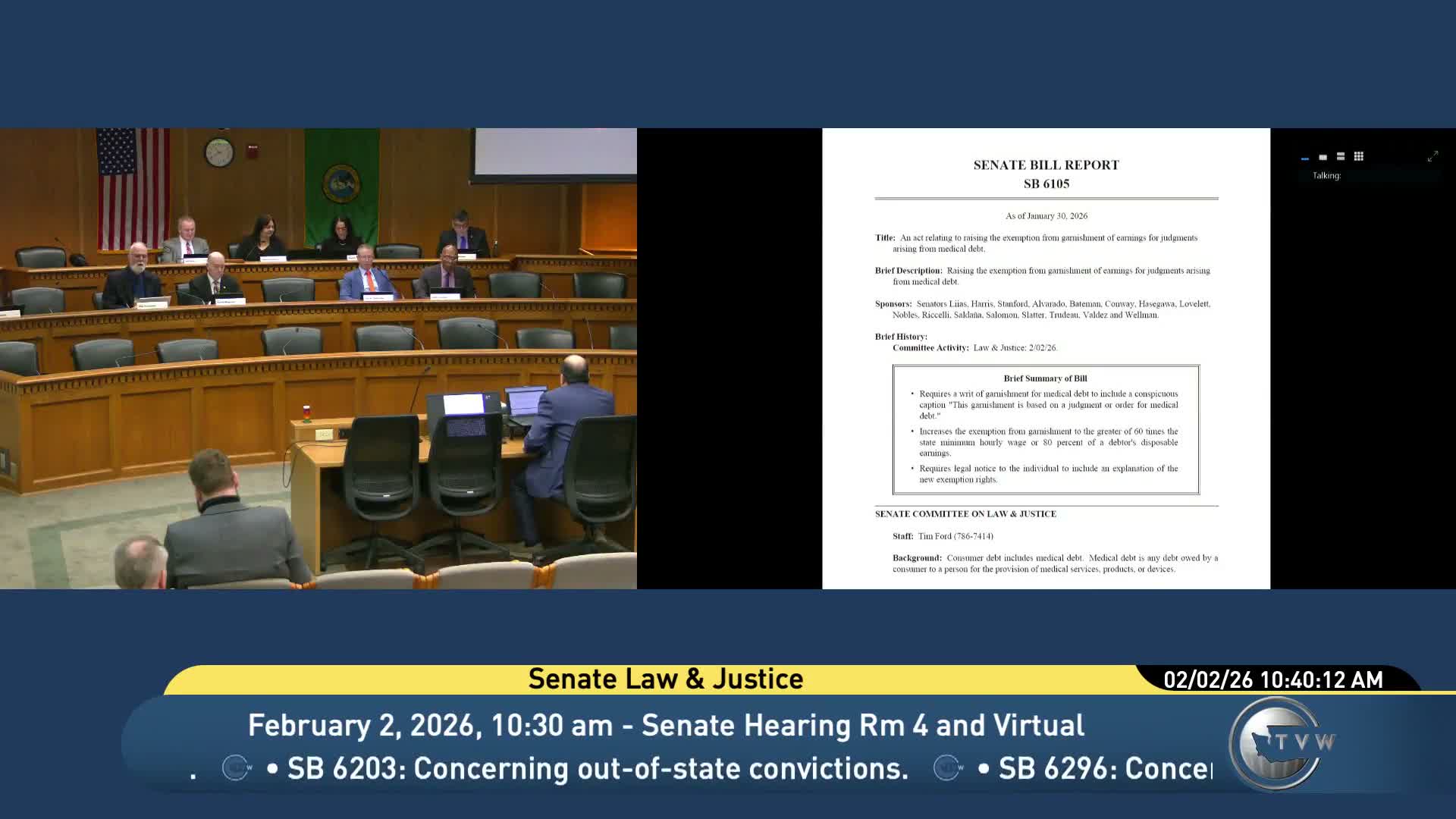
The Senate Law & Justice Committee heard competing testimony Feb. 2 on SB 6105, a bill that would increase wage protections for judgments arising from medical debt and require garnishment paperwork to clearly state it is for medical debt.
Committee staff explained current law exempts the greater of a multiple of the state minimum wage or 80% of disposable earnings from garnishment for consumer debt; SB 6105 raises the minimum-wage multiplier to 60 times the hourly minimum for medical-debt garnishments while retaining the 80% option for higher earners, and instructs that writ captions and debtor notices must clearly state the garnishment relates to medical debt.
Senator Marco Lias (21st LD), the prime sponsor, said the change would better protect low-wage workers and prevent families from being pushed into informal work; he cited Arizona's use of a 60-times threshold as a model and described the exemption roughly moving from $500 to $1,000 weekly for low-wage earners.
Patient advocates and consumer attorneys urged a yes vote. Adam Zarin of Blood Cancer United said many patients delay or skip treatment because of cost; Julia Kellison of Northwest Justice Project described clients who lost 20% of net wages to garnishment and recounted a case where improper service left a consumer garnished for a judgment they never properly received notice of. Kathleen McCall of AARP Washington said the bill would protect older workers who increasingly remain in the labor force.
Industry and provider representatives urged caution. Mindy Chumbley (Northwest Collectors Association) and Alexandra Sandoval (same association) opposed the bill, citing the absence of stakeholder process, concerns that labeling garnishment paperwork as 'medical' could implicate privacy and HIPAA, and that higher exemptions could push providers toward cash-upfront policies or credit financing that could reduce access to care. Diana Hernandez warned the bill's retroactivity could create enforcement and litigation burdens for mixed judgments.
Receivables Management Association suggested adopting the definition of 'medical debt' used in recently enacted SB 5480 (effective 04/22/2025; RCW 9.16100(11)) to avoid ambiguity. The committee did not vote; the vice chair reported 33 pro and 107 con sign-ins.
Next steps: Sponsors and stakeholders may propose amendments to clarify definitions, address privacy concerns, and assess fiscal and access implications before executive action.
Committee staff explained current law exempts the greater of a multiple of the state minimum wage or 80% of disposable earnings from garnishment for consumer debt; SB 6105 raises the minimum-wage multiplier to 60 times the hourly minimum for medical-debt garnishments while retaining the 80% option for higher earners, and instructs that writ captions and debtor notices must clearly state the garnishment relates to medical debt.
Senator Marco Lias (21st LD), the prime sponsor, said the change would better protect low-wage workers and prevent families from being pushed into informal work; he cited Arizona's use of a 60-times threshold as a model and described the exemption roughly moving from $500 to $1,000 weekly for low-wage earners.
Patient advocates and consumer attorneys urged a yes vote. Adam Zarin of Blood Cancer United said many patients delay or skip treatment because of cost; Julia Kellison of Northwest Justice Project described clients who lost 20% of net wages to garnishment and recounted a case where improper service left a consumer garnished for a judgment they never properly received notice of. Kathleen McCall of AARP Washington said the bill would protect older workers who increasingly remain in the labor force.
Industry and provider representatives urged caution. Mindy Chumbley (Northwest Collectors Association) and Alexandra Sandoval (same association) opposed the bill, citing the absence of stakeholder process, concerns that labeling garnishment paperwork as 'medical' could implicate privacy and HIPAA, and that higher exemptions could push providers toward cash-upfront policies or credit financing that could reduce access to care. Diana Hernandez warned the bill's retroactivity could create enforcement and litigation burdens for mixed judgments.
Receivables Management Association suggested adopting the definition of 'medical debt' used in recently enacted SB 5480 (effective 04/22/2025; RCW 9.16100(11)) to avoid ambiguity. The committee did not vote; the vice chair reported 33 pro and 107 con sign-ins.
Next steps: Sponsors and stakeholders may propose amendments to clarify definitions, address privacy concerns, and assess fiscal and access implications before executive action.
View the Full Meeting & All Its Details
This article offers just a summary. Unlock complete video, transcripts, and insights as a Founder Member.
✓
Watch full, unedited meeting videos
✓
Search every word spoken in unlimited transcripts
✓
AI summaries & real-time alerts (all government levels)
✓
Permanent access to expanding government content
30-day money-back guarantee
