Committee weighs far-reaching changes to Involuntary Treatment Act; supporters and civil-rights groups clash
February 02, 2026 | Legislative Sessions, Washington
This article was created by AI summarizing key points discussed. AI makes mistakes, so for full details and context, please refer to the video of the full meeting. Please report any errors so we can fix them. Report an error »
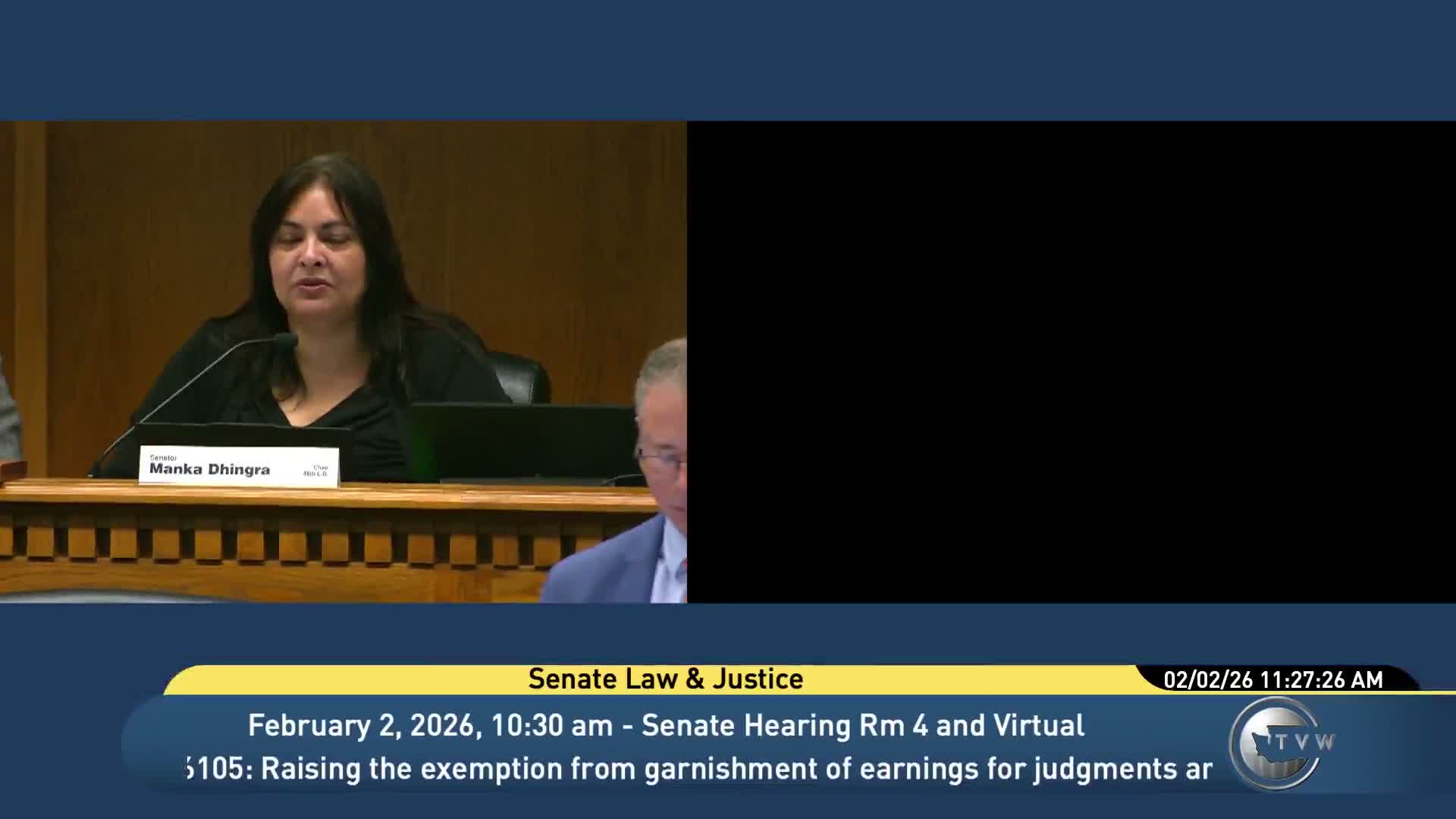
Senators on the Law & Justice Committee heard extensive, often emotional testimony Feb. 2 on SB 6296, a comprehensive bill proposing multiple changes to Washington's Involuntary Treatment Act (ITA).
Staff counsel Maya Aita summarized the bill's core elements: expansion of the list of people who may petition for initial detention (adding family and household members, intimate partners, conservators and certain service providers), notification requirements to prosecutors after release when competency-to-stand-trial dismissals occur, allowing less-restrictive alternative (LRA) orders to include substance-use monitoring (UAs, breathalyzers), and creating a process and compliance-review hearings for firearm-surrender requirements after certain ITA detentions. She also noted a preliminary fiscal note is available.
Sponsor Senator Solomon emphasized four priorities: clarify police authority to assist detentions (responding to local variability and a Ninth Circuit decision he cited), fix firearm-surrender gaps after 120-hour holds, remove the clinician-declarant requirement that obstructs Assisted Outpatient Treatment (AOT) petitions in some counties, and expand Joel's Law petitioners to include people other than immediate family who know the person at risk.
Testimony spanned strong support and pointed opposition. Robert McCullough, an AOT therapist, and facility directors said removing the declarant requirement would make AOT accessible to people who now fall through gaps. Andrea Pace offered emotional family testimony describing repeated failed detentions and unsafe hospital releases, urging faster access to care and oversight changes. Providers and sheriffs' groups acknowledged the need for reform, but urged careful drafting: law enforcement witnesses warned that imposing a mandatory duty to respond or unclear use-of-force language could expose officers to liability (citing Scott v. Smith) or force diversion from higher-priority calls. Hospitals, DCRs and disability-rights groups opposed many provisions as drafted, warning of weakened due process, risks of misuse (e.g., expanding Joel's Law to former partners or roommates), insufficient crisis-center capacity for longer holds, rural transport and staffing constraints, and the danger of returning to coercive institutional approaches rather than investing in community services.
Prosecutors and behavioral-health administrators supported elements such as information sharing, safe-transport improvements and removing the AOT-declarant barrier but flagged operational and constitutional questions about firearms surrender after dismissal and the practicality of court notice timelines.
The hearing closed with vice-chair sign-in counts of 7 pro and 22 con; no committee vote occurred. Sponsors and stakeholders said they will continue negotiations to refine definitions, capacity responses and guardrails for law enforcement and civil-rights protections.
Staff counsel Maya Aita summarized the bill's core elements: expansion of the list of people who may petition for initial detention (adding family and household members, intimate partners, conservators and certain service providers), notification requirements to prosecutors after release when competency-to-stand-trial dismissals occur, allowing less-restrictive alternative (LRA) orders to include substance-use monitoring (UAs, breathalyzers), and creating a process and compliance-review hearings for firearm-surrender requirements after certain ITA detentions. She also noted a preliminary fiscal note is available.
Sponsor Senator Solomon emphasized four priorities: clarify police authority to assist detentions (responding to local variability and a Ninth Circuit decision he cited), fix firearm-surrender gaps after 120-hour holds, remove the clinician-declarant requirement that obstructs Assisted Outpatient Treatment (AOT) petitions in some counties, and expand Joel's Law petitioners to include people other than immediate family who know the person at risk.
Testimony spanned strong support and pointed opposition. Robert McCullough, an AOT therapist, and facility directors said removing the declarant requirement would make AOT accessible to people who now fall through gaps. Andrea Pace offered emotional family testimony describing repeated failed detentions and unsafe hospital releases, urging faster access to care and oversight changes. Providers and sheriffs' groups acknowledged the need for reform, but urged careful drafting: law enforcement witnesses warned that imposing a mandatory duty to respond or unclear use-of-force language could expose officers to liability (citing Scott v. Smith) or force diversion from higher-priority calls. Hospitals, DCRs and disability-rights groups opposed many provisions as drafted, warning of weakened due process, risks of misuse (e.g., expanding Joel's Law to former partners or roommates), insufficient crisis-center capacity for longer holds, rural transport and staffing constraints, and the danger of returning to coercive institutional approaches rather than investing in community services.
Prosecutors and behavioral-health administrators supported elements such as information sharing, safe-transport improvements and removing the AOT-declarant barrier but flagged operational and constitutional questions about firearms surrender after dismissal and the practicality of court notice timelines.
The hearing closed with vice-chair sign-in counts of 7 pro and 22 con; no committee vote occurred. Sponsors and stakeholders said they will continue negotiations to refine definitions, capacity responses and guardrails for law enforcement and civil-rights protections.
Don't Miss a Word: See the Full Meeting!
Go beyond summaries. Unlock every video, transcript, and key insight with a Founder Membership.
✓
Get instant access to full meeting videos
✓
Search and clip any phrase from complete transcripts
✓
Receive AI-powered summaries & custom alerts
✓
Enjoy lifetime, unrestricted access to government data
30-day money-back guarantee
