House committee reports out substitute expanding earned-release time and creating peer-support pilots, amid split over limits
February 02, 2026 | Legislative Sessions, Washington
This article was created by AI summarizing key points discussed. AI makes mistakes, so for full details and context, please refer to the video of the full meeting. Please report any errors so we can fix them. Report an error »
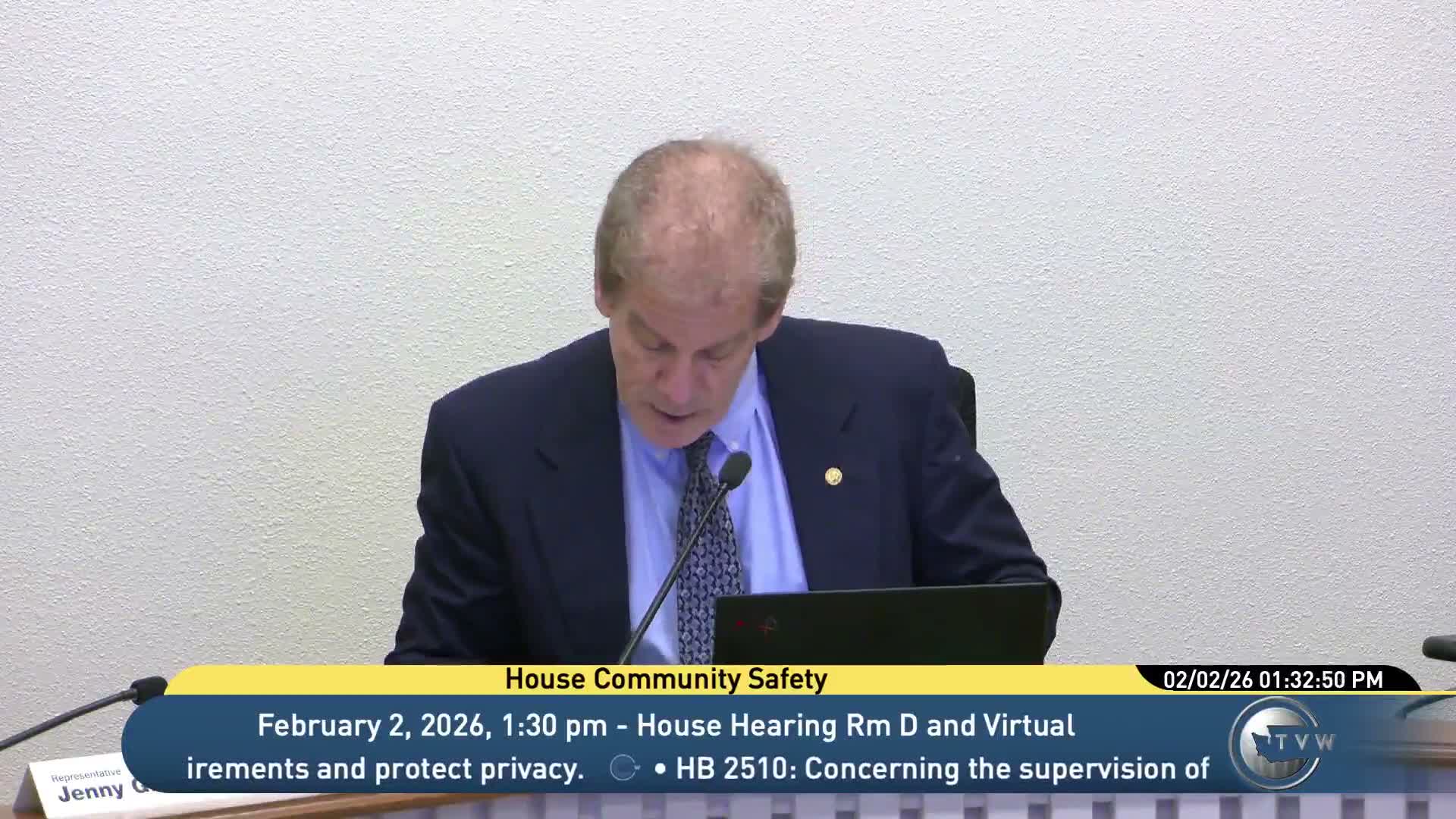
The House Community Safety Committee on Feb. 2 reported substitute House Bill 12-39 to the floor with a due-pass recommendation after a 5-4 roll-call vote, advancing a package that expands earned release time and creates short pilot programs to support incarcerated survivors.
The bill's proposed substitute allows earned release time of up to one-third of a qualifying sentence for eligible categories, but applies prospectively to offenses committed on or after July 1, 2026. It requires the Department of Corrections to establish a two-year pilot program of peer-support specialists at the Washington Corrections Center for Women and, by amendment, at a men's receiving center to support incarcerated survivors of sexual and intimate-partner violence. The Office of Crime Victims Advocacy would be required to provide victims in felony cases with materials explaining sentencing and possible future changes.
Supporters argued the bill provides second chances and addresses racial disproportionality in incarceration. "Only 1% of the population is Native American, but 6% of the prison population," a member said during debate, urging the committee to adopt a prospective approach and improve reentry tools. Vice Chair and other proponents said the bill is the product of several sessions of work and compromises.
Opponents and some victims' advocates warned the policy could reduce effective sentences for the most serious crimes. Representative Davis, urging limits on earned time for serious violent offenses, said of a hypothetical bereaved spouse, "Where do I get 33% off my grief?" That line of testimony helped shape votes on several amendments.
The committee considered five amendments filed in the executive packet. Two amendments were adopted: LANG 177, which excludes any portion of a sentence tied to a bias-motivation sentencing enhancement from accruing earned-release credits and revises how OCVA materials are provided; and LANG 181, which adds a second two-year pilot at a men's receiving center. Three amendments were not adopted: LANG 172 (would have required DOC to supervise individuals transferred to community custody in lieu of earned early release for the duration of total confinement plus any community custody term), LANG 171 (would have reduced maximum earned-release time for specified serious offenses from 33.33% to 20%), and LANG 173 (would have prevented earned credits from counting toward parole eligibility if parole were later established).
On final passage out of committee the roll call recorded these votes: Aye — Representatives Goodman, Simmons, Farvar, Fosse and Obraz. Nay — Representatives Graham, Griffey, Bernette and Davis. The clerk reported a tally of 5 ayes and 4 nays, and the substitute was reported out with a due-pass recommendation to the next floor action.
What happens next: The bill moves to the full House for floor consideration. The committee record shows the bill applies prospectively and includes pilot programs and OCVA notification requirements; further amendments or changes are possible on the floor.
The bill's proposed substitute allows earned release time of up to one-third of a qualifying sentence for eligible categories, but applies prospectively to offenses committed on or after July 1, 2026. It requires the Department of Corrections to establish a two-year pilot program of peer-support specialists at the Washington Corrections Center for Women and, by amendment, at a men's receiving center to support incarcerated survivors of sexual and intimate-partner violence. The Office of Crime Victims Advocacy would be required to provide victims in felony cases with materials explaining sentencing and possible future changes.
Supporters argued the bill provides second chances and addresses racial disproportionality in incarceration. "Only 1% of the population is Native American, but 6% of the prison population," a member said during debate, urging the committee to adopt a prospective approach and improve reentry tools. Vice Chair and other proponents said the bill is the product of several sessions of work and compromises.
Opponents and some victims' advocates warned the policy could reduce effective sentences for the most serious crimes. Representative Davis, urging limits on earned time for serious violent offenses, said of a hypothetical bereaved spouse, "Where do I get 33% off my grief?" That line of testimony helped shape votes on several amendments.
The committee considered five amendments filed in the executive packet. Two amendments were adopted: LANG 177, which excludes any portion of a sentence tied to a bias-motivation sentencing enhancement from accruing earned-release credits and revises how OCVA materials are provided; and LANG 181, which adds a second two-year pilot at a men's receiving center. Three amendments were not adopted: LANG 172 (would have required DOC to supervise individuals transferred to community custody in lieu of earned early release for the duration of total confinement plus any community custody term), LANG 171 (would have reduced maximum earned-release time for specified serious offenses from 33.33% to 20%), and LANG 173 (would have prevented earned credits from counting toward parole eligibility if parole were later established).
On final passage out of committee the roll call recorded these votes: Aye — Representatives Goodman, Simmons, Farvar, Fosse and Obraz. Nay — Representatives Graham, Griffey, Bernette and Davis. The clerk reported a tally of 5 ayes and 4 nays, and the substitute was reported out with a due-pass recommendation to the next floor action.
What happens next: The bill moves to the full House for floor consideration. The committee record shows the bill applies prospectively and includes pilot programs and OCVA notification requirements; further amendments or changes are possible on the floor.
Don't Miss a Word: See the Full Meeting!
Go beyond summaries. Unlock every video, transcript, and key insight with a Founder Membership.
✓
Get instant access to full meeting videos
✓
Search and clip any phrase from complete transcripts
✓
Receive AI-powered summaries & custom alerts
✓
Enjoy lifetime, unrestricted access to government data
30-day money-back guarantee
