House Education Committee advances seven bills; debates albuterol in schools, OEO privacy and special‑education timelines
February 02, 2026 | Legislative Sessions, Washington
This article was created by AI summarizing key points discussed. AI makes mistakes, so for full details and context, please refer to the video of the full meeting. Please report any errors so we can fix them. Report an error »
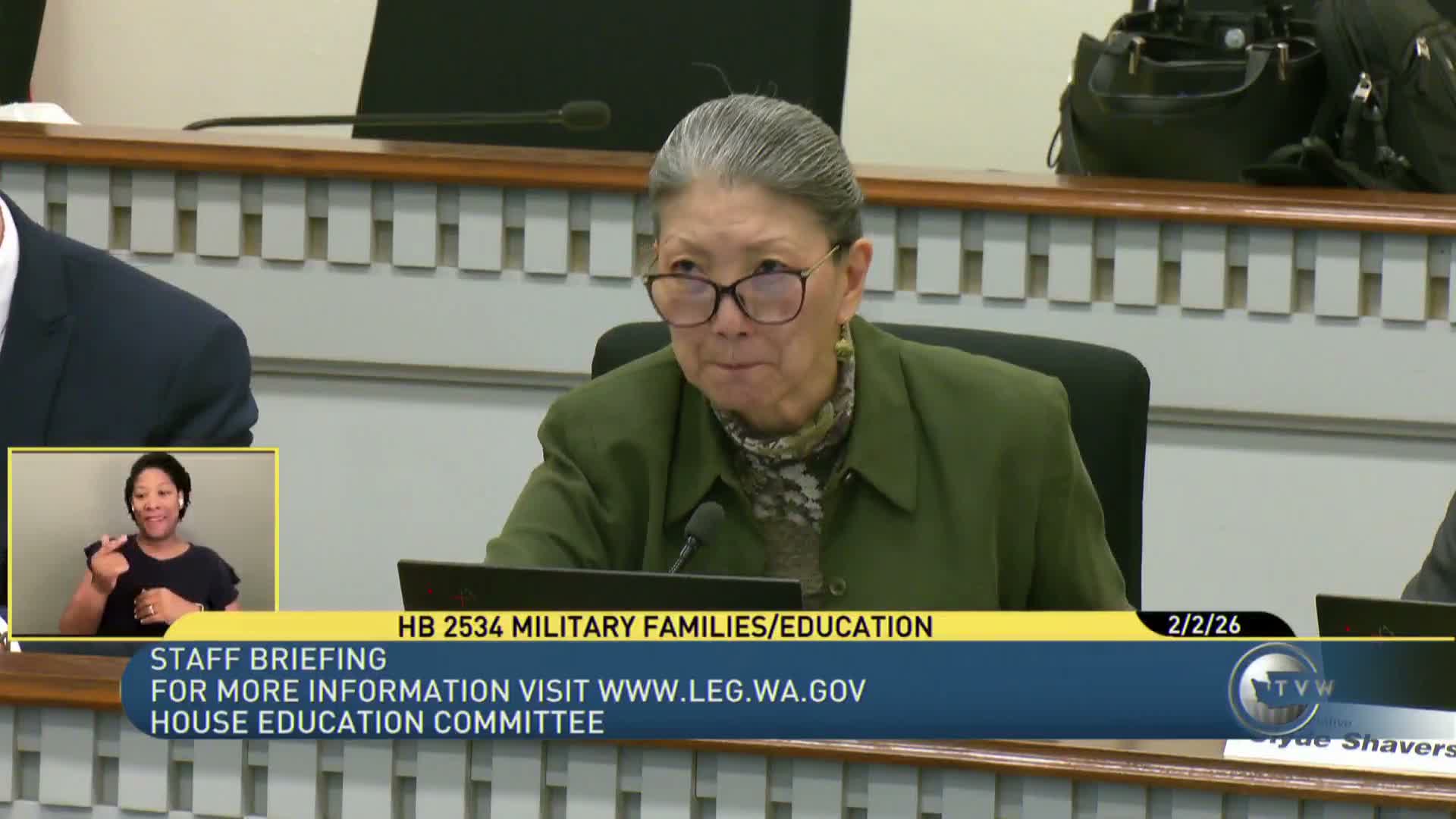
The House Education Committee met in an executive session and reported seven bills out of committee with due‑pass recommendations, moving measures on graduation pathways, school medication policy, local food procurement, surplus technology for students, ombuds privacy, military family enrollment and special‑education timelines to the next stage.
Committee staff opened with briefings on each measure. Megan, the committee staffer who briefed several bills, summarized House Bill 2,007 as a measure authorizing competency‑based assessments and specified graduation pathways and noted an amendment (WARG 268 by Representative Couture) that would add a budget contingency ("null and void" clause). Vice Chair Shavers moved HB 2,007 to be reported; after brief debate in support from Representative Stonier and others the committee adopted a recommendation to pass (19‑0).
A central debate focused on House Bill 2,360, which would authorize public and private schools to obtain, maintain and administer school‑supplied albuterol for individuals experiencing asthma or other respiratory symptoms under specified requirements. Megan explained staff and amendment language clarifying that the amendment WARG 279 by Representative Donaghy removes a requirement that the secretary of health issue a statewide standing order and instead relies on the secretary's existing authority to issue standing orders for biological products, devices or drugs. Donaghy said the amendment "leans instead of requiring the Department of Health to issue an order," and stressed the measure is permissive, noting "it does not require any schools to have albuterol on hand." In debate Representative Marshall urged safeguards about follow‑up care for students receiving albuterol for the first time at school; Donaghy said the policy is intended to give schools a life‑saving option when a respiratory attack occurs on campus: "This would ensure that, when a student has their first attack at school ... they are able to survive until help arrives." The committee adopted technical and sponsor amendments and reported substitute HB 2,360 out of committee with a due‑pass recommendation (17 ayes, 2 nays).
House Bill 2,369, creating a Washington Local Food for Schools grant in the Office of the Superintendent of Public Instruction (OSPI), drew a failed effort to add a null‑and‑void fiscal clause (MOET 506). Representative Reeves framed the bill as a government efficiency to help local farmers deliver nutritious meals to students. The committee reported the bill with a due‑pass recommendation (19‑0).
House Bill 2,432 would exempt school districts from some public notice requirements when selling or granting surplus technology hardware to pupils and asks districts to prioritize students with greatest need. Members supported the bill's aim to keep devices with students while one member suggested a parent‑notification amendment might be appropriate as the bill moves forward. The committee reported HB 2,432 with a due‑pass recommendation (16‑3).
House Bill 2,440 would exempt complaint‑related records and files maintained by the Office of the Education Ombuds (OEO) from public disclosure and subpoena with specified exceptions and require the OEO to provide complainants their complaint with redactions. Chair Santos, who framed the bill as a privacy safeguard to encourage use of the ombuds office, asked for support; Representative Couture argued the change represented a loss of transparency and urged a no vote. The committee reported HB 2,440 with a due‑pass recommendation (12‑7).
Representative Shavers guided the committee through a proposed substitute for House Bill 2,534 to ease school enrollment and records transfer for military families; members praised the substitute for increasing flexibility and the committee reported that substitute with a due‑pass recommendation (19‑0).
Finally, House Bill 2,557 — which would require districts to provide a copy of a special‑education evaluation report to parents or guardians at least five school days before the meeting to determine eligibility, and which establishes statutory timelines for evaluations and eligibility meetings — was debated with amendments adopted to clarify timelines and ensure staff have sufficient time for work. Representative Chase supported an amendment changing wording from "finalized evaluation report" to "completed report" and clarifying scheduling windows. The committee reported the substitute with a due‑pass recommendation (19‑0).
Votes at a glance
- HB 2,007 (competency‑based assessments): reported out, due pass (vote announced 19 ayes, 0 nays).
- HB 2,360 (school albuterol policy): substitute reported out, due pass (vote announced 17 ayes, 2 nays).
- HB 2,369 (Washington Local Food for Schools grant): reported out, due pass (vote announced 19 ayes, 0 nays).
- HB 2,432 (surplus technology to students): reported out, due pass (vote announced 16 ayes, 3 nays).
- HB 2,440 (OEO records confidentiality): reported out, due pass (vote announced 12 ayes, 7 nays).
- HB 2,534 (military family enrollment substitute): reported out, due pass (vote announced 19 ayes, 0 nays).
- HB 2,557 (special‑education evaluation timelines): substitute reported out, due pass (vote announced 19 ayes, 0 nays).
Why it matters
The committee advanced measures that affect classroom practice (competency‑based graduation pathways); student health and safety (availability and administration of albuterol on school grounds); family access to special‑education information and timelines; and procedural matters such as privacy of ombuds complaints and distribution of surplus educational technology. Several measures include or faced proposed "null and void" budget contingencies — an issue that repeatedly sparked cross‑aisle disagreement about where fiscal decisions should be made.
What’s next
All reported bills will proceed per the legislative process to subsequent committee consideration or floor action. Members asked staff and sponsors to continue refining technical language and implementation details, including guidance on medication administration, follow‑up care after on‑site medication use, and parent notification practices for surplus device transfers.
Committee staff opened with briefings on each measure. Megan, the committee staffer who briefed several bills, summarized House Bill 2,007 as a measure authorizing competency‑based assessments and specified graduation pathways and noted an amendment (WARG 268 by Representative Couture) that would add a budget contingency ("null and void" clause). Vice Chair Shavers moved HB 2,007 to be reported; after brief debate in support from Representative Stonier and others the committee adopted a recommendation to pass (19‑0).
A central debate focused on House Bill 2,360, which would authorize public and private schools to obtain, maintain and administer school‑supplied albuterol for individuals experiencing asthma or other respiratory symptoms under specified requirements. Megan explained staff and amendment language clarifying that the amendment WARG 279 by Representative Donaghy removes a requirement that the secretary of health issue a statewide standing order and instead relies on the secretary's existing authority to issue standing orders for biological products, devices or drugs. Donaghy said the amendment "leans instead of requiring the Department of Health to issue an order," and stressed the measure is permissive, noting "it does not require any schools to have albuterol on hand." In debate Representative Marshall urged safeguards about follow‑up care for students receiving albuterol for the first time at school; Donaghy said the policy is intended to give schools a life‑saving option when a respiratory attack occurs on campus: "This would ensure that, when a student has their first attack at school ... they are able to survive until help arrives." The committee adopted technical and sponsor amendments and reported substitute HB 2,360 out of committee with a due‑pass recommendation (17 ayes, 2 nays).
House Bill 2,369, creating a Washington Local Food for Schools grant in the Office of the Superintendent of Public Instruction (OSPI), drew a failed effort to add a null‑and‑void fiscal clause (MOET 506). Representative Reeves framed the bill as a government efficiency to help local farmers deliver nutritious meals to students. The committee reported the bill with a due‑pass recommendation (19‑0).
House Bill 2,432 would exempt school districts from some public notice requirements when selling or granting surplus technology hardware to pupils and asks districts to prioritize students with greatest need. Members supported the bill's aim to keep devices with students while one member suggested a parent‑notification amendment might be appropriate as the bill moves forward. The committee reported HB 2,432 with a due‑pass recommendation (16‑3).
House Bill 2,440 would exempt complaint‑related records and files maintained by the Office of the Education Ombuds (OEO) from public disclosure and subpoena with specified exceptions and require the OEO to provide complainants their complaint with redactions. Chair Santos, who framed the bill as a privacy safeguard to encourage use of the ombuds office, asked for support; Representative Couture argued the change represented a loss of transparency and urged a no vote. The committee reported HB 2,440 with a due‑pass recommendation (12‑7).
Representative Shavers guided the committee through a proposed substitute for House Bill 2,534 to ease school enrollment and records transfer for military families; members praised the substitute for increasing flexibility and the committee reported that substitute with a due‑pass recommendation (19‑0).
Finally, House Bill 2,557 — which would require districts to provide a copy of a special‑education evaluation report to parents or guardians at least five school days before the meeting to determine eligibility, and which establishes statutory timelines for evaluations and eligibility meetings — was debated with amendments adopted to clarify timelines and ensure staff have sufficient time for work. Representative Chase supported an amendment changing wording from "finalized evaluation report" to "completed report" and clarifying scheduling windows. The committee reported the substitute with a due‑pass recommendation (19‑0).
Votes at a glance
- HB 2,007 (competency‑based assessments): reported out, due pass (vote announced 19 ayes, 0 nays).
- HB 2,360 (school albuterol policy): substitute reported out, due pass (vote announced 17 ayes, 2 nays).
- HB 2,369 (Washington Local Food for Schools grant): reported out, due pass (vote announced 19 ayes, 0 nays).
- HB 2,432 (surplus technology to students): reported out, due pass (vote announced 16 ayes, 3 nays).
- HB 2,440 (OEO records confidentiality): reported out, due pass (vote announced 12 ayes, 7 nays).
- HB 2,534 (military family enrollment substitute): reported out, due pass (vote announced 19 ayes, 0 nays).
- HB 2,557 (special‑education evaluation timelines): substitute reported out, due pass (vote announced 19 ayes, 0 nays).
Why it matters
The committee advanced measures that affect classroom practice (competency‑based graduation pathways); student health and safety (availability and administration of albuterol on school grounds); family access to special‑education information and timelines; and procedural matters such as privacy of ombuds complaints and distribution of surplus educational technology. Several measures include or faced proposed "null and void" budget contingencies — an issue that repeatedly sparked cross‑aisle disagreement about where fiscal decisions should be made.
What’s next
All reported bills will proceed per the legislative process to subsequent committee consideration or floor action. Members asked staff and sponsors to continue refining technical language and implementation details, including guidance on medication administration, follow‑up care after on‑site medication use, and parent notification practices for surplus device transfers.
View the Full Meeting & All Its Details
This article offers just a summary. Unlock complete video, transcripts, and insights as a Founder Member.
✓
Watch full, unedited meeting videos
✓
Search every word spoken in unlimited transcripts
✓
AI summaries & real-time alerts (all government levels)
✓
Permanent access to expanding government content
30-day money-back guarantee
