Committee hears students and advocates urge limits on WASFA data sharing and retention
February 02, 2026 | Legislative Sessions, Washington
This article was created by AI summarizing key points discussed. AI makes mistakes, so for full details and context, please refer to the video of the full meeting. Please report any errors so we can fix them. Report an error »
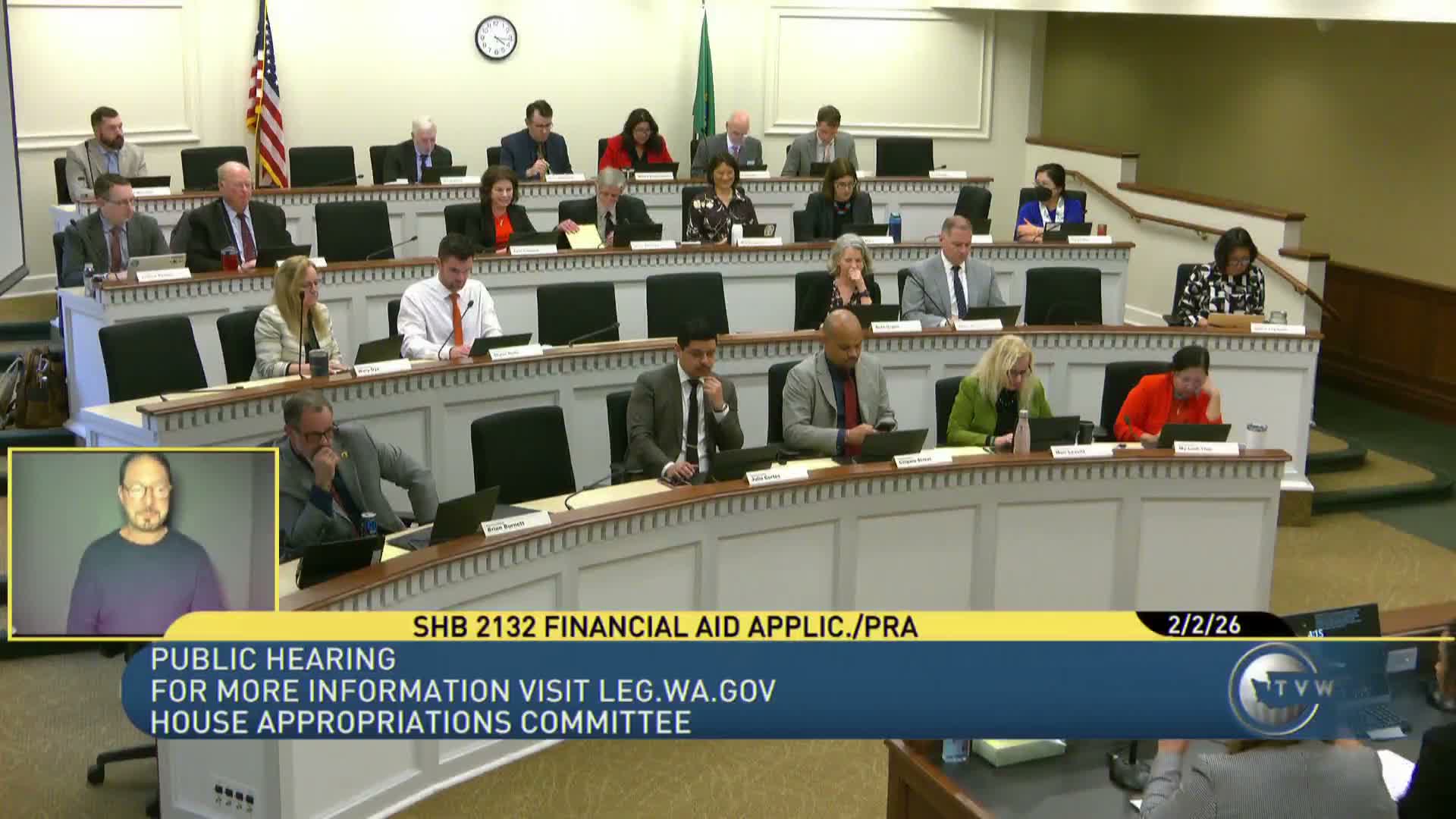
The Appropriations Committee heard a staff briefing and public testimony on a proposed second substitute to House Bill 2132 that would limit disclosure and retention of personally identifying information contained in the Washington Application for State Financial Aid (WASFA).
Saranda Ross (staff) told the committee the substitute would exempt existing and prospective WASFA records from public inspection under the Public Records Act unless disclosure was required by state or federal law or court order. The substitute allows WASFA and institutions to share records only under binding written data-sharing agreements that prohibit onward sharing and that limit sharing to enrollment support, program participation, notifying students of public benefits eligibility, and fraud prevention. The substitute also shortens retention to no longer than one year after the end of an institution’s award year unless an audit appeal or other law requires longer retention.
Kate Henry (staff) presented fiscal estimates from the office budget book (EBB) noting a prior vendor estimate that purging less than 2,300 records cost $154,000 and that an estimated historical purge of 41,000 records could cost roughly $2.8 million. The FY28 estimated cost using that prior vendor estimate was presented as about $670,000; the agencies described some institution-level and state-level staff costs for purging and data‑sharing agreement work.
Students and student‑government representatives — including Brandon Elliott (Associated Students of the University of Washington) and several students from Yakima and Washington State University — testified in support, citing recent data‑sharing concerns, fear among undocumented applicants, and a desire for clearer protections so students will not avoid applying for aid.
Representative Levitt, the bill sponsor, said the measure builds on prior work (including the Real Hope Act) and credited the Student Achievement Council and the attorney general’s office for participation in drafting the substitute. The committee took no final vote on the bill during this hearing; public testimony concluded and staff will continue to provide analysis to the committee.
Saranda Ross (staff) told the committee the substitute would exempt existing and prospective WASFA records from public inspection under the Public Records Act unless disclosure was required by state or federal law or court order. The substitute allows WASFA and institutions to share records only under binding written data-sharing agreements that prohibit onward sharing and that limit sharing to enrollment support, program participation, notifying students of public benefits eligibility, and fraud prevention. The substitute also shortens retention to no longer than one year after the end of an institution’s award year unless an audit appeal or other law requires longer retention.
Kate Henry (staff) presented fiscal estimates from the office budget book (EBB) noting a prior vendor estimate that purging less than 2,300 records cost $154,000 and that an estimated historical purge of 41,000 records could cost roughly $2.8 million. The FY28 estimated cost using that prior vendor estimate was presented as about $670,000; the agencies described some institution-level and state-level staff costs for purging and data‑sharing agreement work.
Students and student‑government representatives — including Brandon Elliott (Associated Students of the University of Washington) and several students from Yakima and Washington State University — testified in support, citing recent data‑sharing concerns, fear among undocumented applicants, and a desire for clearer protections so students will not avoid applying for aid.
Representative Levitt, the bill sponsor, said the measure builds on prior work (including the Real Hope Act) and credited the Student Achievement Council and the attorney general’s office for participation in drafting the substitute. The committee took no final vote on the bill during this hearing; public testimony concluded and staff will continue to provide analysis to the committee.
Don't Miss a Word: See the Full Meeting!
Go beyond summaries. Unlock every video, transcript, and key insight with a Founder Membership.
✓
Get instant access to full meeting videos
✓
Search and clip any phrase from complete transcripts
✓
Receive AI-powered summaries & custom alerts
✓
Enjoy lifetime, unrestricted access to government data
30-day money-back guarantee
