House committee adopts substitute for HB 2266 to standardize siting of step housing
February 02, 2026 | Legislative Sessions, Washington
This article was created by AI summarizing key points discussed. AI makes mistakes, so for full details and context, please refer to the video of the full meeting. Please report any errors so we can fix them. Report an error »
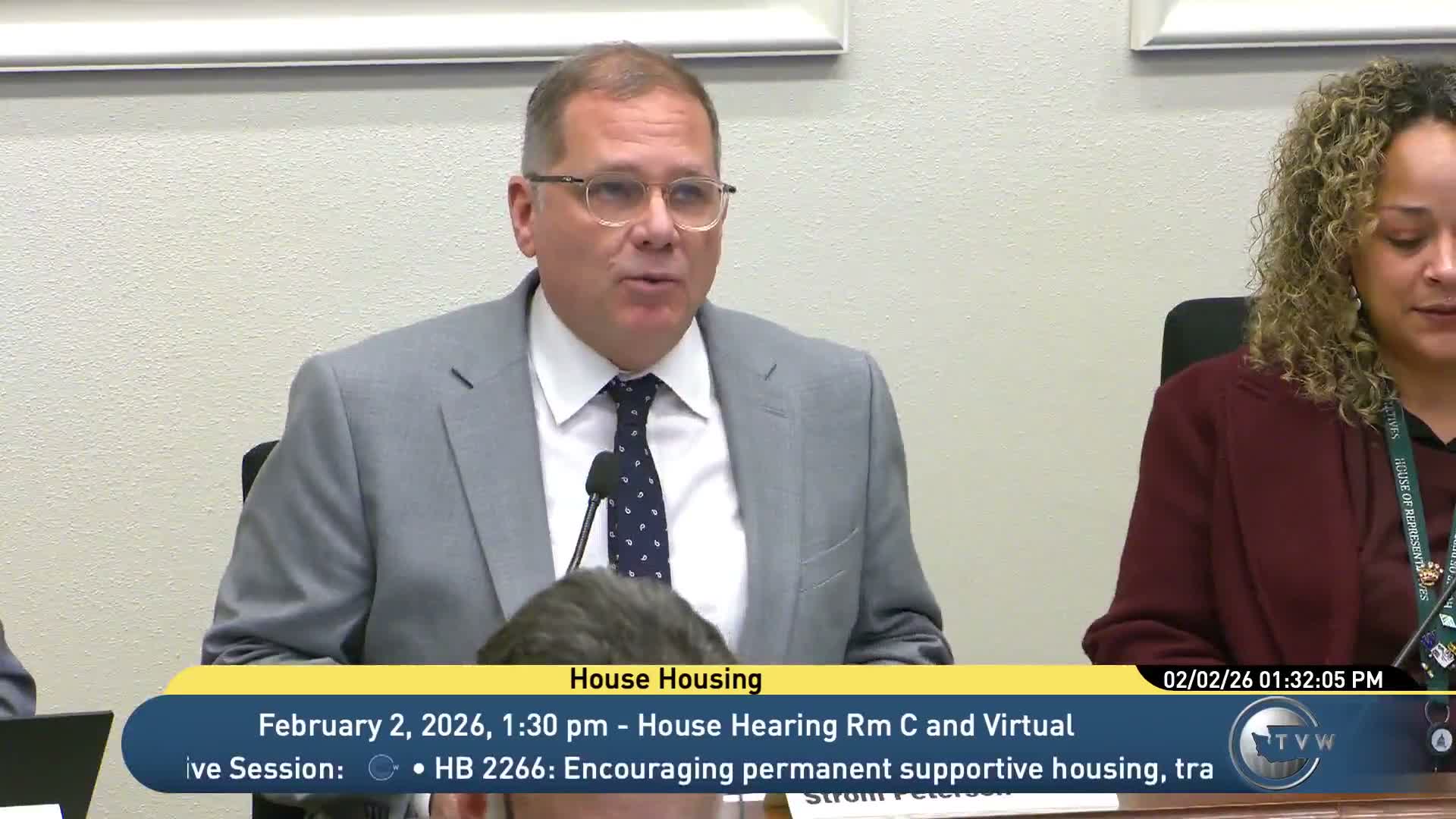
The House Housing Committee on Feb. 2 voted to report substitute House Bill 2266 out of committee with a "do pass" recommendation after approving several amendments that clarify siting and operational standards for "step housing." Vice Chair Hill moved the substitute and the clerk recorded a 10–7 roll-call tally in favor.
The substitute, as described by committee staff Jim, distinguishes siting rules by housing type: transitional and permanent supportive housing must be allowed in zones permitting residential dwellings or hotels, while indoor emergency shelters must be allowed in zones permitting hotels. The substitute allows local governments to prohibit siting in critical natural-hazard or agricultural/forest/mineral lands, permits counties and cities to require certifications from shelter operators (including a 500-foot resident notice and one community meeting), and requires jurisdictions to update development and zoning regulations within two years or at their next comprehensive plan update. The substitute also grandfathered existing step housing from new local regulations.
Rep. Jacobson moved amendment MOR 294 to prohibit indoor emergency shelters within 1,000 feet of a public or private school, daycare center, or another shelter and to allow reasonable capacity limits based on density and fire codes. Jacobson argued the change would "put sensible guardrails" on siting, citing a Puyallup drop-in center that she said caused neighborhood impacts. Representative Thomas urged a no vote on the amendment, citing state homelessness counts for children and the need for colocated services; the amendment failed on a voice vote with the chair voting no.
Other amendment outcomes included adoption of MOR 292 (Representative Richards) to allow form-based codes to apply to step housing and MOR 303 (Representative Zahn) to specify that checklist items must be completed between permit application and certificate-of-occupancy issuance. MOR 293 (Representative Lowe), which would have imposed operational health and safety requirements such as 24/7 on-site supervision and security cameras, and MOR 295 (Representative Monjares), allowing local reporting and auditing as a program participation condition, were not adopted. MOR 301 (Representative Peterson) — preempting conflicting local requirements and clarifying the two-year update window — was adopted.
Representative Barkis and others voiced concern that the substitute mandates statewide siting in ways that may strain jurisdictions and limit public engagement; supporters, including Representative Gregersen, said the substitute creates consistent statewide standards and helps ensure access to critical housing across communities.
The clerk’s roll call for the final motion to report the substitute produced 10 ayes and 7 nays. By the committee’s action, the substitute for HB 2266 was reported out with a due-pass recommendation and will proceed through the legislative process.
The committee recorded a request for additional follow-up on the bill’s fiscal note; staff said they would provide further analysis to members.
The substitute, as described by committee staff Jim, distinguishes siting rules by housing type: transitional and permanent supportive housing must be allowed in zones permitting residential dwellings or hotels, while indoor emergency shelters must be allowed in zones permitting hotels. The substitute allows local governments to prohibit siting in critical natural-hazard or agricultural/forest/mineral lands, permits counties and cities to require certifications from shelter operators (including a 500-foot resident notice and one community meeting), and requires jurisdictions to update development and zoning regulations within two years or at their next comprehensive plan update. The substitute also grandfathered existing step housing from new local regulations.
Rep. Jacobson moved amendment MOR 294 to prohibit indoor emergency shelters within 1,000 feet of a public or private school, daycare center, or another shelter and to allow reasonable capacity limits based on density and fire codes. Jacobson argued the change would "put sensible guardrails" on siting, citing a Puyallup drop-in center that she said caused neighborhood impacts. Representative Thomas urged a no vote on the amendment, citing state homelessness counts for children and the need for colocated services; the amendment failed on a voice vote with the chair voting no.
Other amendment outcomes included adoption of MOR 292 (Representative Richards) to allow form-based codes to apply to step housing and MOR 303 (Representative Zahn) to specify that checklist items must be completed between permit application and certificate-of-occupancy issuance. MOR 293 (Representative Lowe), which would have imposed operational health and safety requirements such as 24/7 on-site supervision and security cameras, and MOR 295 (Representative Monjares), allowing local reporting and auditing as a program participation condition, were not adopted. MOR 301 (Representative Peterson) — preempting conflicting local requirements and clarifying the two-year update window — was adopted.
Representative Barkis and others voiced concern that the substitute mandates statewide siting in ways that may strain jurisdictions and limit public engagement; supporters, including Representative Gregersen, said the substitute creates consistent statewide standards and helps ensure access to critical housing across communities.
The clerk’s roll call for the final motion to report the substitute produced 10 ayes and 7 nays. By the committee’s action, the substitute for HB 2266 was reported out with a due-pass recommendation and will proceed through the legislative process.
The committee recorded a request for additional follow-up on the bill’s fiscal note; staff said they would provide further analysis to members.
View the Full Meeting & All Its Details
This article offers just a summary. Unlock complete video, transcripts, and insights as a Founder Member.
✓
Watch full, unedited meeting videos
✓
Search every word spoken in unlimited transcripts
✓
AI summaries & real-time alerts (all government levels)
✓
Permanent access to expanding government content
30-day money-back guarantee
