Committee hears support and implementation concerns for bill easing school enrollment for military families
February 03, 2026 | Legislative Sessions, Washington
This article was created by AI summarizing key points discussed. AI makes mistakes, so for full details and context, please refer to the video of the full meeting. Please report any errors so we can fix them. Report an error »
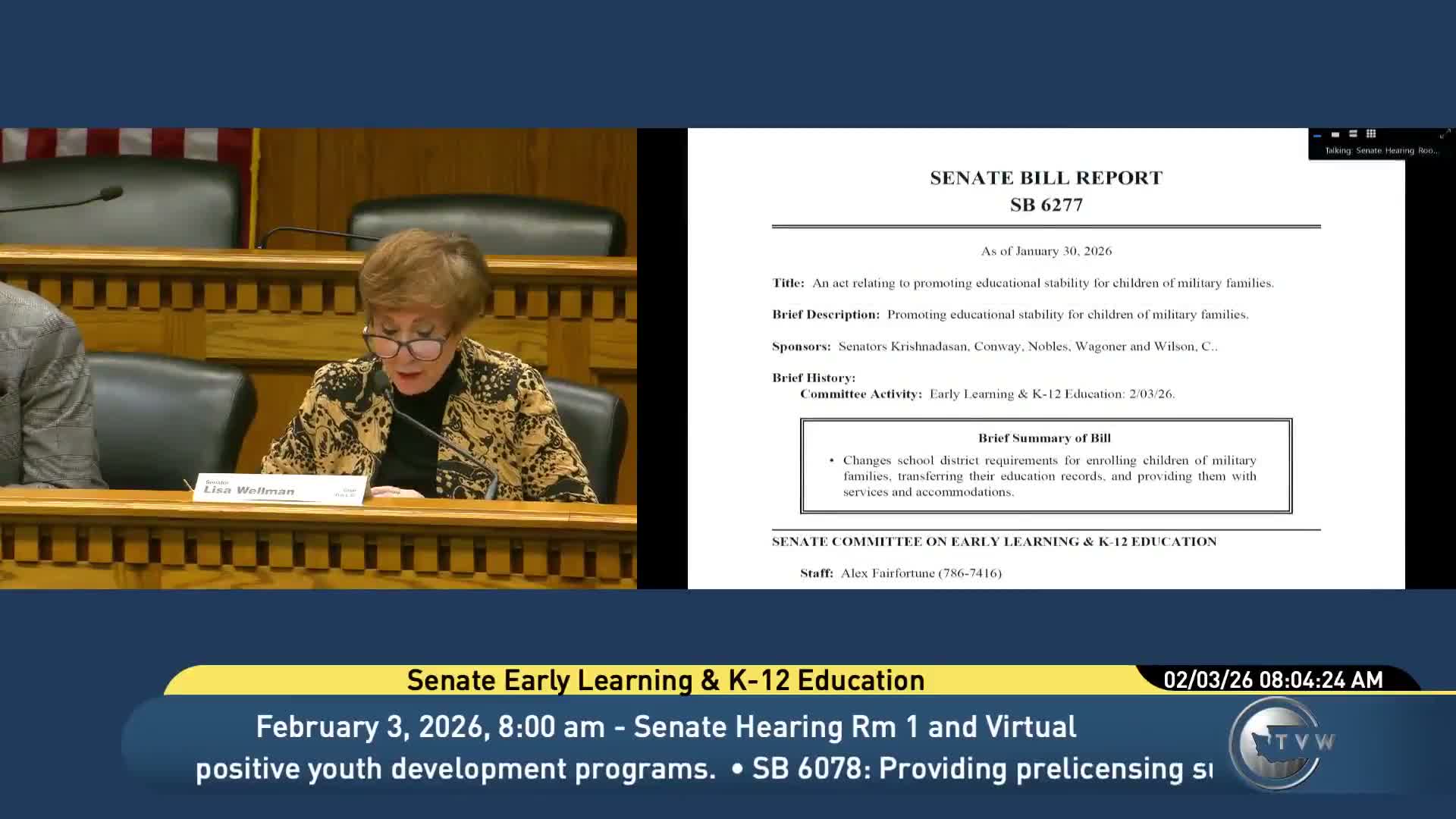
Chair Wellman opened the Early Learning and K‑12 Education Committee and invited testimony on Senate Bill 6,277, a measure aimed at promoting educational stability for children of military families.
Committee staff summarized the bill's key changes: remove an active‑duty residency requirement so families transferring to installations in bordering states or moving for military exigencies can meet enrollment residency rules; extend the deadline to provide proof of residency from 14 days to 90 days; permit conditional electronic applications before families arrive; require districts to accept the transfer of IEP and 504 records and provide appropriate services without unreasonable delay; permit reevaluations, with parental consent, within 30 days if deemed necessary; and clarify that nonresident districts are not required to provide transportation unless state or federal law requires it. Staff noted a fiscal note had been requested but was not yet available.
Multiple witnesses told the committee the bill would reduce disruption for military children. Lake Washington High School senior Kellen Wilk described his family's frequent moves and told senators, “The brave men and women that serve this country have already sacrificed enough, so it'd be the right thing to do to make their life just a little easier and a little less stressful.” Connor Fagan, another senior, said the bill "allows children from military families to enroll before they arrive and helps ensure school records transfer without long gaps." Kate Salveson, a practicing school psychologist representing the Washington State Association of School Psychologists, said the extended timeline and conditional enrollment allow schools to proactively prepare so students with disabilities receive services “as quickly as and appropriately as possible upon arrival.”
Witnesses also emphasized scale and context: Tammy Perot of the Defense State Liaison Office said the state has about 23,500 school‑age military‑connected children and noted many families face multiple moves during a child's K‑12 education, while Natalie Wimberly, president of the Peninsula School District board of directors and a military spouse, told the committee the measure complements the interstate military compact by addressing in‑state transfer stability and district planning for staffing, transportation and special education.
School districts supported the bill’s goals but warned of implementation costs tied to accelerated special‑education timelines. Charlie Brown, speaking on behalf of South Sound superintendents, said the IEP acceleration could create “unintentional costs on school districts,” including the potential need for outside evaluators that may be subject to retail sales tax, and asked the committee to consider changes reflected in the house version that would reduce district costs.
The hearing closed with senators noting the house amendments under consideration and the committee moving to executive session to consider other bills. There was no committee vote on SB 6,277 during this hearing.
Next steps: the bill record will reflect testimony and staff briefings; any subsequent committee action would be posted with fiscal notes and substitute language if adopted.
Committee staff summarized the bill's key changes: remove an active‑duty residency requirement so families transferring to installations in bordering states or moving for military exigencies can meet enrollment residency rules; extend the deadline to provide proof of residency from 14 days to 90 days; permit conditional electronic applications before families arrive; require districts to accept the transfer of IEP and 504 records and provide appropriate services without unreasonable delay; permit reevaluations, with parental consent, within 30 days if deemed necessary; and clarify that nonresident districts are not required to provide transportation unless state or federal law requires it. Staff noted a fiscal note had been requested but was not yet available.
Multiple witnesses told the committee the bill would reduce disruption for military children. Lake Washington High School senior Kellen Wilk described his family's frequent moves and told senators, “The brave men and women that serve this country have already sacrificed enough, so it'd be the right thing to do to make their life just a little easier and a little less stressful.” Connor Fagan, another senior, said the bill "allows children from military families to enroll before they arrive and helps ensure school records transfer without long gaps." Kate Salveson, a practicing school psychologist representing the Washington State Association of School Psychologists, said the extended timeline and conditional enrollment allow schools to proactively prepare so students with disabilities receive services “as quickly as and appropriately as possible upon arrival.”
Witnesses also emphasized scale and context: Tammy Perot of the Defense State Liaison Office said the state has about 23,500 school‑age military‑connected children and noted many families face multiple moves during a child's K‑12 education, while Natalie Wimberly, president of the Peninsula School District board of directors and a military spouse, told the committee the measure complements the interstate military compact by addressing in‑state transfer stability and district planning for staffing, transportation and special education.
School districts supported the bill’s goals but warned of implementation costs tied to accelerated special‑education timelines. Charlie Brown, speaking on behalf of South Sound superintendents, said the IEP acceleration could create “unintentional costs on school districts,” including the potential need for outside evaluators that may be subject to retail sales tax, and asked the committee to consider changes reflected in the house version that would reduce district costs.
The hearing closed with senators noting the house amendments under consideration and the committee moving to executive session to consider other bills. There was no committee vote on SB 6,277 during this hearing.
Next steps: the bill record will reflect testimony and staff briefings; any subsequent committee action would be posted with fiscal notes and substitute language if adopted.
View the Full Meeting & All Its Details
This article offers just a summary. Unlock complete video, transcripts, and insights as a Founder Member.
✓
Watch full, unedited meeting videos
✓
Search every word spoken in unlimited transcripts
✓
AI summaries & real-time alerts (all government levels)
✓
Permanent access to expanding government content
30-day money-back guarantee
