Senate panel advances measure to expand Attorney General investigative powers, rejects some carve-outs for use-of-force probes
February 03, 2026 | Legislative Sessions, Washington
This article was created by AI summarizing key points discussed. AI makes mistakes, so for full details and context, please refer to the video of the full meeting. Please report any errors so we can fix them. Report an error »
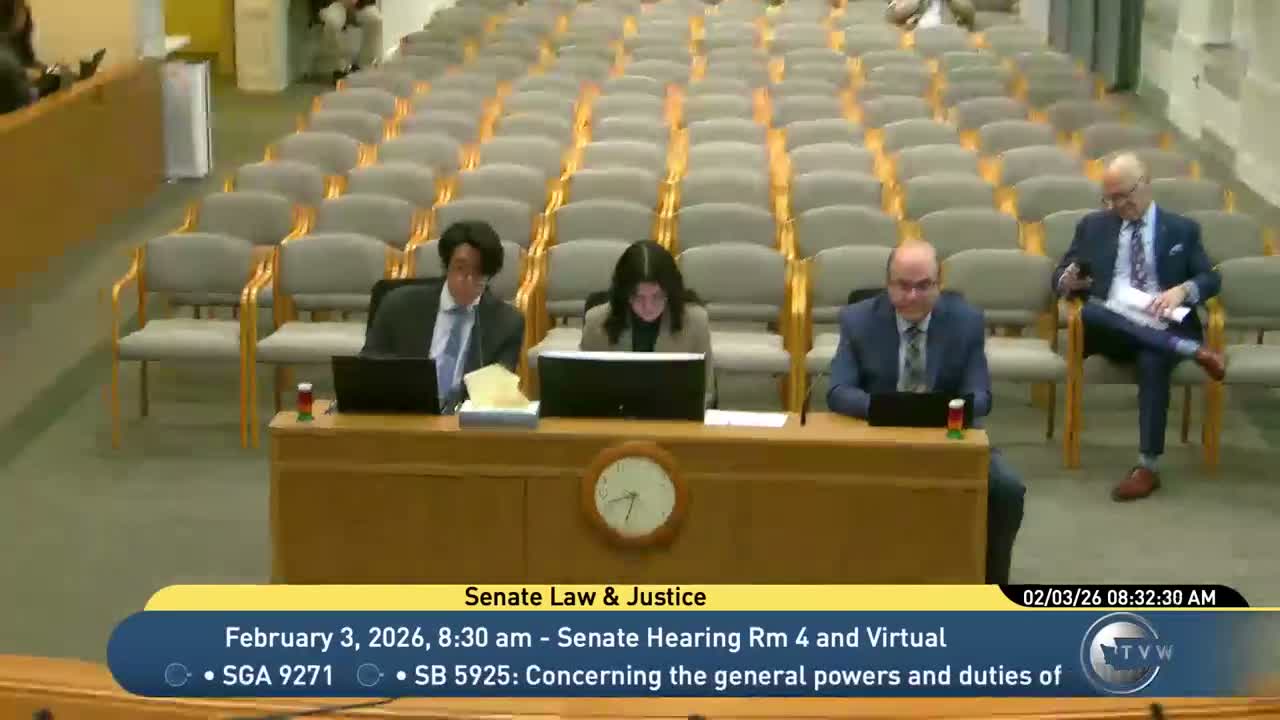
The Senate Law and Justice Committee advanced Senate Bill 5,925 on Feb. 3 after debating several amendments that would limit how and when the Attorney General may issue civil investigative demands.
Ryan Giannini, staff counsel to the committee, told members that SB 5,925 would "grant the Attorney General the authority to issue civil investigative demands to investigate possible violations of The United States Constitution, the Washington State Constitution, and specific state laws." He outlined multiple amendments under consideration.
Amendment alpha, offered by Senator Torres and described by staff, would have prevented the Attorney General from issuing written civil investigative demands to small businesses when investigating wage-law violations; staff clarified that "small business" in the amendment was defined to include limited liability companies with 50 or fewer employees. Senator Torres said the exemption aimed to give smaller employers "a little bit of leeway." The committee rejected the alpha amendment.
Members approved Amendment Charlie, which removes the section of the bill addressing law-enforcement use of force and clarifies that the Attorney General's civil investigative demand authority does not apply to criminal investigations; Charlie also extended administrative response timelines in one provision. Senator Dhingra sponsored Charlie and the committee adopted it.
Senator Wagner proposed Amendment Delta, which would have required the Attorney General to make a documented finding by a preponderance of the evidence that a violation exists before serving a civil investigative demand. Wagner said the amendment was intended to prevent "fishing expeditions." The chair and other members expressed concern that requiring a preponderance finding before seeking documentation could be circular and impede investigations; Delta failed.
After discussion about remaining amendments and whether provisions should be handled on the floor, the committee voted to roll agreed amendments into a new proposed substitute and gave the bill a due-pass recommendation to the Rules Committee, subject to signatures.
The committee's action sends the measure to the Rules calendar; sponsors and staff said they expect to continue refining language on thresholds and law-enforcement-related provisions before floor consideration.
Ryan Giannini, staff counsel to the committee, told members that SB 5,925 would "grant the Attorney General the authority to issue civil investigative demands to investigate possible violations of The United States Constitution, the Washington State Constitution, and specific state laws." He outlined multiple amendments under consideration.
Amendment alpha, offered by Senator Torres and described by staff, would have prevented the Attorney General from issuing written civil investigative demands to small businesses when investigating wage-law violations; staff clarified that "small business" in the amendment was defined to include limited liability companies with 50 or fewer employees. Senator Torres said the exemption aimed to give smaller employers "a little bit of leeway." The committee rejected the alpha amendment.
Members approved Amendment Charlie, which removes the section of the bill addressing law-enforcement use of force and clarifies that the Attorney General's civil investigative demand authority does not apply to criminal investigations; Charlie also extended administrative response timelines in one provision. Senator Dhingra sponsored Charlie and the committee adopted it.
Senator Wagner proposed Amendment Delta, which would have required the Attorney General to make a documented finding by a preponderance of the evidence that a violation exists before serving a civil investigative demand. Wagner said the amendment was intended to prevent "fishing expeditions." The chair and other members expressed concern that requiring a preponderance finding before seeking documentation could be circular and impede investigations; Delta failed.
After discussion about remaining amendments and whether provisions should be handled on the floor, the committee voted to roll agreed amendments into a new proposed substitute and gave the bill a due-pass recommendation to the Rules Committee, subject to signatures.
The committee's action sends the measure to the Rules calendar; sponsors and staff said they expect to continue refining language on thresholds and law-enforcement-related provisions before floor consideration.
View the Full Meeting & All Its Details
This article offers just a summary. Unlock complete video, transcripts, and insights as a Founder Member.
✓
Watch full, unedited meeting videos
✓
Search every word spoken in unlimited transcripts
✓
AI summaries & real-time alerts (all government levels)
✓
Permanent access to expanding government content
30-day money-back guarantee
