Lawmakers debate $500,000 infusion and trust fund for equine rescues; committee vote ties in floor discussion
February 03, 2026 | House of Representatives, Committees, Legislative, New Mexico
This article was created by AI summarizing key points discussed. AI makes mistakes, so for full details and context, please refer to the video of the full meeting. Please report any errors so we can fix them. Report an error »
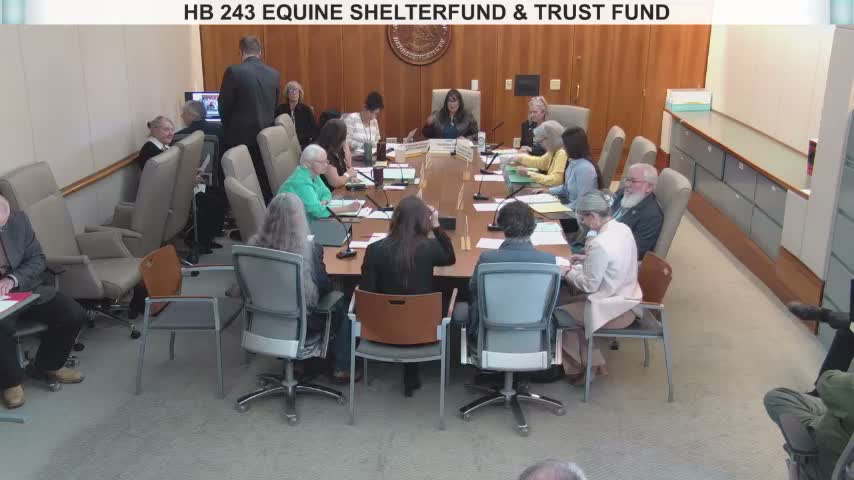
Sponsor introduced HB 243, which aims to strengthen New Mexico's Equine Shelter Rescue Fund and create an Equine Welfare Trust Fund to produce long-term support for nonprofit equine shelters that take in abused, abandoned or seized horses, donkeys and mules.
Panelists described the current system: "New Mexico has 12 nonprofit equine shelters registered with the state that provide services to law enforcement and the New Mexico Livestock Board," said the sponsor. Witnesses told the committee the rescue fund, created in 2013, has received inconsistent appropriations and that tax checkoff donations typically total less than $10,000 per year.
Belinda Garland, executive director of the New Mexico Livestock Board, told members the state relies on rescues for stray and abused equines and contracts with shelters to take animals in when needed: "We rely on them to take these horses. Whenever we have abuse cases, we rely on them. We contract with them to take care of these horses." She urged funding to maintain capacity.
The bill would make a direct $500,000 appropriation to the existing Equine Shelter Rescue Fund, move administration of the fund from the Livestock Board to the Department of Agriculture, strengthen grant requirements and reporting, and create an Equine Welfare Trust Fund seeded with $5,000,000 to generate recurring earnings for the rescue program.
Public commenters who spoke in favor emphasized the shelters' role and raised accountability questions. One commenter, who identified herself as Patience, said the tax checkoff has been small and recounted that at least one horse from a rescue was later sent to auction: "I have gotten, a horse was at least 1 horse was sent to Stroud's Livestock Auction from 1 of these rescues." She asked that rescues' names appear on health certificates rather than listing the Livestock Board as a holding pen.
Committee members pressed on two themes: whether caring for equines is strictly a government function best handled as recurring appropriations to the Livestock Board, and whether creating an investment trust is an appropriate, sustainable response. Representative Cadena said recurring funding through the existing livestock line item would be preferable if the state treats equine welfare as a government responsibility. He and others also expressed concern about proliferating small investment funds and the administrative complexity of moving the fund.
Witnesses and the sponsor defended the trust approach as pragmatic: under bill language, a $5 million seed could produce earnings (estimated at average 6% per year in testimony) whose distributions (capped at 4% of earnings in the bill language as explained) would contribute recurring resources, while the immediate $500,000 payment would be divided among the 12 licensed shelters.
Procedurally, members debated a tabling motion (which failed) and returned to the do-pass motion (moved by Representative Rubio, seconded by Representative Cates). The chair at one point read a 4–4 tally and told members the bill had not passed; members offered explanations for their votes. The transcript does not record a definitive committee passage to the next stage.
Next steps: the transcript ends with members explaining votes and the committee moving on; sponsors may seek further negotiation on administration and funding design before any final floor action.
Panelists described the current system: "New Mexico has 12 nonprofit equine shelters registered with the state that provide services to law enforcement and the New Mexico Livestock Board," said the sponsor. Witnesses told the committee the rescue fund, created in 2013, has received inconsistent appropriations and that tax checkoff donations typically total less than $10,000 per year.
Belinda Garland, executive director of the New Mexico Livestock Board, told members the state relies on rescues for stray and abused equines and contracts with shelters to take animals in when needed: "We rely on them to take these horses. Whenever we have abuse cases, we rely on them. We contract with them to take care of these horses." She urged funding to maintain capacity.
The bill would make a direct $500,000 appropriation to the existing Equine Shelter Rescue Fund, move administration of the fund from the Livestock Board to the Department of Agriculture, strengthen grant requirements and reporting, and create an Equine Welfare Trust Fund seeded with $5,000,000 to generate recurring earnings for the rescue program.
Public commenters who spoke in favor emphasized the shelters' role and raised accountability questions. One commenter, who identified herself as Patience, said the tax checkoff has been small and recounted that at least one horse from a rescue was later sent to auction: "I have gotten, a horse was at least 1 horse was sent to Stroud's Livestock Auction from 1 of these rescues." She asked that rescues' names appear on health certificates rather than listing the Livestock Board as a holding pen.
Committee members pressed on two themes: whether caring for equines is strictly a government function best handled as recurring appropriations to the Livestock Board, and whether creating an investment trust is an appropriate, sustainable response. Representative Cadena said recurring funding through the existing livestock line item would be preferable if the state treats equine welfare as a government responsibility. He and others also expressed concern about proliferating small investment funds and the administrative complexity of moving the fund.
Witnesses and the sponsor defended the trust approach as pragmatic: under bill language, a $5 million seed could produce earnings (estimated at average 6% per year in testimony) whose distributions (capped at 4% of earnings in the bill language as explained) would contribute recurring resources, while the immediate $500,000 payment would be divided among the 12 licensed shelters.
Procedurally, members debated a tabling motion (which failed) and returned to the do-pass motion (moved by Representative Rubio, seconded by Representative Cates). The chair at one point read a 4–4 tally and told members the bill had not passed; members offered explanations for their votes. The transcript does not record a definitive committee passage to the next stage.
Next steps: the transcript ends with members explaining votes and the committee moving on; sponsors may seek further negotiation on administration and funding design before any final floor action.
View the Full Meeting & All Its Details
This article offers just a summary. Unlock complete video, transcripts, and insights as a Founder Member.
✓
Watch full, unedited meeting videos
✓
Search every word spoken in unlimited transcripts
✓
AI summaries & real-time alerts (all government levels)
✓
Permanent access to expanding government content
30-day money-back guarantee
