New Mexico Senate committee backs study into forced sterilization after survivor testimony
February 03, 2026 | Senate, Committees, Legislative, New Mexico
This article was created by AI summarizing key points discussed. AI makes mistakes, so for full details and context, please refer to the video of the full meeting. Please report any errors so we can fix them. Report an error »
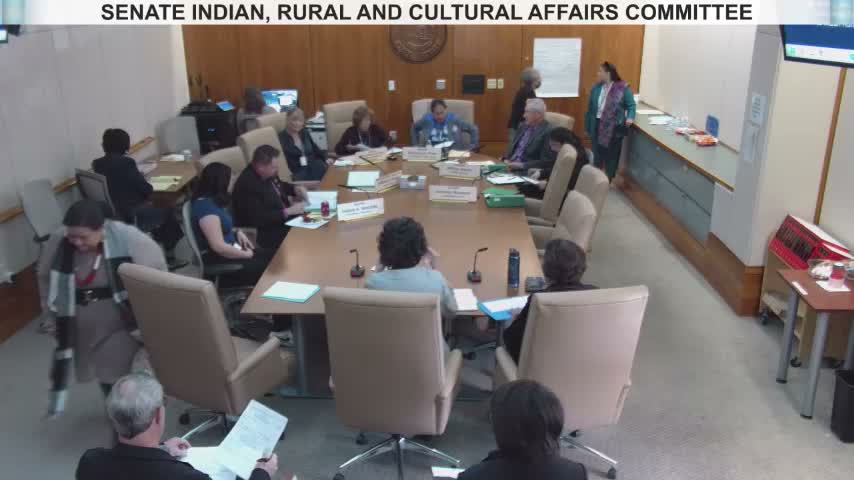
The New Mexico Senate Indian Affairs Committee voted 4–0 on a committee recommendation to advance Senate Memorial 14, a measure requesting a comprehensive study into the forced and coerced sterilization of Indigenous women and women of color in New Mexico.
Senate Memorial 14, introduced by committee sponsors, asks the Department of Indian Affairs and the Commission on the Status of Women to lead a culturally sensitive investigation into the history, scope and continuing impacts of sterilizations carried out without free, prior and informed consent. "We have Senate Memorial 14, which is to address the forced sterilization policy," the sponsor told the committee as the measure was presented.
The committee heard survivor testimony, academic research and advocacy statements. Jean Whitehorse, a member of the Navajo Nation, described being sterilized in 1972 at the Gallup Indian Health Service facility without her knowledge or informed consent and urged the committee to "consider this memorial and how it affects your constituents." Representative Caballero, who is sponsoring a companion memorial in the House, described a personal near‑miss — forms presented while sedated that contained a checked box for a hysterectomy she had not agreed to — and said survivor testimony had given her the courage to support the legislation.
Research testimony from Keeley Badger summarized decades‑old government and academic work and described a large information gap. Badger cited a government review that examined four Indian Health Service clinics for the period 1973–1976 and said that review found more than 4,500 Native American women sterilized in that sample. She told the committee that state‑level requests and political will would likely be necessary to access sealed or difficult‑to‑retrieve records and to provide safe, confidential spaces for survivors to come forward.
Jennifer Rafael Goetz, director of the Commission on the Status of Women, outlined a three‑phase plan the commission would use if charged with the work: (1) gather data and historical records, (2) hold community conversations guided by Indigenous subject‑matter partners, and (3) contract with Indigenous‑led organizations to prepare the final report in collaboration with the commission.
Advocates and civil‑rights groups urged the committee to fund culturally competent research and survivor protection. Diana Warren, an attorney with the ACLU of New Mexico, called the memorial "a critical step toward truth, justice, and healing," and Rachel Lorenzo, founder of Indigenous Women Rising, said addressing reproductive coercion is essential to reproductive justice. Other witnesses — including representatives of NM Native Vote, Bold Futures and student advocates — urged support and emphasized data sovereignty and survivor testimony.
Committee members asked how records would be obtained and whether records exist or are being blocked. Badger said researchers encountered archival obstacles and that official state requests and contracted capacity would likely be required to assemble a complete record.
Following the testimony and questions, a committee member moved a "do pass" recommendation. The clerk called the roll and recorded yes votes from Senators Mayesas, Sanchez, Solis and Pinto; the clerk and chair announced a 4–0 do‑pass recommendation, sending the memorial forward with the committee’s endorsement.
The committee record shows broad testimony in favor of the memorial but no recorded public opposition during the hearing. The chair noted the memorial remains in Senate Rules and that further scheduling would be determined by Senate leadership.
Next steps: with a committee "do pass" recommendation, the memorial may move through Senate Rules and to the full chamber or be scheduled as appropriate under chamber procedures.
Senate Memorial 14, introduced by committee sponsors, asks the Department of Indian Affairs and the Commission on the Status of Women to lead a culturally sensitive investigation into the history, scope and continuing impacts of sterilizations carried out without free, prior and informed consent. "We have Senate Memorial 14, which is to address the forced sterilization policy," the sponsor told the committee as the measure was presented.
The committee heard survivor testimony, academic research and advocacy statements. Jean Whitehorse, a member of the Navajo Nation, described being sterilized in 1972 at the Gallup Indian Health Service facility without her knowledge or informed consent and urged the committee to "consider this memorial and how it affects your constituents." Representative Caballero, who is sponsoring a companion memorial in the House, described a personal near‑miss — forms presented while sedated that contained a checked box for a hysterectomy she had not agreed to — and said survivor testimony had given her the courage to support the legislation.
Research testimony from Keeley Badger summarized decades‑old government and academic work and described a large information gap. Badger cited a government review that examined four Indian Health Service clinics for the period 1973–1976 and said that review found more than 4,500 Native American women sterilized in that sample. She told the committee that state‑level requests and political will would likely be necessary to access sealed or difficult‑to‑retrieve records and to provide safe, confidential spaces for survivors to come forward.
Jennifer Rafael Goetz, director of the Commission on the Status of Women, outlined a three‑phase plan the commission would use if charged with the work: (1) gather data and historical records, (2) hold community conversations guided by Indigenous subject‑matter partners, and (3) contract with Indigenous‑led organizations to prepare the final report in collaboration with the commission.
Advocates and civil‑rights groups urged the committee to fund culturally competent research and survivor protection. Diana Warren, an attorney with the ACLU of New Mexico, called the memorial "a critical step toward truth, justice, and healing," and Rachel Lorenzo, founder of Indigenous Women Rising, said addressing reproductive coercion is essential to reproductive justice. Other witnesses — including representatives of NM Native Vote, Bold Futures and student advocates — urged support and emphasized data sovereignty and survivor testimony.
Committee members asked how records would be obtained and whether records exist or are being blocked. Badger said researchers encountered archival obstacles and that official state requests and contracted capacity would likely be required to assemble a complete record.
Following the testimony and questions, a committee member moved a "do pass" recommendation. The clerk called the roll and recorded yes votes from Senators Mayesas, Sanchez, Solis and Pinto; the clerk and chair announced a 4–0 do‑pass recommendation, sending the memorial forward with the committee’s endorsement.
The committee record shows broad testimony in favor of the memorial but no recorded public opposition during the hearing. The chair noted the memorial remains in Senate Rules and that further scheduling would be determined by Senate leadership.
Next steps: with a committee "do pass" recommendation, the memorial may move through Senate Rules and to the full chamber or be scheduled as appropriate under chamber procedures.
View the Full Meeting & All Its Details
This article offers just a summary. Unlock complete video, transcripts, and insights as a Founder Member.
✓
Watch full, unedited meeting videos
✓
Search every word spoken in unlimited transcripts
✓
AI summaries & real-time alerts (all government levels)
✓
Permanent access to expanding government content
30-day money-back guarantee
