Senate committee advances bill to bar public bodies from ICE detention contracts
February 02, 2026 | Senate, Committees, Legislative, New Mexico
This article was created by AI summarizing key points discussed. AI makes mistakes, so for full details and context, please refer to the video of the full meeting. Please report any errors so we can fix them. Report an error »
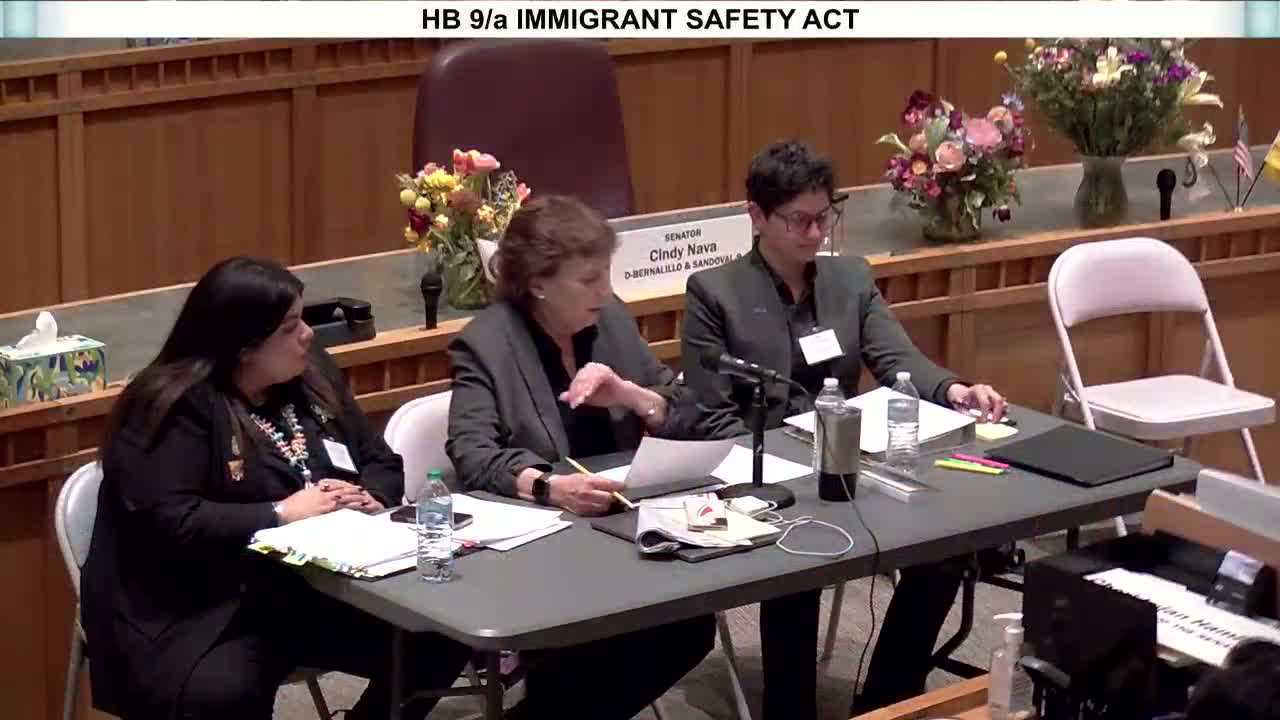
The Senate Judiciary Committee recommended advancing House Bill 9 on a 5‑3 vote after extended debate over whether New Mexico should withdraw public‑body participation in immigration detention.
Senator Chavez, the bill sponsor, told the committee that "ICE has become more dangerous and less accountable than ever," and described HB9 as the "Immigrant Safety Act," which would prohibit any public body from entering agreements to detain individuals for federal immigration violations, require termination of existing agreements "at the earliest possible date," and preserve ordinary local cooperation with federal law enforcement on non‑immigration matters.
Supporters who testified said the bill is a public‑safety and accountability measure. Janet Williams of the National Organization for Women said detention centers are "cruel and inhuman" and urged senators to back the measure. Bruce Thompson, a New Mexico trial lawyer, testified that "when detention becomes a revenue model the incentives are predictable," arguing the state should not use public property or contracts to enable a private detention marketplace.
Opponents stressed economic and logistical harms for rural communities that host detention facilities. Candy Williams, a village manager, described a town with about 2,300 residents and a 1,300‑bed facility that currently has roughly 600 beds occupied, of which about 200 are ICE detainees; she warned that losing 200 detainees would remove about one‑third of current bed usage and could push the village below thresholds for federal grant funding. Carlos Sontag, president and CEO of the New Mexico Business Coalition, said the bill "puts hundreds and potentially thousands of jobs at risk" and would destabilize local economies that rely on detention facilities as major employers.
Lawmakers pressed both sides on practical consequences and legal risk. Senator Townsend and others asked where detainees would be sent if public‑body contracts end and whether counties and employees would be held harmless; sponsors replied that HB9 does not mandate facility closures and that ICE retains discretion over where to hold people, but that the bill removes one contracting option (intergovernmental service agreements) from public bodies. Senator Brantley raised a Third Circuit decision that struck down a New Jersey ban on federal detention contracts; counsel for the bill said HB9 is narrower — withdrawing state involvement rather than regulating federal contractors — and cited agency analyses (including the New Mexico Department of Justice) the sponsors say support that view.
After roughly three hours of testimony and questioning, the committee moved and recorded a due‑pass recommendation on HB9, taken by roll call and announced in the record as 5 in favor and 3 opposed. The committee chair said the bill will proceed according to the legislative calendar.
What happens next: HB9 now moves toward the full Senate calendar where floor action and any additional amendments or legal analyses will be possible.
Senator Chavez, the bill sponsor, told the committee that "ICE has become more dangerous and less accountable than ever," and described HB9 as the "Immigrant Safety Act," which would prohibit any public body from entering agreements to detain individuals for federal immigration violations, require termination of existing agreements "at the earliest possible date," and preserve ordinary local cooperation with federal law enforcement on non‑immigration matters.
Supporters who testified said the bill is a public‑safety and accountability measure. Janet Williams of the National Organization for Women said detention centers are "cruel and inhuman" and urged senators to back the measure. Bruce Thompson, a New Mexico trial lawyer, testified that "when detention becomes a revenue model the incentives are predictable," arguing the state should not use public property or contracts to enable a private detention marketplace.
Opponents stressed economic and logistical harms for rural communities that host detention facilities. Candy Williams, a village manager, described a town with about 2,300 residents and a 1,300‑bed facility that currently has roughly 600 beds occupied, of which about 200 are ICE detainees; she warned that losing 200 detainees would remove about one‑third of current bed usage and could push the village below thresholds for federal grant funding. Carlos Sontag, president and CEO of the New Mexico Business Coalition, said the bill "puts hundreds and potentially thousands of jobs at risk" and would destabilize local economies that rely on detention facilities as major employers.
Lawmakers pressed both sides on practical consequences and legal risk. Senator Townsend and others asked where detainees would be sent if public‑body contracts end and whether counties and employees would be held harmless; sponsors replied that HB9 does not mandate facility closures and that ICE retains discretion over where to hold people, but that the bill removes one contracting option (intergovernmental service agreements) from public bodies. Senator Brantley raised a Third Circuit decision that struck down a New Jersey ban on federal detention contracts; counsel for the bill said HB9 is narrower — withdrawing state involvement rather than regulating federal contractors — and cited agency analyses (including the New Mexico Department of Justice) the sponsors say support that view.
After roughly three hours of testimony and questioning, the committee moved and recorded a due‑pass recommendation on HB9, taken by roll call and announced in the record as 5 in favor and 3 opposed. The committee chair said the bill will proceed according to the legislative calendar.
What happens next: HB9 now moves toward the full Senate calendar where floor action and any additional amendments or legal analyses will be possible.
View the Full Meeting & All Its Details
This article offers just a summary. Unlock complete video, transcripts, and insights as a Founder Member.
✓
Watch full, unedited meeting videos
✓
Search every word spoken in unlimited transcripts
✓
AI summaries & real-time alerts (all government levels)
✓
Permanent access to expanding government content
30-day money-back guarantee
