Senate committee backs study into forced and coerced sterilization of Indigenous women and women of color
February 02, 2026 | Senate, Committees, Legislative, New Mexico
This article was created by AI summarizing key points discussed. AI makes mistakes, so for full details and context, please refer to the video of the full meeting. Please report any errors so we can fix them. Report an error »
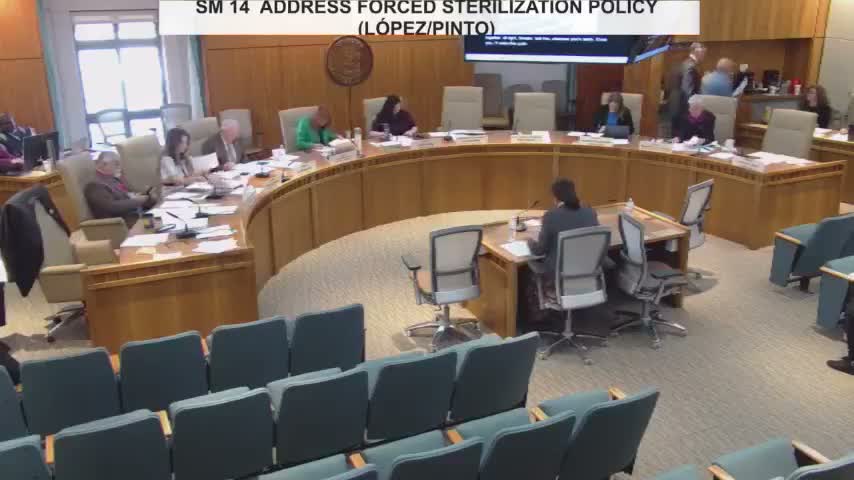
The Senate Rules Committee voted to give Senate Memorial 14 a "do pass," endorsing a study of forced and coerced sterilization of Indigenous women and women of color in New Mexico and exploring a state-level truth and reconciliation process.
Sponsor remarks framed the memorial as a step to document the scale and scope of past harms and to begin reconciliation. Keeley Badger, an international human rights attorney who has investigated coerced sterilization, told the committee that preliminary Government Accountability Office work on four Indian Health Service facilities found more than 3,400 Native American women were sterilized during a three-year span (1973–1976), and that independent investigations have hypothesized much larger totals; Badger and other witnesses urged a state-level study and acknowledgment.
Multiple survivors and family members gave testimony. Jean Whitehorse described learning two years after an operation in 1972 that she had been sterilized and urged the committee to treat the memorial as more than text: "I urge this committee to consider the memorial and how it affects your constituents," she said. Rachel Lorenzo and Dr. Christine Benally described personal and family impacts; Planned Parenthood and Indigenous Women Rising representatives also voiced support.
Some senators expressed procedural concerns about the memorial as a vehicle to create a commission and noted that the Indian Affairs Department and the Commission on the Status of Women appeared to have capacity concerns or were not fully endorsing the specific vehicle; sponsors said they had met with agency staff and sought to design culturally responsible data collection and possible grant funding to support the work.
Sponsor moved a 'do pass' and the committee recorded a roll-call result with seven in favor and two opposed. Senator Gallegos explained her 'no' vote while expressing sympathy for survivors.
The memorial requests agencies to study historical and contemporary practices and does not itself create a binding statutory remedy; it does, however, direct legislative attention to the issue and seeks recommendations for acknowledgment, investigation and possible reconciliation steps.
Sponsor remarks framed the memorial as a step to document the scale and scope of past harms and to begin reconciliation. Keeley Badger, an international human rights attorney who has investigated coerced sterilization, told the committee that preliminary Government Accountability Office work on four Indian Health Service facilities found more than 3,400 Native American women were sterilized during a three-year span (1973–1976), and that independent investigations have hypothesized much larger totals; Badger and other witnesses urged a state-level study and acknowledgment.
Multiple survivors and family members gave testimony. Jean Whitehorse described learning two years after an operation in 1972 that she had been sterilized and urged the committee to treat the memorial as more than text: "I urge this committee to consider the memorial and how it affects your constituents," she said. Rachel Lorenzo and Dr. Christine Benally described personal and family impacts; Planned Parenthood and Indigenous Women Rising representatives also voiced support.
Some senators expressed procedural concerns about the memorial as a vehicle to create a commission and noted that the Indian Affairs Department and the Commission on the Status of Women appeared to have capacity concerns or were not fully endorsing the specific vehicle; sponsors said they had met with agency staff and sought to design culturally responsible data collection and possible grant funding to support the work.
Sponsor moved a 'do pass' and the committee recorded a roll-call result with seven in favor and two opposed. Senator Gallegos explained her 'no' vote while expressing sympathy for survivors.
The memorial requests agencies to study historical and contemporary practices and does not itself create a binding statutory remedy; it does, however, direct legislative attention to the issue and seeks recommendations for acknowledgment, investigation and possible reconciliation steps.
View the Full Meeting & All Its Details
This article offers just a summary. Unlock complete video, transcripts, and insights as a Founder Member.
✓
Watch full, unedited meeting videos
✓
Search every word spoken in unlimited transcripts
✓
AI summaries & real-time alerts (all government levels)
✓
Permanent access to expanding government content
30-day money-back guarantee
