Senate committee advances domestic‑terrorism designation process and narrow public‑records exemptions amid heavy public pushback
February 03, 2026 | 2026 Legislature FL, Florida
This article was created by AI summarizing key points discussed. AI makes mistakes, so for full details and context, please refer to the video of the full meeting. Please report any errors so we can fix them. Report an error »
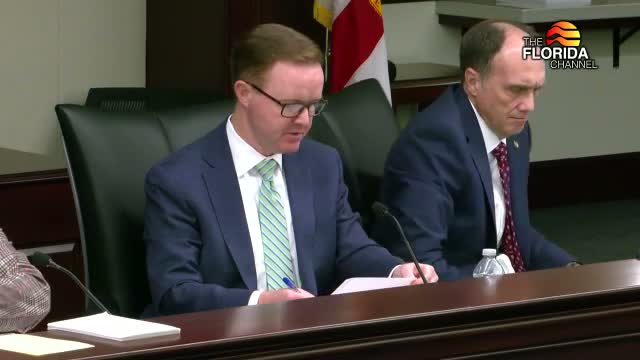
A Senate committee on Feb. 4 advanced SB 1632, which would create a state process for designating domestic terrorist organizations and attach penalties and restrictions for promotion or material support, and SB 1634, which would create limited public‑records exemptions for evidence critical to state or national security.
Sponsor remarks and supporters framed the measures as filling legal and administrative gaps. "SB 16 32 is a constitution first public safety bill," the sponsor said, describing a designation procedure modeled on existing federal processes and a CPI‑indexed approach to certain limits elsewhere in state law. Supporters from public‑safety and policy groups argued the bills would help identify and counter foreign influence and violent networks.
But senators pressed the sponsor repeatedly on due‑process and First Amendment risks. One senator asked whether a student who retweeted content could be deemed to be "promoting" a designated organization; the sponsor replied that designation and sanctions would be fact‑specific and require intent and criminal acts beyond mere speech. Several senators sought clarity about who would get notice when a designation was considered and how much of the administrative record would be discoverable in court.
Public testimony was extensive and sharply divided. Civil‑liberties groups including Common Cause and the Southern Poverty Law Center warned that the definition and discretionary designation process could sweep in nonviolent civil‑disobedience and political organizing. "This bill could treat nonviolent civil disobedience as terrorist activity," Amy Keith of Common Cause warned. Labor and faith‑group witnesses raised similar concerns about broad or disparate application. Conversely, national‑security researchers and criminal‑justice experts urged stronger transparency and registration tools to deter malign influence and foreign‑backed operations.
The committee adopted a technical amendment clarifying references to the governor and cabinet and other cross references, then took final votes: CS for SB 16 32 was reported favorably (8 yeas, 3 nays) and CS for SB 16 34 (records exemption) was reported favorably (7 yeas, 4 nays). Sponsors said they expect further refinements in later committees.
What remains unresolved: Opponents repeatedly asked for clearer evidentiary standards and stronger safeguards for free‑speech activity and student conduct; supporters argued those safeguards exist via statutory definitions and judicial review. The bills now move to additional committees where sponsors said they will accept technical and substantive edits.
Sponsor remarks and supporters framed the measures as filling legal and administrative gaps. "SB 16 32 is a constitution first public safety bill," the sponsor said, describing a designation procedure modeled on existing federal processes and a CPI‑indexed approach to certain limits elsewhere in state law. Supporters from public‑safety and policy groups argued the bills would help identify and counter foreign influence and violent networks.
But senators pressed the sponsor repeatedly on due‑process and First Amendment risks. One senator asked whether a student who retweeted content could be deemed to be "promoting" a designated organization; the sponsor replied that designation and sanctions would be fact‑specific and require intent and criminal acts beyond mere speech. Several senators sought clarity about who would get notice when a designation was considered and how much of the administrative record would be discoverable in court.
Public testimony was extensive and sharply divided. Civil‑liberties groups including Common Cause and the Southern Poverty Law Center warned that the definition and discretionary designation process could sweep in nonviolent civil‑disobedience and political organizing. "This bill could treat nonviolent civil disobedience as terrorist activity," Amy Keith of Common Cause warned. Labor and faith‑group witnesses raised similar concerns about broad or disparate application. Conversely, national‑security researchers and criminal‑justice experts urged stronger transparency and registration tools to deter malign influence and foreign‑backed operations.
The committee adopted a technical amendment clarifying references to the governor and cabinet and other cross references, then took final votes: CS for SB 16 32 was reported favorably (8 yeas, 3 nays) and CS for SB 16 34 (records exemption) was reported favorably (7 yeas, 4 nays). Sponsors said they expect further refinements in later committees.
What remains unresolved: Opponents repeatedly asked for clearer evidentiary standards and stronger safeguards for free‑speech activity and student conduct; supporters argued those safeguards exist via statutory definitions and judicial review. The bills now move to additional committees where sponsors said they will accept technical and substantive edits.
Don't Miss a Word: See the Full Meeting!
Go beyond summaries. Unlock every video, transcript, and key insight with a Founder Membership.
✓
Get instant access to full meeting videos
✓
Search and clip any phrase from complete transcripts
✓
Receive AI-powered summaries & custom alerts
✓
Enjoy lifetime, unrestricted access to government data
30-day money-back guarantee
