Committee advances Salzman campus safety bill expanding Guardian program to colleges
February 03, 2026 | 2026 Legislature FL, Florida
This article was created by AI summarizing key points discussed. AI makes mistakes, so for full details and context, please refer to the video of the full meeting. Please report any errors so we can fix them. Report an error »
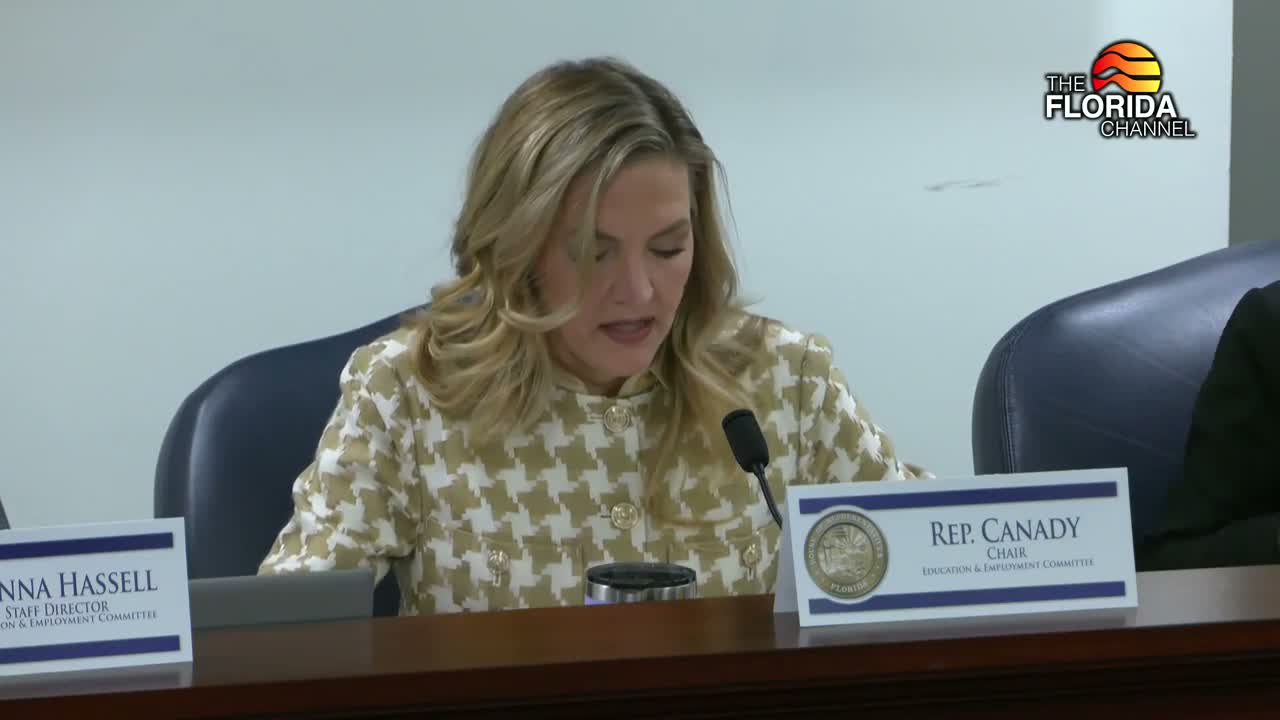
Representative Salzman presented CS/4 HB 7 57 as a higher-education adaptation of elements of the Marjory Stoneman Douglas law, saying it would build prevention and response systems for public colleges and universities. Key provisions she described include an opt-in expansion of the Guardian program to allow faculty and staff to qualify through background checks and required training; grant or scholarship funding to support participation; campuswide rapid-alert and reunification plans; threat-assessment teams; guidance from the commissioner and chancellor on information-sharing; annual security assessments; and a 1,000-foot buffer extending certain penalties for firearm discharges around campuses.
Emily Stewart, an assistant professor at Florida State University who testified in opposition, recounted her experience during the April FSU shooting and warned that adding armed, ‘‘somewhat trained’’ civilians could complicate police response and increase risk during chaotic incidents. Organizational witnesses—including representatives of the State University System and Pensacola State College—waved in support. Committee members praised the sponsor’s work but pressed for clarity on details including whether security plans would be public records, how guardians would be identified during an incident, and how the program would coordinate across multiple responding agencies.
Representative Salzman said the program is opt-in, requires background checks and more than 180 hours of training, requires concealed-carry permits and limits carriage to working hours, and that campuses would create and communicate response plans. After extended debate the committee voted 17-0 to report the bill favorably.
The hearing did not resolve all operational questions; members requested amendment language and clearer guidance on public access to security plans, interoperability with law enforcement, and how the program would be implemented at smaller state colleges.
Emily Stewart, an assistant professor at Florida State University who testified in opposition, recounted her experience during the April FSU shooting and warned that adding armed, ‘‘somewhat trained’’ civilians could complicate police response and increase risk during chaotic incidents. Organizational witnesses—including representatives of the State University System and Pensacola State College—waved in support. Committee members praised the sponsor’s work but pressed for clarity on details including whether security plans would be public records, how guardians would be identified during an incident, and how the program would coordinate across multiple responding agencies.
Representative Salzman said the program is opt-in, requires background checks and more than 180 hours of training, requires concealed-carry permits and limits carriage to working hours, and that campuses would create and communicate response plans. After extended debate the committee voted 17-0 to report the bill favorably.
The hearing did not resolve all operational questions; members requested amendment language and clearer guidance on public access to security plans, interoperability with law enforcement, and how the program would be implemented at smaller state colleges.
Don't Miss a Word: See the Full Meeting!
Go beyond summaries. Unlock every video, transcript, and key insight with a Founder Membership.
✓
Get instant access to full meeting videos
✓
Search and clip any phrase from complete transcripts
✓
Receive AI-powered summaries & custom alerts
✓
Enjoy lifetime, unrestricted access to government data
30-day money-back guarantee
