House committee approves agriculture 'cleanup' bill with tweak to brand language
February 02, 2026 | 2026 Utah Legislature, Utah Legislature, Utah Legislative Branch, Utah
This article was created by AI summarizing key points discussed. AI makes mistakes, so for full details and context, please refer to the video of the full meeting. Please report any errors so we can fix them. Report an error »
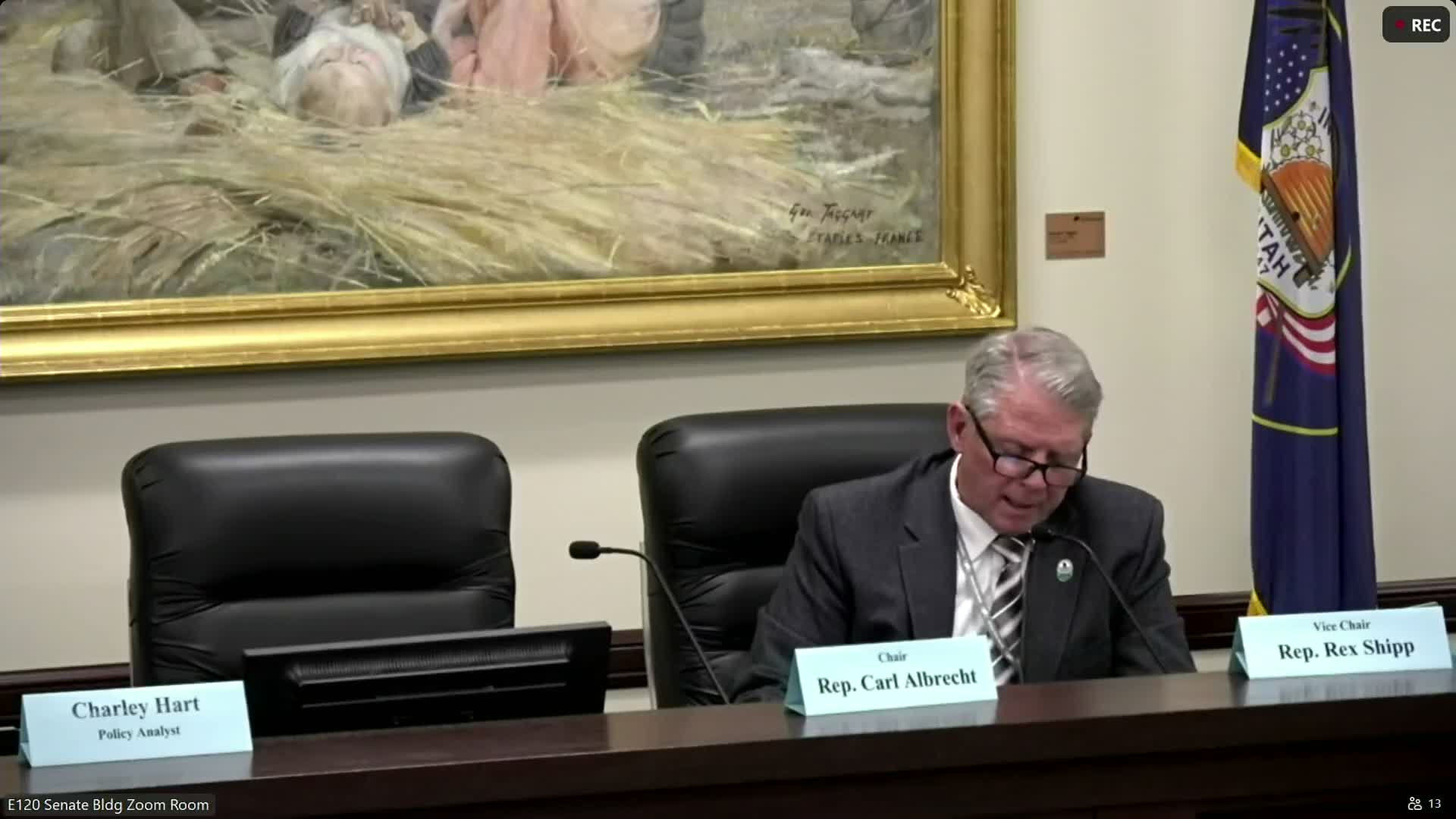
Representative Albrecht, sponsor of HB 369, told the committee the bill is the annual agricultural and food 'cleanup' measure and contains seven narrow statutory changes, including shifting some mandates from 'shall' to 'may,' clarifying emergency uses of ARTL loans and adding an expendable special revenue fund for weights and measures. Albrecht said the changes were vetted with stakeholders and are smaller than last year’s bill.
Amber Brown, Deputy Commissioner at the Utah Department of Agriculture and Food, told the committee the department supports the bill and that Representative Albrecht had covered the substantive points. During committee questioning, Representative Tiara Chu raised concerns about proposed removal of language that had allowed tattoos or shaping of the brisket area to be recognized as registered brands, saying some families had relied on brisket‑shaping to identify livestock.
Wade Garrett, vice president of the Utah Farm Bureau, said ear tattoos used for brucellosis identification and lip tattoos would remain recognized and that the housekeeping change targeted only brisket‑area tattoo language that had not been used for decades. Troy Forrest, deputy commissioner at UDAF, said wattles (also called 'waddles' in testimony) and other identifying marks would still be permitted as identifying marks and that the department’s intent was cleanup, not removal of longstanding identification tools.
Representative Chu offered a verbal amendment to retain shaping of the ears or brisket while striking the word 'tattoo.' The sponsor agreed and the committee adopted the amendment by voice vote. Chu then moved that the committee pass HB 369 favorably as amended; the committee approved the motion unanimously by voice vote.
The committee record shows broad stakeholder support—several producer groups testified in favor—and the sponsor said the goal is to remove obsolete language while leaving practical identification options in place. The bill next proceeds to the full House for further consideration.
Amber Brown, Deputy Commissioner at the Utah Department of Agriculture and Food, told the committee the department supports the bill and that Representative Albrecht had covered the substantive points. During committee questioning, Representative Tiara Chu raised concerns about proposed removal of language that had allowed tattoos or shaping of the brisket area to be recognized as registered brands, saying some families had relied on brisket‑shaping to identify livestock.
Wade Garrett, vice president of the Utah Farm Bureau, said ear tattoos used for brucellosis identification and lip tattoos would remain recognized and that the housekeeping change targeted only brisket‑area tattoo language that had not been used for decades. Troy Forrest, deputy commissioner at UDAF, said wattles (also called 'waddles' in testimony) and other identifying marks would still be permitted as identifying marks and that the department’s intent was cleanup, not removal of longstanding identification tools.
Representative Chu offered a verbal amendment to retain shaping of the ears or brisket while striking the word 'tattoo.' The sponsor agreed and the committee adopted the amendment by voice vote. Chu then moved that the committee pass HB 369 favorably as amended; the committee approved the motion unanimously by voice vote.
The committee record shows broad stakeholder support—several producer groups testified in favor—and the sponsor said the goal is to remove obsolete language while leaving practical identification options in place. The bill next proceeds to the full House for further consideration.
View the Full Meeting & All Its Details
This article offers just a summary. Unlock complete video, transcripts, and insights as a Founder Member.
✓
Watch full, unedited meeting videos
✓
Search every word spoken in unlimited transcripts
✓
AI summaries & real-time alerts (all government levels)
✓
Permanent access to expanding government content
30-day money-back guarantee
