Administration proposes FY27 budget with boosts for education, roads, safety and AI; lawmakers press voucher costs
February 03, 2026 | 2026 Legislature TN, Tennessee
This article was created by AI summarizing key points discussed. AI makes mistakes, so for full details and context, please refer to the video of the full meeting. Please report any errors so we can fix them. Report an error »
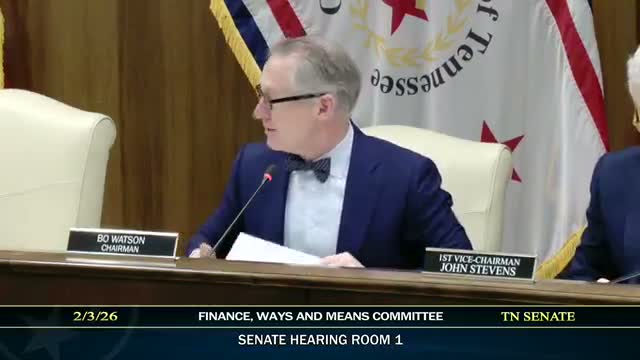
Commissioner Bryson (identified in the meeting agenda as Commissioner Bryson) presented the administration's FY27 budget highlights to the Senate Finance, Ways and Means Committee on Feb. 3.
Bryson framed the budget around modest economic growth (about 2.35% for FY27) and an emphasis on "rightsizing" after years of atypical revenue growth. The proposal listed approximately $2.5 to $2.6 billion in available revenues for the general fund side of the budget and outlined major priorities:
- K'12 and TISA: $339 million additional for public education overall, including $250 million aimed at TISA (the state funding formula). Bryson said the budget meets the administration's goal of raising starting teacher pay to $50,000. "This general assembly and this administration have demonstrated deep and lasting commitment to Tennessee's public education," he said.
- Education Freedom Scholarships: The administration included $155 million in scholarship funding to cover inflation for prior slots and to support 20,000 additional scholarship slots; members disputed how much of that amount is recurring or requires legislative action. Director David Thurman explained his office scored first-year collections from a recent vaping tax as set aside in a reserve for the legislature while later-year estimates were treated as recurring revenue in the administration's recommendation.
- Roads and infrastructure: The budget proposes $400 million nonrecurring and $25 million recurring to address a multibillion-dollar roads backlog; members debated the pace and prioritization for TDOT and noted a larger structural funding problem remains.
- Public safety and Memphis grants: The proposal would add 50 road troopers and $80 million in Memphis-focused safety grants (downtown safety, violent-crime reduction, and workforce programs).
- Technology and AI: The administration proposed a $70 million down payment to modernize "Edison" (the state's 20-year-old enterprise system), $20 million to complete North Data Center work, $20 million for a quantum backbone network, and $50 million nonrecurring to manage AI services, data and risk.
- Capital and other: The capital budget includes billions in higher-education capital projects (UT Health Sciences Center and others), $71 million for higher-education maintenance and a proposed $20 million addition to the rainy day fund.
Members pressed repeatedly on the long-term affordability of the scholarship expansion and on whether the administration is relying on nonrecurring solutions to cover recurring needs. Senator Yarbrough warned of eroding purchasing power if revenue growth continues to lag inflation, and Director Thurman said the office did not project an increase in purchasing power in the immediate forecasting period.
On workforce and AI, Senator Lamar asked about job losses; the commissioner said the administration expects many current employees to be retirement-eligible and that the state plans to retrain and reshape positions, and that AI tools could capture institutional knowledge to aid transitions.
Why it matters: The administration's budget proposal sets priorities for education, infrastructure, public safety and emerging technology; several items (voucher expansion, road funding, the Edison project and AI reserve) will require committee scrutiny on recurring cost, funding source and implementation safeguards.
Next steps: The Senate Finance Committee will continue hearings and gather follow-up numbers, including more detail on TISA attendance assumptions, the precise treatment of new tax collections, and program-level implementation guidance for capital and grant proposals.
Bryson framed the budget around modest economic growth (about 2.35% for FY27) and an emphasis on "rightsizing" after years of atypical revenue growth. The proposal listed approximately $2.5 to $2.6 billion in available revenues for the general fund side of the budget and outlined major priorities:
- K'12 and TISA: $339 million additional for public education overall, including $250 million aimed at TISA (the state funding formula). Bryson said the budget meets the administration's goal of raising starting teacher pay to $50,000. "This general assembly and this administration have demonstrated deep and lasting commitment to Tennessee's public education," he said.
- Education Freedom Scholarships: The administration included $155 million in scholarship funding to cover inflation for prior slots and to support 20,000 additional scholarship slots; members disputed how much of that amount is recurring or requires legislative action. Director David Thurman explained his office scored first-year collections from a recent vaping tax as set aside in a reserve for the legislature while later-year estimates were treated as recurring revenue in the administration's recommendation.
- Roads and infrastructure: The budget proposes $400 million nonrecurring and $25 million recurring to address a multibillion-dollar roads backlog; members debated the pace and prioritization for TDOT and noted a larger structural funding problem remains.
- Public safety and Memphis grants: The proposal would add 50 road troopers and $80 million in Memphis-focused safety grants (downtown safety, violent-crime reduction, and workforce programs).
- Technology and AI: The administration proposed a $70 million down payment to modernize "Edison" (the state's 20-year-old enterprise system), $20 million to complete North Data Center work, $20 million for a quantum backbone network, and $50 million nonrecurring to manage AI services, data and risk.
- Capital and other: The capital budget includes billions in higher-education capital projects (UT Health Sciences Center and others), $71 million for higher-education maintenance and a proposed $20 million addition to the rainy day fund.
Members pressed repeatedly on the long-term affordability of the scholarship expansion and on whether the administration is relying on nonrecurring solutions to cover recurring needs. Senator Yarbrough warned of eroding purchasing power if revenue growth continues to lag inflation, and Director Thurman said the office did not project an increase in purchasing power in the immediate forecasting period.
On workforce and AI, Senator Lamar asked about job losses; the commissioner said the administration expects many current employees to be retirement-eligible and that the state plans to retrain and reshape positions, and that AI tools could capture institutional knowledge to aid transitions.
Why it matters: The administration's budget proposal sets priorities for education, infrastructure, public safety and emerging technology; several items (voucher expansion, road funding, the Edison project and AI reserve) will require committee scrutiny on recurring cost, funding source and implementation safeguards.
Next steps: The Senate Finance Committee will continue hearings and gather follow-up numbers, including more detail on TISA attendance assumptions, the precise treatment of new tax collections, and program-level implementation guidance for capital and grant proposals.
View the Full Meeting & All Its Details
This article offers just a summary. Unlock complete video, transcripts, and insights as a Founder Member.
✓
Watch full, unedited meeting videos
✓
Search every word spoken in unlimited transcripts
✓
AI summaries & real-time alerts (all government levels)
✓
Permanent access to expanding government content
30-day money-back guarantee
