Subcommittee advances iGaming bill after hours of public testimony; reported to Appropriations 5–4
February 03, 2026 | 2026 Legislature VA, Virginia
This article was created by AI summarizing key points discussed. AI makes mistakes, so for full details and context, please refer to the video of the full meeting. Please report any errors so we can fix them. Report an error »
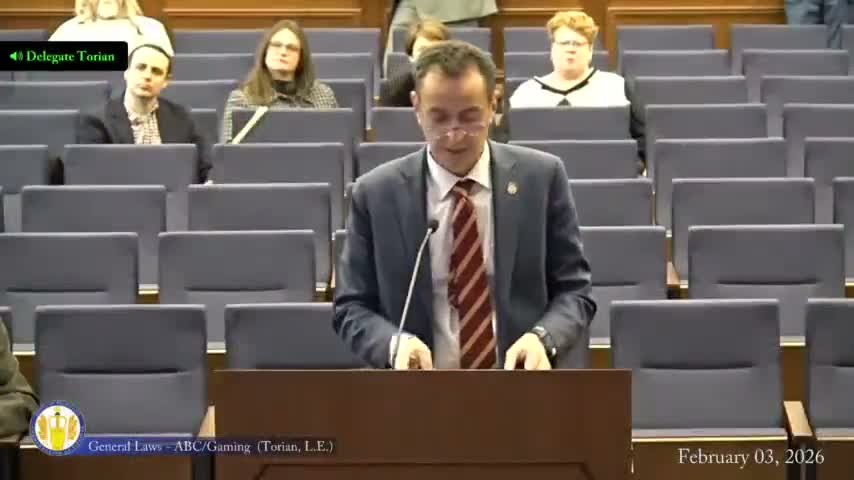
Elliot Price, the bill patron, told the subcommittee that House Bill 161 is designed to bring already‑widespread, unregulated casino‑style gaming on phones into a regulated framework with consumer protections and labor requirements.
Price said the substitute would require a $2,000,000 casino platform fee, a $500,000 iGaming operator license fee and a 15% tax on iGaming operators, with 5% of that tax directed to a problem‑gaming fund. The substitute includes a provision to allocate 6% of iGaming general revenue to an "iGaming hold harmless" fund to support brick‑and‑mortar casinos financially impacted by online competition, and it would ban prepaid cards as an approved method of payment. Price also described automated player‑account monitoring and a minimum three‑phase intervention plan to identify and restrict problem gambling.
"Casino‑style gaming is happening on people's phones in the Commonwealth of Virginia already," Price said in his presentation. He argued regulation would be safer than prohibition and highlighted a labor component that would require Virginia‑based live dealer studios and labor peace agreements to protect jobs.
Khali Jones, executive director of the Virginia Lottery, told the subcommittee that lottery profits are earmarked for K–12 public education and warned the bill, as currently drafted, could reduce lottery transfers. "We estimate up to $616,000,000 over the first full five years of the program, as currently constructed," Jones said when asked about fiscal impacts on the lottery proceeds fund.
Opponents and witnesses offered personal testimony and research claiming increased social harms and economic displacement. Stacy Rendon, testifying from Michigan, described losing personal assets after her state introduced online gaming, and David Nangle, a national advocate, called online gaming "engineered to be addictive." Industry witnesses and interest groups, including representatives of brick‑and‑mortar casinos, horse‑racing interests and veterans' organizations, warned the measure could cannibalize existing gaming, lottery revenue and local charitable gaming operations.
Committee members pressed the patron on age verification and enforcement. Price responded that the substitute requires operators to implement mechanisms to "reasonably identify" that an individual is 21 or older and that the bill relies on regulations and technology rather than specifying a single verification method.
After the discussion, Delegate Seabolt moved to report the substitute and refer HB 161 to the Appropriations Committee. The motion carried on a roll call vote, 5–4; the subcommittee reported the bill with the substitute for further fiscal review.
The action does not adopt final law; the bill will next be considered by Appropriations, where fiscal questions—particularly the projected impact on lottery transfers supporting K–12—will be central to the next stage.
Price said the substitute would require a $2,000,000 casino platform fee, a $500,000 iGaming operator license fee and a 15% tax on iGaming operators, with 5% of that tax directed to a problem‑gaming fund. The substitute includes a provision to allocate 6% of iGaming general revenue to an "iGaming hold harmless" fund to support brick‑and‑mortar casinos financially impacted by online competition, and it would ban prepaid cards as an approved method of payment. Price also described automated player‑account monitoring and a minimum three‑phase intervention plan to identify and restrict problem gambling.
"Casino‑style gaming is happening on people's phones in the Commonwealth of Virginia already," Price said in his presentation. He argued regulation would be safer than prohibition and highlighted a labor component that would require Virginia‑based live dealer studios and labor peace agreements to protect jobs.
Khali Jones, executive director of the Virginia Lottery, told the subcommittee that lottery profits are earmarked for K–12 public education and warned the bill, as currently drafted, could reduce lottery transfers. "We estimate up to $616,000,000 over the first full five years of the program, as currently constructed," Jones said when asked about fiscal impacts on the lottery proceeds fund.
Opponents and witnesses offered personal testimony and research claiming increased social harms and economic displacement. Stacy Rendon, testifying from Michigan, described losing personal assets after her state introduced online gaming, and David Nangle, a national advocate, called online gaming "engineered to be addictive." Industry witnesses and interest groups, including representatives of brick‑and‑mortar casinos, horse‑racing interests and veterans' organizations, warned the measure could cannibalize existing gaming, lottery revenue and local charitable gaming operations.
Committee members pressed the patron on age verification and enforcement. Price responded that the substitute requires operators to implement mechanisms to "reasonably identify" that an individual is 21 or older and that the bill relies on regulations and technology rather than specifying a single verification method.
After the discussion, Delegate Seabolt moved to report the substitute and refer HB 161 to the Appropriations Committee. The motion carried on a roll call vote, 5–4; the subcommittee reported the bill with the substitute for further fiscal review.
The action does not adopt final law; the bill will next be considered by Appropriations, where fiscal questions—particularly the projected impact on lottery transfers supporting K–12—will be central to the next stage.
View the Full Meeting & All Its Details
This article offers just a summary. Unlock complete video, transcripts, and insights as a Founder Member.
✓
Watch full, unedited meeting videos
✓
Search every word spoken in unlimited transcripts
✓
AI summaries & real-time alerts (all government levels)
✓
Permanent access to expanding government content
30-day money-back guarantee
