Lawmakers Hear Charter School Funding Review; Advocates Seek $15.995M One‑Time Fix and Comprehensive Study
February 02, 2026 | 2026 Utah Legislature, Utah Legislature, Utah Legislative Branch, Utah
This article was created by AI summarizing key points discussed. AI makes mistakes, so for full details and context, please refer to the video of the full meeting. Please report any errors so we can fix them. Report an error »
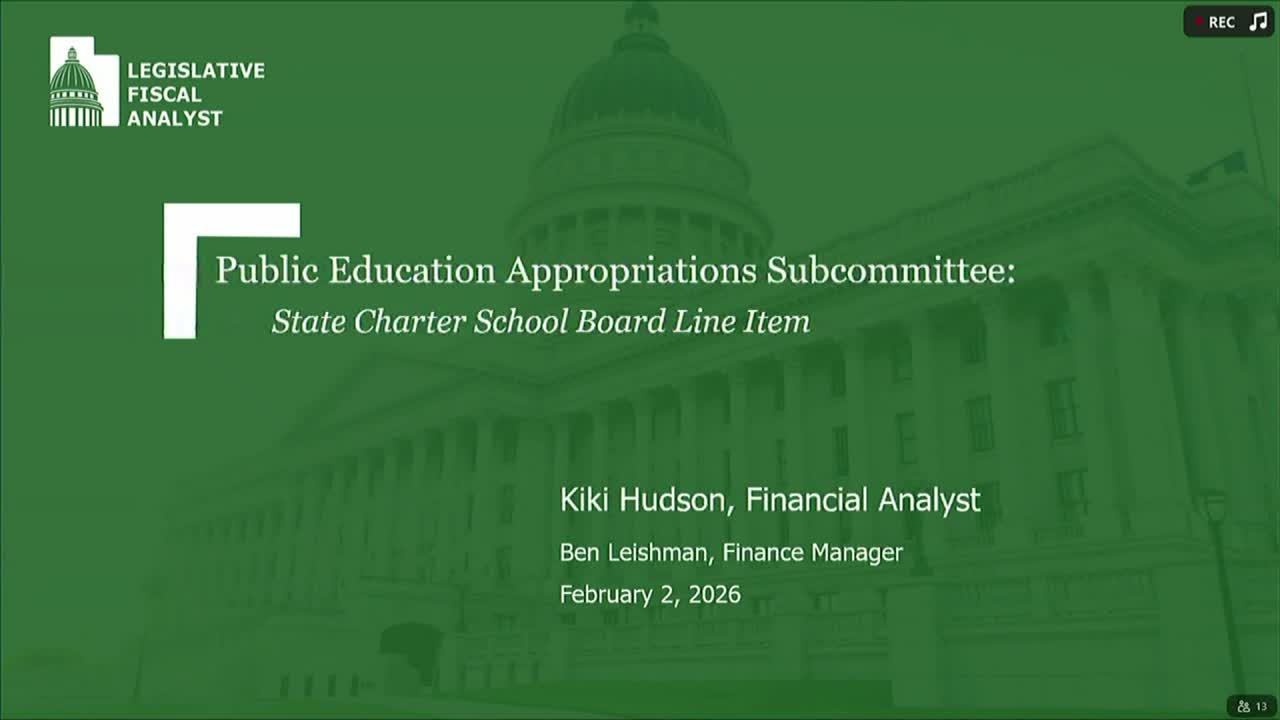
The Public Education Appropriations Committee on Monday reviewed the State Charter School Board line item and heard a request for a one‑time appropriation to close shortfalls while a study of charter funding is completed.
In an LFA overview, analyst Kiki Hudson described the State Charter School Board line and the programs it supports, including administration, a startup funding program and a statewide training program. Hudson said the Legislature appropriated “approximately $5,100,000 for this line item” and identified an LFA recommendation that would remove $400,000 in ongoing funding for the statewide charter school training program.
Deputy Superintendent Scott Jones, speaking for the Utah State Board of Education, told the committee the agency "concur[s] with the reduction for the $400,000 ongoing," and explained that some training functions could be administered by charter associations or funded through grants if state funding is reduced.
State Charter School Board chair Dr. Stephanie Spiker and interim executive director Marie Steffensen urged caution. Spiker said the board provides authorizing oversight and technical support; Steffensen warned reductions could limit the board’s ability to support schools during a leadership transition and reduce mentoring and professional learning the board provides.
Several charter leaders described how SCSB programs have supported their schools. Peter Aylin, executive director of Bear River Charter School, said mentoring and the Lehi Forward Network helped improve kindergarten readiness and attendance. Jeff Bossard, dean at Itineris Early College High School, credited SCSB waivers and alignment with higher education partners for high graduation and college‑credit outcomes.
LFA staff Ben Leshman gave a detailed explanation of how charter schools are funded in Utah, walking the committee through weighted pupil units, categorical programs and the local replacement formula. Leshman said the local replacement total is about $336,400,000 and that the formula currently produces a per‑student local replacement rate in the neighborhood of roughly $3,746 to $3,793 depending on adjustments and a lag in the data used.
Following those presentations, Senator Baldry and Kim Frank introduced an RFA asking for a one‑time $15,995,000 appropriation from the Education Stabilization Fund. Frank told the committee that, based on an analysis with the state board finance team, “Charter schools receive $25,000,000 less to do the same reports that small school districts do,” and said the requested funding would help charter schools cover reporting and administrative costs while a comprehensive study of disparities is completed.
Committee members asked whether the study should be completed before making a one‑time appropriation. Kim Frank said the intent is to do the study promptly but to provide temporary funds to allow charter schools to meet reporting and administrative requirements in the near term.
The presentations and question‑and‑answer exchanges concluded with committee members thanking the board, staff and school representatives for the information. No final appropriation vote was recorded in the transcript during this meeting.
What’s next: The committee may consider the RFA and related statutory or appropriation requests in future hearings and would weigh the LFA and USBE recommendations against stakeholder testimony before taking final action.
In an LFA overview, analyst Kiki Hudson described the State Charter School Board line and the programs it supports, including administration, a startup funding program and a statewide training program. Hudson said the Legislature appropriated “approximately $5,100,000 for this line item” and identified an LFA recommendation that would remove $400,000 in ongoing funding for the statewide charter school training program.
Deputy Superintendent Scott Jones, speaking for the Utah State Board of Education, told the committee the agency "concur[s] with the reduction for the $400,000 ongoing," and explained that some training functions could be administered by charter associations or funded through grants if state funding is reduced.
State Charter School Board chair Dr. Stephanie Spiker and interim executive director Marie Steffensen urged caution. Spiker said the board provides authorizing oversight and technical support; Steffensen warned reductions could limit the board’s ability to support schools during a leadership transition and reduce mentoring and professional learning the board provides.
Several charter leaders described how SCSB programs have supported their schools. Peter Aylin, executive director of Bear River Charter School, said mentoring and the Lehi Forward Network helped improve kindergarten readiness and attendance. Jeff Bossard, dean at Itineris Early College High School, credited SCSB waivers and alignment with higher education partners for high graduation and college‑credit outcomes.
LFA staff Ben Leshman gave a detailed explanation of how charter schools are funded in Utah, walking the committee through weighted pupil units, categorical programs and the local replacement formula. Leshman said the local replacement total is about $336,400,000 and that the formula currently produces a per‑student local replacement rate in the neighborhood of roughly $3,746 to $3,793 depending on adjustments and a lag in the data used.
Following those presentations, Senator Baldry and Kim Frank introduced an RFA asking for a one‑time $15,995,000 appropriation from the Education Stabilization Fund. Frank told the committee that, based on an analysis with the state board finance team, “Charter schools receive $25,000,000 less to do the same reports that small school districts do,” and said the requested funding would help charter schools cover reporting and administrative costs while a comprehensive study of disparities is completed.
Committee members asked whether the study should be completed before making a one‑time appropriation. Kim Frank said the intent is to do the study promptly but to provide temporary funds to allow charter schools to meet reporting and administrative requirements in the near term.
The presentations and question‑and‑answer exchanges concluded with committee members thanking the board, staff and school representatives for the information. No final appropriation vote was recorded in the transcript during this meeting.
What’s next: The committee may consider the RFA and related statutory or appropriation requests in future hearings and would weigh the LFA and USBE recommendations against stakeholder testimony before taking final action.
Don't Miss a Word: See the Full Meeting!
Go beyond summaries. Unlock every video, transcript, and key insight with a Founder Membership.
✓
Get instant access to full meeting videos
✓
Search and clip any phrase from complete transcripts
✓
Receive AI-powered summaries & custom alerts
✓
Enjoy lifetime, unrestricted access to government data
30-day money-back guarantee
