Lady Lake workshop reviews Rooms To Go site plan and waiver requests
February 02, 2026 | Town of Lady Lake, Lake County, Florida
This article was created by AI summarizing key points discussed. AI makes mistakes, so for full details and context, please refer to the video of the full meeting. Please report any errors so we can fix them. Report an error »
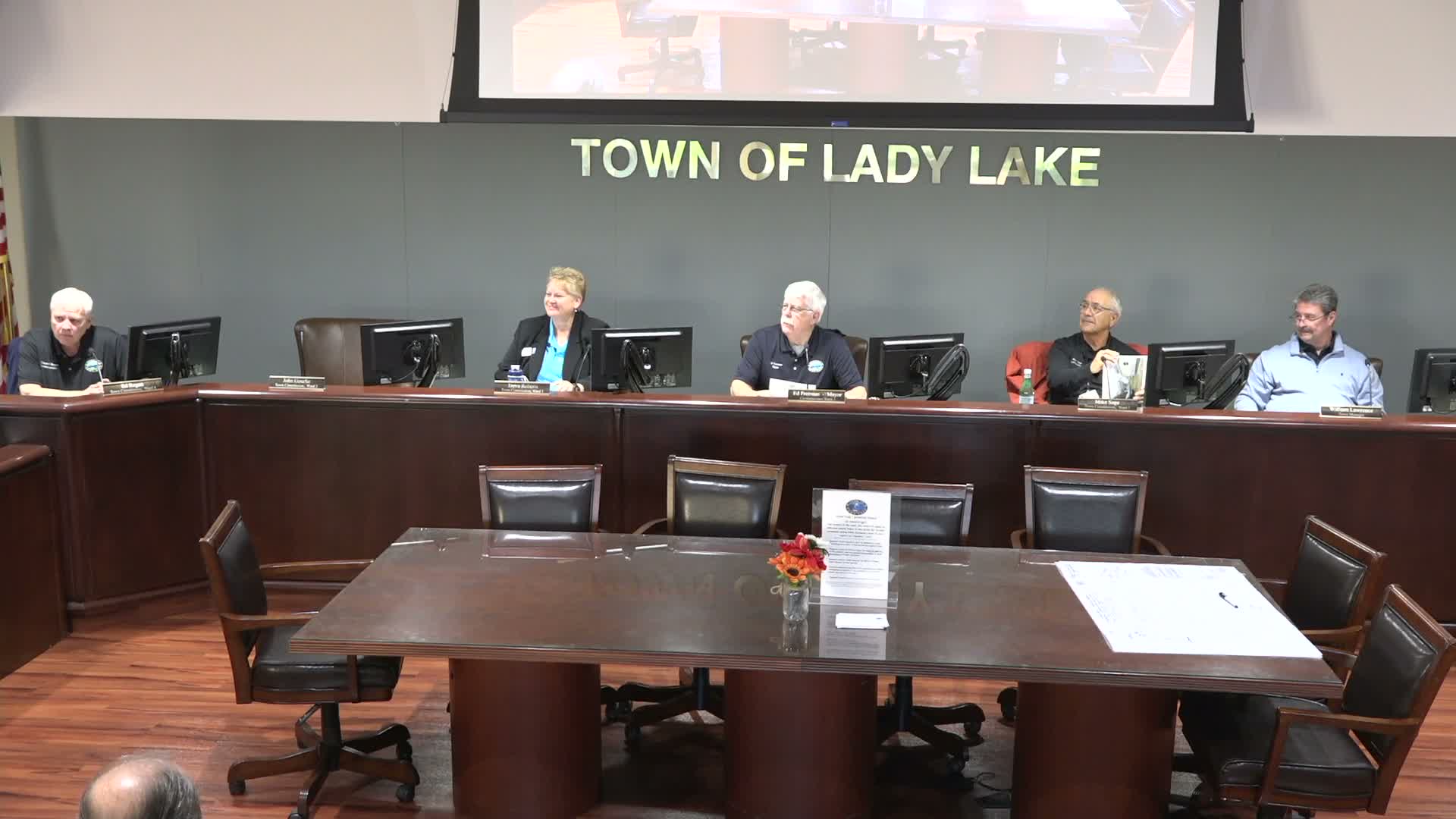
Town of Lady Lake staff reviewed a proposal for a 41,800-square-foot Rooms To Go retail showroom at the intersection of County Road 25 and North Highway 441, describing five waiver requests covering landscaping, commercial design, façade composition and parking. The workshop discussion produced informal agreement to the concept but no formal vote.
Becky, a town staff member presenting the plan, told commissioners the applicant is Robert Raab and the owner is SRK Lady Lake 43 Associates, LLC. She said the proposal envisions a 41,800-square-foot showroom on about 5.5 acres with 196 parking spaces and noted five waiver requests: one landscaping waiver (to avoid required canopy trees because of overhead power lines) and four commercial-design waivers tied to the town’s design code.
The landscaping waiver stems from utility constraints within the required buffer; staff highlighted canopy and understory species proposed for the site, including magnolias, live oaks, elms and slash pines, with cypress, crepe myrtles, hollies and Japanese privet in the understory. On design, staff said the applicant has identified elements from the town’s four recommended architectural styles (frame vernacular, craftsman bungalow, Mediterranean, Mission) to adapt the national Rooms To Go prototype to local context.
Staff also explained a code conflict on curtain-wall glazing and façade modulation. The town’s standards limit reflective or predominant glass storefronts and set modulation requirements for long façades. The presenter said the proposed curtain wall is recessed, includes masonry sills and cornice details, and that the submitted glazing totals about 11 percent of the frontage—below the town’s 15 percent reflective-glass limit identified by staff.
Parking drew extensive discussion. Commissioners and participants questioned whether 196 spaces were necessary for the use; staff cited the town’s land development regulations and the Institute of Traffic Engineers (ITE) ratios as the basis for required parking, noting that requirements vary by use type and are detailed in the Chapter 7 parking matrix. When asked where accessible parking would be located, staff pointed to six handicap spaces shown at the front of the site facing Highway 441.
Marty Delabovi of Benchmark Group (Amherst, New York), who said he has handled similar sites, told the group, "We have to meet code," and acknowledged local concerns that ‘‘we are over parked in the municipality here.’' Delabovi proposed a widely used compromise: show the full number of required spaces on official plans but designate a portion as unpaved “paper spaces” that can be converted to paved stalls later if demand requires it. "We could have green areas there so that if... you say you're no longer conforming to the number of spaces, we could always go back and add those spaces back in," he said.
Staff confirmed the town’s administrative process allows up to a 10 percent parking reduction administratively; any larger reduction would require a variance application and additional approvals. Delabovi also described lease and restrictive- covenant (REA) constraints that typically require self-parking for retail tenants and said the paper-space approach preserves lease compliance while reducing initial paving and increasing accessible spaces up front if requested.
Commissioners and participants discussed site placement and corridor design; Delabovi said the building was intentionally pulled forward to provide a visual "bookend" for the corridor while locating more required parking to the rear where possible. Several participants said they preferred less visible paving; one commissioner suggested significantly reducing the paved area, citing impervious-surface concerns.
Because the meeting was a workshop, participants made no formal motion or vote. Commissioners indicated informal agreement that the plan "looks like an okay plan" in concept and raised options for staff to pursue (including possible administrative parking reductions or variance paths) as the project moves through the town’s review process.
The workshop ended with no formal action. Further formal approvals, variances or permitting steps will be required before construction can proceed.
Becky, a town staff member presenting the plan, told commissioners the applicant is Robert Raab and the owner is SRK Lady Lake 43 Associates, LLC. She said the proposal envisions a 41,800-square-foot showroom on about 5.5 acres with 196 parking spaces and noted five waiver requests: one landscaping waiver (to avoid required canopy trees because of overhead power lines) and four commercial-design waivers tied to the town’s design code.
The landscaping waiver stems from utility constraints within the required buffer; staff highlighted canopy and understory species proposed for the site, including magnolias, live oaks, elms and slash pines, with cypress, crepe myrtles, hollies and Japanese privet in the understory. On design, staff said the applicant has identified elements from the town’s four recommended architectural styles (frame vernacular, craftsman bungalow, Mediterranean, Mission) to adapt the national Rooms To Go prototype to local context.
Staff also explained a code conflict on curtain-wall glazing and façade modulation. The town’s standards limit reflective or predominant glass storefronts and set modulation requirements for long façades. The presenter said the proposed curtain wall is recessed, includes masonry sills and cornice details, and that the submitted glazing totals about 11 percent of the frontage—below the town’s 15 percent reflective-glass limit identified by staff.
Parking drew extensive discussion. Commissioners and participants questioned whether 196 spaces were necessary for the use; staff cited the town’s land development regulations and the Institute of Traffic Engineers (ITE) ratios as the basis for required parking, noting that requirements vary by use type and are detailed in the Chapter 7 parking matrix. When asked where accessible parking would be located, staff pointed to six handicap spaces shown at the front of the site facing Highway 441.
Marty Delabovi of Benchmark Group (Amherst, New York), who said he has handled similar sites, told the group, "We have to meet code," and acknowledged local concerns that ‘‘we are over parked in the municipality here.’' Delabovi proposed a widely used compromise: show the full number of required spaces on official plans but designate a portion as unpaved “paper spaces” that can be converted to paved stalls later if demand requires it. "We could have green areas there so that if... you say you're no longer conforming to the number of spaces, we could always go back and add those spaces back in," he said.
Staff confirmed the town’s administrative process allows up to a 10 percent parking reduction administratively; any larger reduction would require a variance application and additional approvals. Delabovi also described lease and restrictive- covenant (REA) constraints that typically require self-parking for retail tenants and said the paper-space approach preserves lease compliance while reducing initial paving and increasing accessible spaces up front if requested.
Commissioners and participants discussed site placement and corridor design; Delabovi said the building was intentionally pulled forward to provide a visual "bookend" for the corridor while locating more required parking to the rear where possible. Several participants said they preferred less visible paving; one commissioner suggested significantly reducing the paved area, citing impervious-surface concerns.
Because the meeting was a workshop, participants made no formal motion or vote. Commissioners indicated informal agreement that the plan "looks like an okay plan" in concept and raised options for staff to pursue (including possible administrative parking reductions or variance paths) as the project moves through the town’s review process.
The workshop ended with no formal action. Further formal approvals, variances or permitting steps will be required before construction can proceed.
View the Full Meeting & All Its Details
This article offers just a summary. Unlock complete video, transcripts, and insights as a Founder Member.
✓
Watch full, unedited meeting videos
✓
Search every word spoken in unlimited transcripts
✓
AI summaries & real-time alerts (all government levels)
✓
Permanent access to expanding government content
30-day money-back guarantee
