Committee discusses revised HB 107: late‑registration penalties and capped tax credit to offset private‑sale tax disparity
January 26, 2026 | 2026 Utah Legislature, Utah Legislature, Utah Legislative Branch, Utah
This article was created by AI summarizing key points discussed. AI makes mistakes, so for full details and context, please refer to the video of the full meeting. Please report any errors so we can fix them. Report an error »
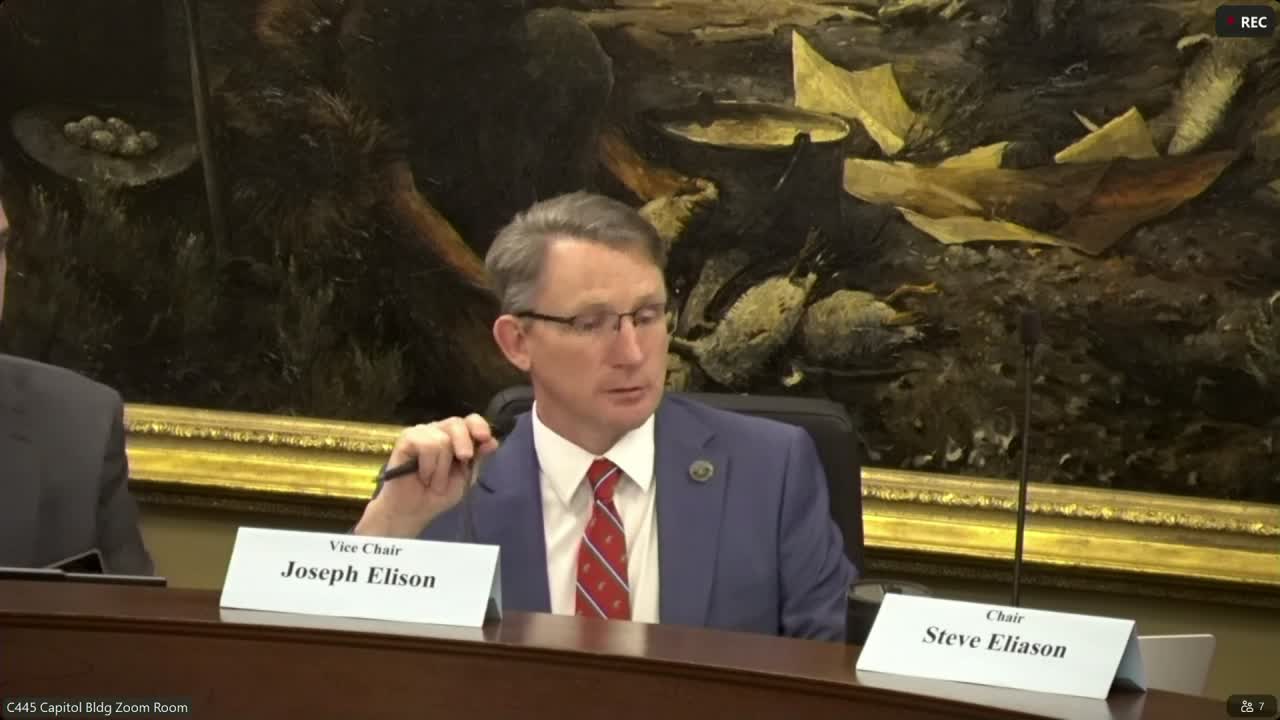
Representative Tuscher presented the second substitute to HB 107 as a two‑part approach: first, incentivize on‑time vehicle registration through late‑registration penalties; second, use revenue from those penalties (and penalties for out‑of‑state avoided registration) to seed a restricted account that would partially fund a nonrefundable income‑tax credit to reduce the sales‑tax disparity when private vehicle sales accompany a purchase.
Under the substitute, a 30‑day grace period would apply after a registration’s due date; after that window a $50 penalty would apply, with an additional $50 penalty applied each month up to 12 months. Those penalties would be held in a restricted account and then divided among eligible taxpayers seeking a nonrefundable tax credit; the annual per‑claim cap would depend on the amount in the restricted account and the number of applicants. The sponsor described an illustrative example: if the account generated $7 million and 7,000 applicants applied, the cap could be about $1,000 per claimant.
The sponsor said fiscal analysts estimated the original approach would create a roughly $38 million fiscal gap; analysts projected the substitute would generate between $7 million and $8 million in revenue. Committee members raised concerns about potential disproportionate effects on people with low‑value vehicles and asked how the system would verify private sale values. The sponsor noted verification would rely on bills of sale and that taxpayers claiming the credit would be subject to audit.
Representative Daley Provo moved to move HB 107 to a future agenda so the sponsor could refine the substitute and coordinate with the Tax Commission. The committee approved that motion by voice vote; no final vote on the substitute was taken.
What happens next: HB 107 will return to committee for further amendment and coordination with the Tax Commission and fiscal analysts.
Under the substitute, a 30‑day grace period would apply after a registration’s due date; after that window a $50 penalty would apply, with an additional $50 penalty applied each month up to 12 months. Those penalties would be held in a restricted account and then divided among eligible taxpayers seeking a nonrefundable tax credit; the annual per‑claim cap would depend on the amount in the restricted account and the number of applicants. The sponsor described an illustrative example: if the account generated $7 million and 7,000 applicants applied, the cap could be about $1,000 per claimant.
The sponsor said fiscal analysts estimated the original approach would create a roughly $38 million fiscal gap; analysts projected the substitute would generate between $7 million and $8 million in revenue. Committee members raised concerns about potential disproportionate effects on people with low‑value vehicles and asked how the system would verify private sale values. The sponsor noted verification would rely on bills of sale and that taxpayers claiming the credit would be subject to audit.
Representative Daley Provo moved to move HB 107 to a future agenda so the sponsor could refine the substitute and coordinate with the Tax Commission. The committee approved that motion by voice vote; no final vote on the substitute was taken.
What happens next: HB 107 will return to committee for further amendment and coordination with the Tax Commission and fiscal analysts.
Don't Miss a Word: See the Full Meeting!
Go beyond summaries. Unlock every video, transcript, and key insight with a Founder Membership.
✓
Get instant access to full meeting videos
✓
Search and clip any phrase from complete transcripts
✓
Receive AI-powered summaries & custom alerts
✓
Enjoy lifetime, unrestricted access to government data
30-day money-back guarantee
