Legislature unveils Vesta, a new interactive property-tax tool to map Utah taxes
January 23, 2026 | 2026 Utah Legislature, Utah Legislature, Utah Legislative Branch, Utah
This article was created by AI summarizing key points discussed. AI makes mistakes, so for full details and context, please refer to the video of the full meeting. Please report any errors so we can fix them. Report an error »
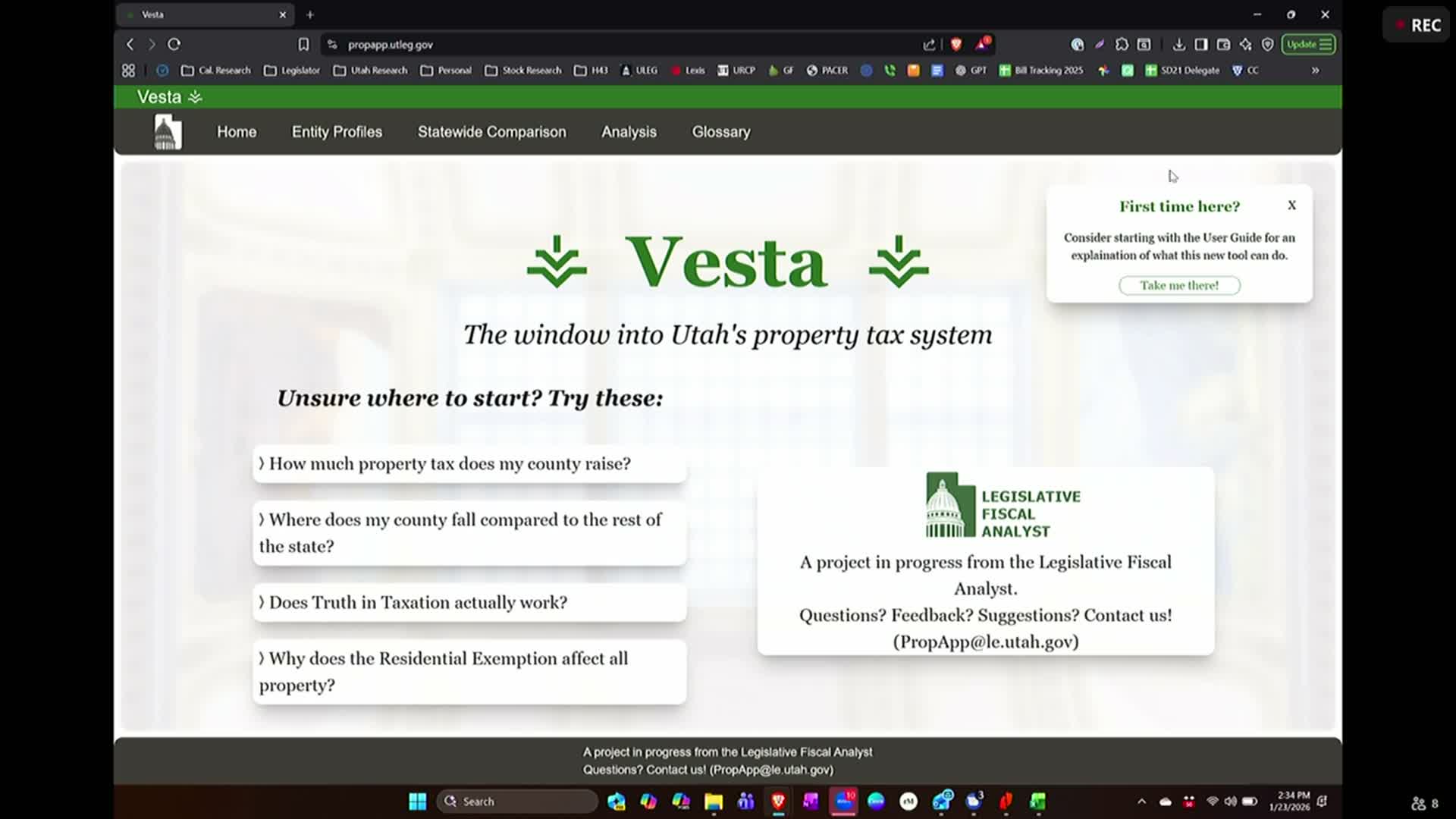
Senator Dan McKay, chair of the Senate Revenue and Taxation Committee, invited Jared Gibbs, an economist with the Office of Legislative Fiscal Analyst (LFA), to present Vesta, the LFA’s new interactive property-tax web application, during the committee’s Jan. 23 hearing. McKay said the tool — developed over roughly two years — aims to reduce public confusion about how Utah property taxes are calculated and to make local taxing authority data more accessible.
Gibbs began with a concise primer on Utah’s property-tax mechanics, saying the certified tax rate is derived by dividing a taxing entity’s targeted revenue by the current tax base. “Instead of asking how much revenue does the statutory rate generate, we instead ask what is the rate we need to generate the revenue,” Gibbs told the committee, explaining that certified rates typically decline as property values rise unless entities pursue additional revenue via new growth or the truth-in-taxation process.
The nut graf: Vesta brings together entity-level profiles, statewide comparison charts and analytical sandboxes so legislators and the public can inspect how rates, revenues and tax-base composition have changed over time and simulate policy choices — for example, raising the residential exemption from the current 45% to 55% or 60% and observing effects on certified rates and tax shares across counties.
In the demonstration, Gibbs navigated an entity profile page (example labelled in the transcript as Tewela/Tula City) that displayed historical tax-rate and revenue series, taxable-value trends, hypothetical liability charts for sample residential and commercial properties, and shares of taxable value by property type. He then showed a statewide comparison page that lets users compare the same measures across counties or other taxing-entity types; the presentation highlighted Salt Lake County’s much larger tax base (displayed in the tool as nearly $200 billion).
Gibbs also showcased the analysis sandbox, which lets users simulate policy changes. Using the residential-exemption example, he demonstrated that increasing the exemption shrinks the taxable base and, in the model, increases the certified rates needed to hit the same revenue target. Gibbs said the methodology and assumptions behind each simulation are documented on the tool’s analysis pages.
On the question of how taxing entities can raise revenue under Utah’s certified-rate system, Gibbs reiterated two mechanisms: new growth (new property added to the tax base, which can raise total revenue without raising an entity’s certified rate) and truth in taxation, the public process by which a taxing entity proposes and votes on increased revenue after a public meeting. He noted Utah has dozens of taxing jurisdictions — the presentation cited about 44 school districts, 29 counties and 253 cities and towns among a total that exceeds 1,000 entities with taxing authority — underscoring the need for a centralized tool.
Committee members responded positively. McKay said the presentation will help the public understand truth in taxation and how local taxing entities’ budgets change. A committee member called Gibbs’s explanation “succinct” and “effective,” and remarks from the transcript indicated the committee will host the presentation materials on Vesta’s homepage and consider a dedicated taxpayer learning page (taxes.le.utah.gov) with maps and additional resources.
Gibbs listed planned enhancements after the session: tax-area views that stack county, school-district and municipal taxes to reflect an individual taxpayer’s combined liability; an interactive map of taxing entities; and growth of the tool’s analysis library and glossary, though he cautioned timelines for additions are uncertain.
The hearing concluded with routine procedural motions. Senator Brammer moved to adjourn and the committee voice-voted in the affirmative.
The LFA’s Vesta tool and the presentation materials are intended to be publicly available; committee leaders said they expect questions and additional requests for features as the legislature handles property-tax policy this session.
Gibbs began with a concise primer on Utah’s property-tax mechanics, saying the certified tax rate is derived by dividing a taxing entity’s targeted revenue by the current tax base. “Instead of asking how much revenue does the statutory rate generate, we instead ask what is the rate we need to generate the revenue,” Gibbs told the committee, explaining that certified rates typically decline as property values rise unless entities pursue additional revenue via new growth or the truth-in-taxation process.
The nut graf: Vesta brings together entity-level profiles, statewide comparison charts and analytical sandboxes so legislators and the public can inspect how rates, revenues and tax-base composition have changed over time and simulate policy choices — for example, raising the residential exemption from the current 45% to 55% or 60% and observing effects on certified rates and tax shares across counties.
In the demonstration, Gibbs navigated an entity profile page (example labelled in the transcript as Tewela/Tula City) that displayed historical tax-rate and revenue series, taxable-value trends, hypothetical liability charts for sample residential and commercial properties, and shares of taxable value by property type. He then showed a statewide comparison page that lets users compare the same measures across counties or other taxing-entity types; the presentation highlighted Salt Lake County’s much larger tax base (displayed in the tool as nearly $200 billion).
Gibbs also showcased the analysis sandbox, which lets users simulate policy changes. Using the residential-exemption example, he demonstrated that increasing the exemption shrinks the taxable base and, in the model, increases the certified rates needed to hit the same revenue target. Gibbs said the methodology and assumptions behind each simulation are documented on the tool’s analysis pages.
On the question of how taxing entities can raise revenue under Utah’s certified-rate system, Gibbs reiterated two mechanisms: new growth (new property added to the tax base, which can raise total revenue without raising an entity’s certified rate) and truth in taxation, the public process by which a taxing entity proposes and votes on increased revenue after a public meeting. He noted Utah has dozens of taxing jurisdictions — the presentation cited about 44 school districts, 29 counties and 253 cities and towns among a total that exceeds 1,000 entities with taxing authority — underscoring the need for a centralized tool.
Committee members responded positively. McKay said the presentation will help the public understand truth in taxation and how local taxing entities’ budgets change. A committee member called Gibbs’s explanation “succinct” and “effective,” and remarks from the transcript indicated the committee will host the presentation materials on Vesta’s homepage and consider a dedicated taxpayer learning page (taxes.le.utah.gov) with maps and additional resources.
Gibbs listed planned enhancements after the session: tax-area views that stack county, school-district and municipal taxes to reflect an individual taxpayer’s combined liability; an interactive map of taxing entities; and growth of the tool’s analysis library and glossary, though he cautioned timelines for additions are uncertain.
The hearing concluded with routine procedural motions. Senator Brammer moved to adjourn and the committee voice-voted in the affirmative.
The LFA’s Vesta tool and the presentation materials are intended to be publicly available; committee leaders said they expect questions and additional requests for features as the legislature handles property-tax policy this session.
View the Full Meeting & All Its Details
This article offers just a summary. Unlock complete video, transcripts, and insights as a Founder Member.
✓
Watch full, unedited meeting videos
✓
Search every word spoken in unlimited transcripts
✓
AI summaries & real-time alerts (all government levels)
✓
Permanent access to expanding government content
30-day money-back guarantee
