Attorney General warns 5% cuts would hit personnel after overview of high-stakes litigation
February 03, 2026 | 2026 Utah Legislature, Utah Legislature, Utah Legislative Branch, Utah
This article was created by AI summarizing key points discussed. AI makes mistakes, so for full details and context, please refer to the video of the full meeting. Please report any errors so we can fix them. Report an error »
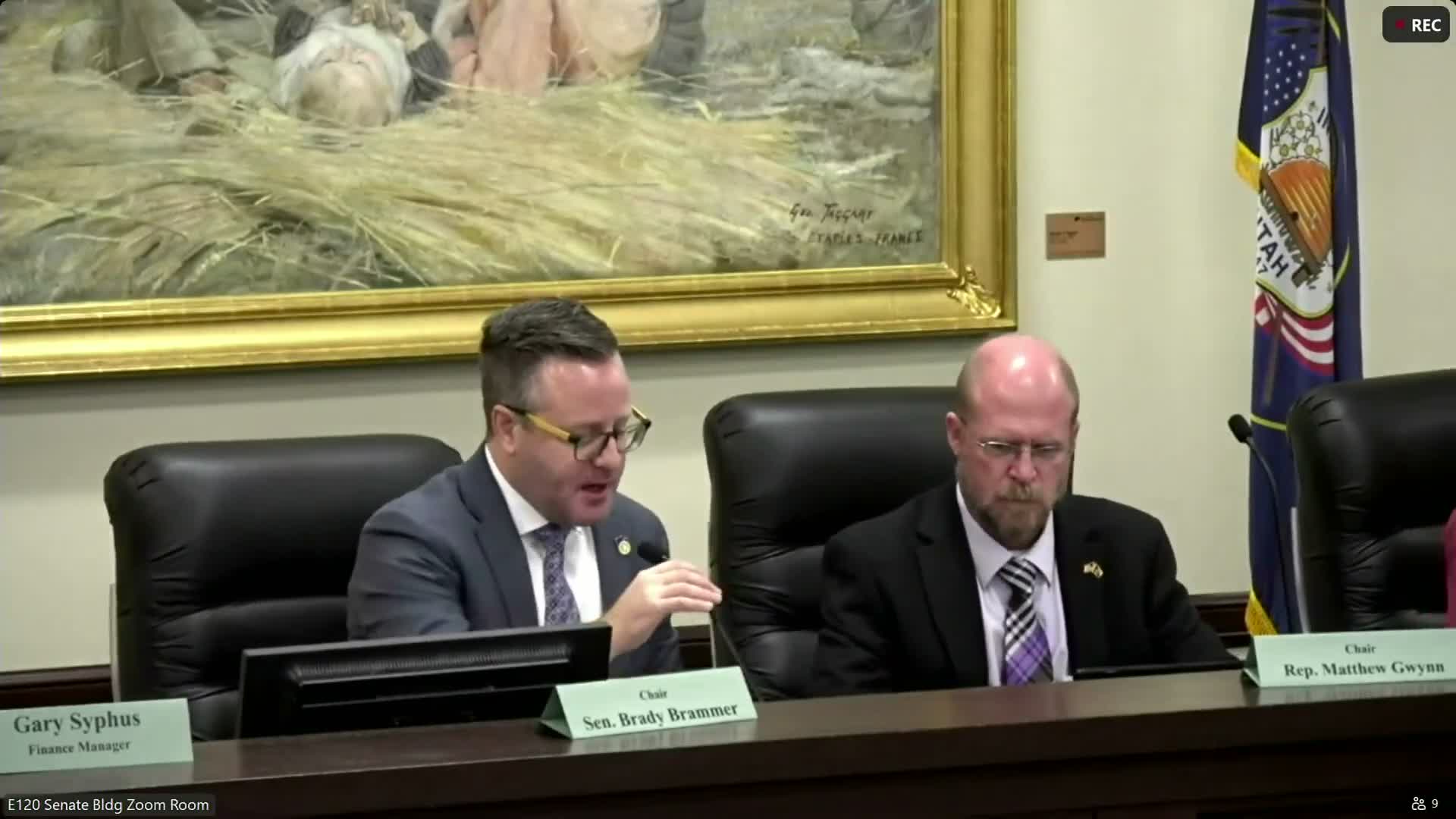
The appropriations subcommittee heard a budget overview for the Attorney General's Office on Wednesday, including three proposed 5%-reduction items targeted mainly at personnel costs.
Legislative fiscal analyst Nate Osborne summarized the proposals, saying the office is largely general‑funded and personnel driven. "$58,400 was the ongoing amount appropriated" for one underused firearms transaction fund that the analyst proposed to remove, he said. Osborne also described a proposal to replace $248,000 of general‑fund support for the Medicaid Fraud Control Unit with restricted Medicaid ACA funds, and a nearly $2 million ongoing reduction tied to unfilled vacant positions.
Those cuts, Osborne said, reflect a simple principle: "sometimes you just have to go where the money is," and most of the AG's spending is personnel.
The Attorney General followed with a wider presentation of the office's work—describing three core roles (counsel to state agencies, protector of public interests, and steward of resources)—and warned that smaller staffs or pay reductions would affect the office's ability to defend the state in major litigation. "Every dollar that we cut here, in effect, seeds ground to those who are active litigants or activists that are going against the state of Utah," the Attorney General said, arguing that reduced capacity can raise downstream liability or require costly outside counsel.
Officials cited several high‑cost and high‑priority matters the office is handling, including: appellate work ("This last year, our team filed 225 criminal appeals"), expanded prosecutions for crimes against children online ("This last year, we had 179 prosecutions" compared with 71 the prior year), cases involving public lands and FLPMA, Great Salt Lake public‑trust litigation, and Colorado River compact preparation. The office also noted consumer‑protection litigation such as a joint suit with the FTC involving Ticketmaster and work on opioid settlements and the state's trigger‑law defense.
Staffing and recruiting pressures surfaced repeatedly. The Attorney General and administrators said private‑sector pay in the Salt Lake area has pulled lawyers from the office and that some efficiency gains come from new tools such as e‑discovery and AI assistance. John Dougal, the office administrator, and Dan Burton, chief deputy, outlined efforts to shift some work internally and to use technology to handle large document sets more efficiently.
Committee members pressed for data on post‑conviction outcomes and recidivism for child‑exploitation cases; Stuart Young, the criminal deputy, said stronger investigations and cross‑designation with federal prosecutors have led to more prosecutions and, in many cases, cases moving to federal court.
What happens next: the subcommittee now has the fiscal analyst's reduction options on the table. Formal budget decisions and placement of any reductions will be part of later appropriations deliberations.
Legislative fiscal analyst Nate Osborne summarized the proposals, saying the office is largely general‑funded and personnel driven. "$58,400 was the ongoing amount appropriated" for one underused firearms transaction fund that the analyst proposed to remove, he said. Osborne also described a proposal to replace $248,000 of general‑fund support for the Medicaid Fraud Control Unit with restricted Medicaid ACA funds, and a nearly $2 million ongoing reduction tied to unfilled vacant positions.
Those cuts, Osborne said, reflect a simple principle: "sometimes you just have to go where the money is," and most of the AG's spending is personnel.
The Attorney General followed with a wider presentation of the office's work—describing three core roles (counsel to state agencies, protector of public interests, and steward of resources)—and warned that smaller staffs or pay reductions would affect the office's ability to defend the state in major litigation. "Every dollar that we cut here, in effect, seeds ground to those who are active litigants or activists that are going against the state of Utah," the Attorney General said, arguing that reduced capacity can raise downstream liability or require costly outside counsel.
Officials cited several high‑cost and high‑priority matters the office is handling, including: appellate work ("This last year, our team filed 225 criminal appeals"), expanded prosecutions for crimes against children online ("This last year, we had 179 prosecutions" compared with 71 the prior year), cases involving public lands and FLPMA, Great Salt Lake public‑trust litigation, and Colorado River compact preparation. The office also noted consumer‑protection litigation such as a joint suit with the FTC involving Ticketmaster and work on opioid settlements and the state's trigger‑law defense.
Staffing and recruiting pressures surfaced repeatedly. The Attorney General and administrators said private‑sector pay in the Salt Lake area has pulled lawyers from the office and that some efficiency gains come from new tools such as e‑discovery and AI assistance. John Dougal, the office administrator, and Dan Burton, chief deputy, outlined efforts to shift some work internally and to use technology to handle large document sets more efficiently.
Committee members pressed for data on post‑conviction outcomes and recidivism for child‑exploitation cases; Stuart Young, the criminal deputy, said stronger investigations and cross‑designation with federal prosecutors have led to more prosecutions and, in many cases, cases moving to federal court.
What happens next: the subcommittee now has the fiscal analyst's reduction options on the table. Formal budget decisions and placement of any reductions will be part of later appropriations deliberations.
View the Full Meeting & All Its Details
This article offers just a summary. Unlock complete video, transcripts, and insights as a Founder Member.
✓
Watch full, unedited meeting videos
✓
Search every word spoken in unlimited transcripts
✓
AI summaries & real-time alerts (all government levels)
✓
Permanent access to expanding government content
30-day money-back guarantee
