Committee forwards ordinance to expand Castro LGBTQ Cultural District to include DeBose Triangle
February 02, 2026 | San Francisco County, California
This article was created by AI summarizing key points discussed. AI makes mistakes, so for full details and context, please refer to the video of the full meeting. Please report any errors so we can fix them. Report an error »
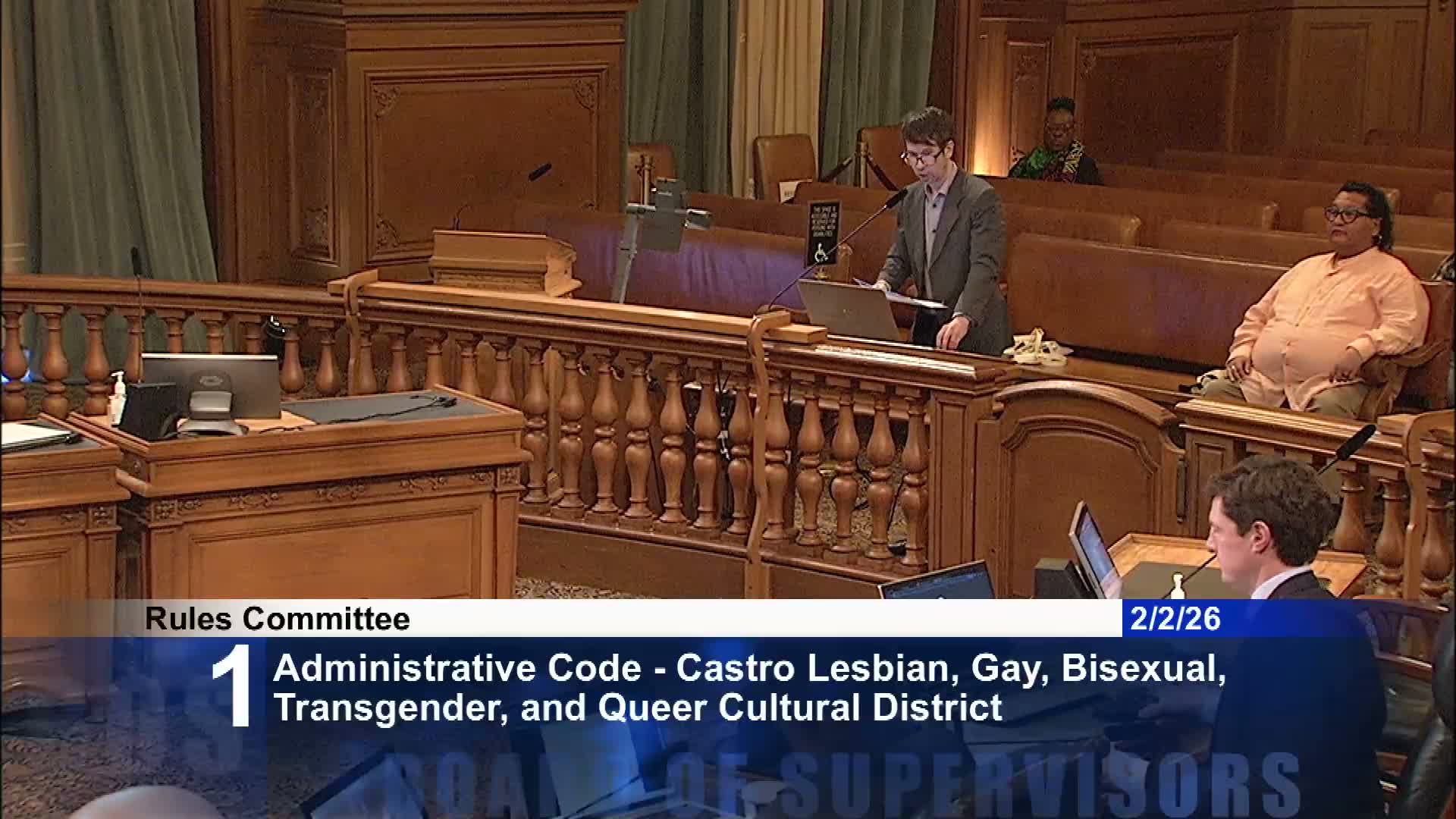
The San Francisco County Rules Committee on Monday moved to forward to the full Board an ordinance that would expand the Castro LGBTQ Cultural District to include the DeBose Triangle neighborhood.
Planning Department staff presented the ordinance and supporting findings, including an update to Administrative Code chapter 107 (section 107B 0.1) and the department’s recommendation to approve. Alex Westhoff said the CHES (cultural history, housing and economic sustainability) work identified DeBose Triangle as a neighborhood with a significant LGBTQ presence and noted the Historic Preservation Commission passed a supporting resolution on Nov. 19, 2025. Westhoff also noted the ordinance affirms the Planning Department’s determination under the California Environmental Quality Act.
The proposed boundary change was introduced by President Mandelmann, who framed the expansion as an acknowledgment of DeBose Triangle’s shared LGBTQ history with the Castro and cited neighborhood ties dating to the 1960s and 1970s. "DeBose Triangle is adjacent to Castro in both proximity and history," Mandelmann said, noting historic LGBTQ businesses and residents.
Representatives of the Castro LGBTQ Cultural District testified in favor. Tina Valentina Guire said the expansion is important to center queer and trans people and urged racial and gender equity within the district: "It's really important that queer and trans people are centered, remain centered in the Castro and that our presence is acknowledged in DuBose Triangle," she said. Em Rocket, who identified themself as a member of the cultural district board, said adding DeBose Triangle "expands our access and the people's access to us."
Following the presentation and public comment, Mandelmann moved to forward the ordinance to the full Board with a positive recommendation. The clerk recorded voice votes and announced the motion "passes without objection." The committee did not request amendments or send the item to hearing; the measure will proceed to the Board of Supervisors for further consideration and scheduling on the Board agenda.
Next steps: the committee’s recommendation moves the ordinance toward a Board hearing and vote; scheduling and any additional referrals will be set by the Board of Supervisors.
Planning Department staff presented the ordinance and supporting findings, including an update to Administrative Code chapter 107 (section 107B 0.1) and the department’s recommendation to approve. Alex Westhoff said the CHES (cultural history, housing and economic sustainability) work identified DeBose Triangle as a neighborhood with a significant LGBTQ presence and noted the Historic Preservation Commission passed a supporting resolution on Nov. 19, 2025. Westhoff also noted the ordinance affirms the Planning Department’s determination under the California Environmental Quality Act.
The proposed boundary change was introduced by President Mandelmann, who framed the expansion as an acknowledgment of DeBose Triangle’s shared LGBTQ history with the Castro and cited neighborhood ties dating to the 1960s and 1970s. "DeBose Triangle is adjacent to Castro in both proximity and history," Mandelmann said, noting historic LGBTQ businesses and residents.
Representatives of the Castro LGBTQ Cultural District testified in favor. Tina Valentina Guire said the expansion is important to center queer and trans people and urged racial and gender equity within the district: "It's really important that queer and trans people are centered, remain centered in the Castro and that our presence is acknowledged in DuBose Triangle," she said. Em Rocket, who identified themself as a member of the cultural district board, said adding DeBose Triangle "expands our access and the people's access to us."
Following the presentation and public comment, Mandelmann moved to forward the ordinance to the full Board with a positive recommendation. The clerk recorded voice votes and announced the motion "passes without objection." The committee did not request amendments or send the item to hearing; the measure will proceed to the Board of Supervisors for further consideration and scheduling on the Board agenda.
Next steps: the committee’s recommendation moves the ordinance toward a Board hearing and vote; scheduling and any additional referrals will be set by the Board of Supervisors.
View the Full Meeting & All Its Details
This article offers just a summary. Unlock complete video, transcripts, and insights as a Founder Member.
✓
Watch full, unedited meeting videos
✓
Search every word spoken in unlimited transcripts
✓
AI summaries & real-time alerts (all government levels)
✓
Permanent access to expanding government content
30-day money-back guarantee
